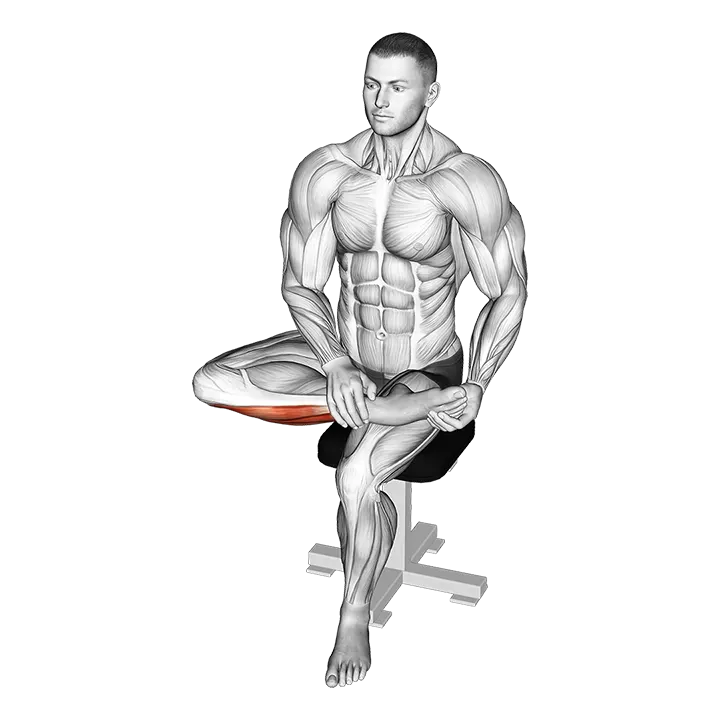
Seated Toe Extensor And Foot Everter Stretch
- Músculo objetivo
- —
- Equipamiento
- Body weight
- Parte del cuerpo
- Calves
- Tipo
- Stretching
The Seated Toe Extensor And Foot Everter Stretch is a bodyweight flexibility exercise performed in a seated position that targets the toe extensor muscles (extensor digitorum longus and extensor hallucis longus) along the front of the lower leg, as well as the peroneus longus and peroneus brevis on the lateral side. By pointing the toes downward and turning the sole of the foot inward, you place a controlled stretch across these muscles and tendons. Regular practice can improve ankle mobility, relieve tension in the outer lower leg, and support recovery from activities that stress the front and lateral calf.
Cómo hacer el Seated Toe Extensor And Foot Everter Stretch
- 1Sit upright on a sturdy chair or bench with your feet flat on the floor and your hands resting comfortably on your thighs.
- 2Lift your right foot slightly off the floor so it is free to move without restriction.
- 3Point your toes downward toward the floor, as if you are trying to lengthen the top of your foot away from your shin.
- 4While keeping the toes pointed, slowly rotate the sole of your foot inward so it faces toward the midline of your body — this is foot inversion.
- 5Hold this combined position — toes pointed down, sole turned inward — for 20 to 30 seconds, breathing steadily throughout.
- 6Gently release the foot back to a neutral, flat-footed position and rest for a few seconds.
- 7Repeat on the same foot for the desired number of holds, then switch to the left foot and perform the same sequence.
Consejos de técnica
- Move into the stretch slowly and without forcing — the lateral lower leg tendons can be sensitive, so a gentle, progressive pull is more effective and safer than a sudden rotation.
- Keep your knee still throughout the movement; all the motion should come from the ankle and foot, not from twisting the knee.
- Breathe steadily during the hold — exhaling fully can help you relax into a slightly deeper stretch without adding force.
- If you feel a sharp or pinching sensation rather than a mild pulling sensation along the outer shin or top of the foot, ease off the rotation immediately.
- For a stronger stretch, try crossing the ankle over the opposite knee before pointing and inverting the foot — this provides a more stable base.
Errores comunes
- Forcing the inversion too aggressively: Yanking the foot into a deep inversion puts excessive stress on the lateral ankle ligaments and peroneal tendons, which can cause irritation rather than a productive stretch.
- Neglecting the toe-point and only inverting: Inversion alone primarily stresses the ankle ligaments rather than the peroneal muscles; combining inversion with plantarflexion (pointing the toes) is what places the peroneus longus and brevis under meaningful stretch.
- Holding the breath during the hold: Breath-holding increases muscle tension throughout the body, which works against achieving a deep, relaxed stretch in the targeted muscles.
- Rushing through the hold: Holding for fewer than 15 seconds does not give the musculotendinous unit enough time to relax and lengthen, limiting the flexibility benefit of the stretch.
- Allowing the knee to rotate outward: Letting the knee drop to the side during the movement shifts tension to the knee joint rather than keeping it focused on the lower leg extensors and everters.
Preguntas frecuentes
What muscles does the Seated Toe Extensor And Foot Everter Stretch target?
The stretch primarily targets the toe extensor muscles — extensor digitorum longus and extensor hallucis longus — which run along the front and outer surface of the lower leg and lift the toes. It also stretches the foot everters, specifically the peroneus longus and peroneus brevis, which run along the lateral shin and are responsible for turning the sole of the foot outward. Pointing the toes downward and inverting the foot places both muscle groups under tension simultaneously.
When should I include this stretch in my workout?
This stretch is best used as part of a post-workout cool-down, when the muscles are warm and more receptive to lengthening. It is also useful as a stand-alone recovery stretch after activities that involve a lot of running, lateral movement, or time on your feet, as these activities frequently load the peroneal muscles and toe extensors. Avoid performing it cold before training as your primary warm-up.
How long should I hold the stretch, and how many times should I repeat it?
Hold each position for 20 to 30 seconds and aim for 2 to 3 repetitions per foot. This duration is consistent with current flexibility guidelines for static stretching aimed at improving range of motion. If you are using the stretch purely for tension relief after activity, a single 30-second hold per foot may be sufficient.
Can this stretch help with shin splints or peroneal tendonitis?
Gentle stretching of the toe extensors and peroneal muscles is commonly used as part of rehabilitation for shin splints and peroneal tendonitis, as chronic tightness in these areas can contribute to both conditions. However, if you have been diagnosed with either condition, you should work with a physiotherapist before adding this stretch to confirm it is appropriate for your stage of recovery and that you are performing it correctly.
Is there a way to make the stretch more intense if I am not feeling enough of a pull?
Yes. Crossing the foot over the opposite knee before pointing and inverting gives you better control and a more stable position, which typically allows a deeper stretch. You can also use your hand to gently assist the foot into slightly more plantarflexion or inversion — but add only as much manual pressure as is needed to feel a mild to moderate pulling sensation, never enough to cause pain.







