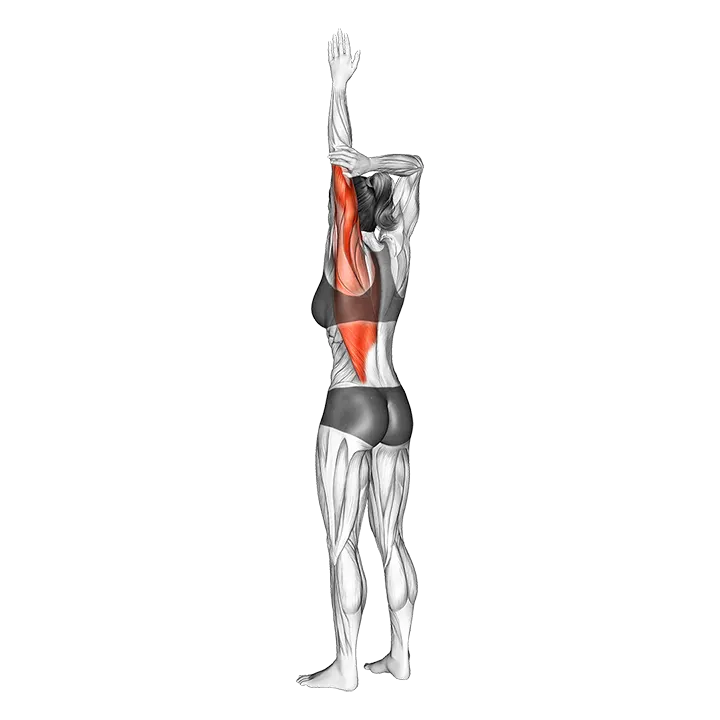
Shoulder Adductor Elevator And Protractor Stretch
- Músculo objetivo
- —
- Equipamiento
- Body weight
- Parte del cuerpo
- Shoulders
- Tipo
- Stretching
The shoulder adductor elevator and protractor stretch is a bodyweight mobility exercise that targets the muscles responsible for shoulder adduction, elevation, and scapular protraction — including the latissimus dorsi, teres major, pectoralis major, upper trapezius, levator scapulae, serratus anterior, and pectoralis minor. It is used to improve shoulder range of motion, reduce tension from prolonged sitting or overhead work, and support better postural alignment.
Cómo hacer el Shoulder Adductor Elevator And Protractor Stretch
- 1Stand or sit tall with your spine neutral and your feet hip-width apart if standing.
- 2Raise one arm and reach it across your body at shoulder height, drawing it toward the opposite shoulder.
- 3Use your opposite hand to grasp just above the elbow of the reaching arm and gently pull it closer to your chest.
- 4As you apply the pull, allow your shoulder blade to round forward slightly so the serratus anterior and pectoralis minor are also engaged in the stretch.
- 5Simultaneously let your shoulder shrug upward slightly to load the levator scapulae and upper trapezius portion of the stretch.
- 6Hold the combined position for 20 to 30 seconds, breathing steadily and allowing the muscles to release with each exhale.
- 7Release slowly, lower the arm, and repeat on the opposite side.
- 8Perform 2 to 3 repetitions per side.
Consejos de técnica
- Keep your torso upright throughout — avoid rotating your trunk to chase a deeper stretch, as that reduces tension on the target muscles.
- Apply the pull gradually; the stretch should feel like moderate tension, not sharp or pinching pain near the shoulder joint.
- Breathe out slowly during the hold — exhaling helps the nervous system release muscle guarding and deepens the stretch over time.
- If you feel impingement or pinching at the front of the shoulder, reduce the elevation component and focus on the horizontal adduction portion only.
- For a stronger protractor stretch, actively push your shoulder blade away from your spine while holding the arm across your body.
Errores comunes
- Rotating the torso toward the pulling arm — this shifts the stretch off the shoulder muscles and onto the upper back, reducing effectiveness.
- Jerking or forcing the arm across — rapid overpressure can irritate the shoulder capsule and rotator cuff; always ease into the end range.
- Holding the breath — breath-holding increases muscular tension and prevents the target muscles from releasing fully.
- Pulling at the wrist instead of above the elbow — gripping at the wrist torques the elbow joint and produces uneven tension through the arm.
- Neglecting the scapular component — performing only the arm-across motion without allowing the shoulder blade to protract misses the serratus anterior and pectoralis minor, which are part of the intended stretch.
Preguntas frecuentes
How is this stretch different from a standard cross-body shoulder stretch?
A standard cross-body stretch emphasizes horizontal adduction to target the posterior deltoid and rotator cuff. This variation adds an elevation component (shrugging) and conscious scapular protraction, which brings the shoulder elevators (upper trapezius, levator scapulae) and protractors (serratus anterior, pectoralis minor) into the stretch alongside the adductors.
When is a good time to do this stretch?
It works well as part of a warm-up to increase shoulder mobility before upper-body training, or as a cool-down to release tension after pressing, rowing, or overhead work. It is also useful during the day if you sit at a desk for long periods, since desk posture tends to shorten the pectoralis minor and levator scapulae.
How long should I hold each repetition?
Hold each repetition for 20 to 30 seconds. This duration is generally sufficient to allow the myotatic reflex to subside and the muscle to lengthen. Holding longer than 60 seconds per set offers diminishing returns for most people.
Can I do this stretch if I have shoulder impingement?
Proceed cautiously. The elevation component can aggravate impingement symptoms in some individuals. If you experience pinching or pain at the front of the shoulder, omit the shrug and perform only the horizontal adduction and protraction portions. Consult a physiotherapist if symptoms persist.







