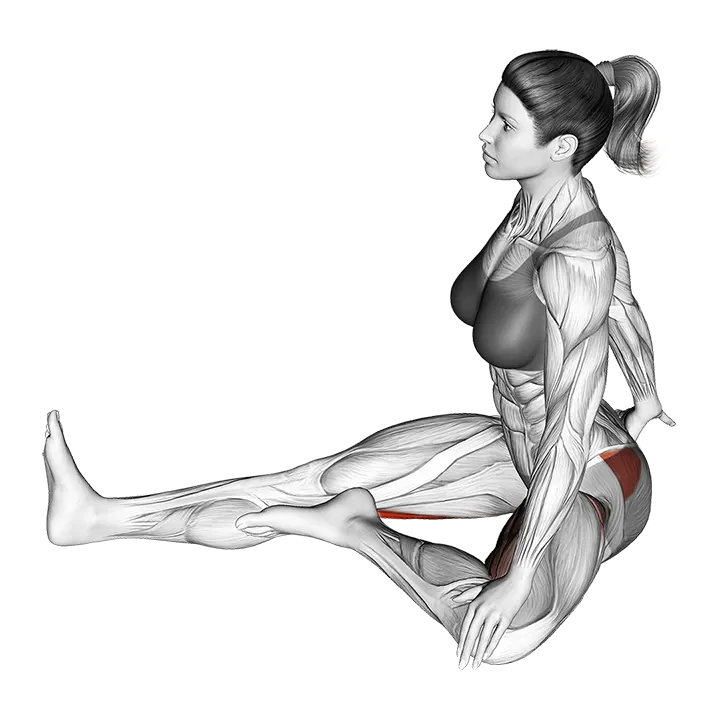
Sitting One Leg External Stretch
- Músculo objetivo
- —
- Equipamiento
- Body weight
- Parte del cuerpo
- Hips
- Tipo
- Stretching
The Sitting One Leg External Stretch is a floor-based bodyweight movement that targets the hip external rotators and outer hip — including the piriformis and deep gluteal muscles — by pulling one leg into external rotation while seated upright. It is particularly effective for relieving tightness in the hips caused by prolonged sitting, running, or lower-body training.
Cómo hacer el Sitting One Leg External Stretch
- 1Sit on the floor with both legs extended straight in front of you and your spine tall.
- 2Bend your right knee and lift the right foot, crossing the ankle just above the left knee so the right shin rests roughly parallel to the floor in a figure-4 position.
- 3Flex your right foot slightly to protect the knee joint and keep the ankle neutral.
- 4Place your hands on the floor beside your hips or lightly rest them on your right shin — do not force the knee down.
- 5Sit tall, pressing your sitting bones into the floor and lengthening through the crown of your head.
- 6On an exhale, hinge forward slowly from the hips — not by rounding your lower back — until you feel a firm stretch in the outer right hip and glute.
- 7Hold the deepest comfortable position for 20–30 seconds, breathing steadily and relaxing the hip with each exhale.
- 8Sit back upright, uncross your leg, and repeat on the left side.
Consejos de técnica
- Keep your spine long throughout — think of your chest moving toward your shin rather than your chin dropping to your chest.
- Allow gravity and your breath to deepen the stretch; do not press or bounce the bent knee toward the floor, as this can strain the knee ligaments.
- Flex the top foot (toes toward your shin) to create stability in the ankle and reduce torque on the knee.
- If your hips are very tight and you cannot sit upright comfortably, sit on a folded blanket or yoga block to tilt your pelvis forward slightly.
Errores comunes
- Rounding the lower back instead of hinging at the hips, which shifts stress away from the hip external rotators and onto the lumbar spine.
- Forcing the top knee down with the hand, which compresses the knee joint rather than creating the intended hip stretch.
- Letting the ankle collapse into plantarflexion (pointed foot), which reduces stability and increases rotational load on the knee.
- Holding the breath, which causes the surrounding muscles to brace and resist the stretch rather than releasing into it.
- Crossing the ankle too high onto the thigh (near the hip) at first, which overstretches the joint before the tissues are ready — start with the ankle just above the opposite knee.
Preguntas frecuentes
What muscles does the Sitting One Leg External Stretch target?
It primarily stretches the hip external rotators — especially the piriformis and the deeper gluteal muscles — and the outer hip. These muscles often become tight from prolonged sitting, cycling, or running.
How long should I hold the Sitting One Leg External Stretch?
Hold each side for 20–30 seconds to begin, and work up to 45–60 seconds as your flexibility improves. Two to three rounds per side in a single session is a good starting point.
Is the Sitting One Leg External Stretch good for sciatica?
It can help when sciatica is caused by piriformis tightness compressing the sciatic nerve, as this stretch directly targets that muscle. However, if your symptoms include sharp or radiating pain down the leg, consult a healthcare professional before using it.
What is a good alternative to the Sitting One Leg External Stretch?
The supine figure-4 stretch (lying on your back and pulling the bent leg toward you) works the same muscles with less demand on hip mobility and is easier for beginners. Standing pigeon or seated chair stretches are also useful alternatives.
Can I do this stretch every day?
Yes — daily practice is appropriate for this type of passive flexibility work. Consistent daily stretching, especially after workouts or long periods of sitting, yields the best improvements in hip mobility over time.







