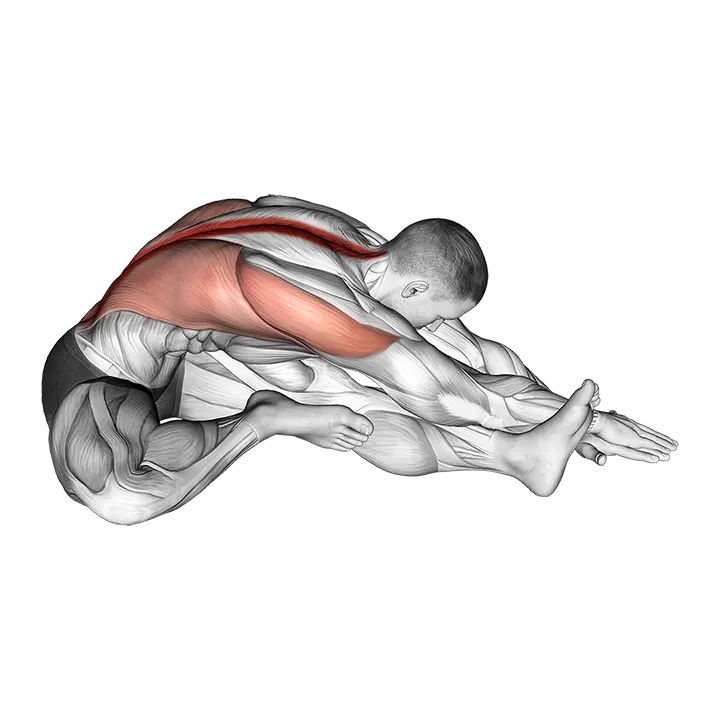
Sitting Side Reach Stretch
- Músculo objetivo
- —
- Equipamiento
- Body weight
- Parte del cuerpo
- Back
- Tipo
- Stretching
The Sitting Side Reach Stretch lengthens the lateral back muscles — including the latissimus dorsi, obliques, and quadratus lumborum — along one side of the torso at a time. Performed seated on the floor with no equipment, it improves side-bending range of motion, relieves tightness from prolonged sitting, and makes an effective cool-down or mobility drill at any fitness level.
Cómo hacer el Sitting Side Reach Stretch
- 1Sit on the floor with your legs crossed or extended straight in front of you. Sit tall, stacking your shoulders over your hips and lengthening through the top of your head.
- 2Place your left hand on the floor a few inches beside your left hip for light support.
- 3Raise your right arm straight overhead, keeping it close to your ear with your elbow fully extended.
- 4Inhale to lengthen your spine, then exhale and slowly lean your torso to the left, reaching your right hand up and over toward the left side.
- 5Hold the deepest comfortable position for 20–30 seconds, breathing steadily and allowing the right side of your torso to lengthen further with each exhale.
- 6On an inhale, engage your core and press gently through your support hand to return to an upright position.
- 7Switch sides: place your right hand on the floor beside your right hip, raise your left arm overhead, and lean to the right.
- 8Hold for the same duration, then return to centre to complete one full set.
Consejos de técnica
- Initiate the lean from your hip rather than collapsing at the shoulder — the stretch should run continuously from your outer hip up through your armpit.
- Keep both sit bones pressing evenly into the floor throughout the hold; lifting one side shifts the stretch away from the lateral back and into the hip.
- Breathe into the side being stretched: as you inhale the ribcage expands and creates traction, and as you exhale you can deepen the reach slightly.
- Keep the overhead arm close to your ear and the elbow straight to maximise the stretch along the latissimus dorsi from the armpit to the hip.
Errores comunes
- Rotating the torso forward or backward as you lean, which converts the lateral stretch into a twist and removes tension from the obliques and quadratus lumborum.
- Rounding the lower back before beginning the lean, which pre-compresses the lateral chain and limits how far it can lengthen.
- Letting the support-side elbow bend and the shoulder collapse, so you sink downward instead of reaching sideways — this shortens the effective stretch.
- Holding the breath to power through discomfort, which increases muscular tension and prevents the lateral muscles from releasing into the stretch.
Preguntas frecuentes
What muscles does the Sitting Side Reach Stretch work?
It primarily stretches the lateral back muscles — the latissimus dorsi, the obliques (external and internal), and the quadratus lumborum — on the side opposite to the direction you lean.
How long should I hold the Sitting Side Reach Stretch?
Hold each side for 20–30 seconds and repeat 2–3 times per side. For chronic tightness, builds up to 45–60 seconds per side once you are comfortable in the position.
Is the Sitting Side Reach Stretch good for lower-back pain?
It can help relieve tightness in the quadratus lumborum, a common contributor to lower-back discomfort. Keep the movement gentle, stop if pain sharpens, and consult a healthcare professional before using it to address an existing injury.
Can I do this stretch every day?
Yes. As a low-load bodyweight stretch it is suitable daily, either as a warm-up to open the lateral chain or as a cool-down after training, desk work, or any prolonged period of sitting.
What is the difference between the Sitting Side Reach Stretch and a standing side bend?
The seated position fixes the pelvis to the floor, which isolates the lateral torso more effectively and reduces the tendency to shift weight through the hips. Standing side bends allow more hip movement and engage the legs for balance, making them slightly less targeted for the obliques and quadratus lumborum.







