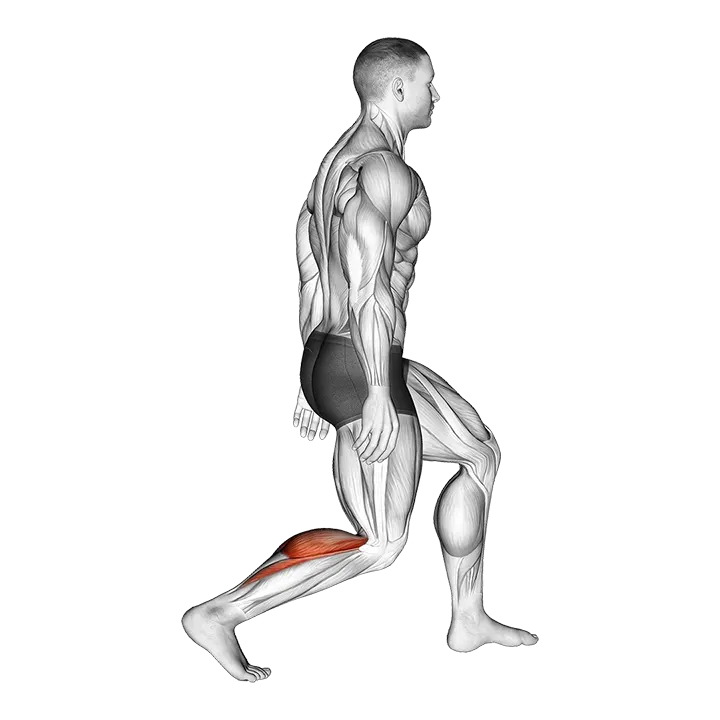
Standing Achilles Stretch
- Músculo objetivo
- —
- Equipamiento
- Body weight
- Parte del cuerpo
- Calves
- Tipo
- Stretching
The standing Achilles stretch is a bodyweight flexibility exercise that targets the Achilles tendon and the deep calf muscle (soleus) by placing the back leg in a bent-knee lunge position close to the ground. Unlike a straight-leg calf stretch, the bent knee bypasses the gastrocnemius and isolates the soleus and Achilles tendon, making it essential for runners, jumpers, and anyone recovering from lower-leg tightness.
Cómo hacer el Standing Achilles Stretch
- 1Stand facing a wall or sturdy surface and place both hands on it at roughly chest height for support.
- 2Step one foot back about one stride length, keeping the foot flat and pointing straight ahead.
- 3Bend both knees, sinking your hips down and forward while keeping your back heel pressed firmly into the floor.
- 4Continue bending the back knee until you feel a deep stretch low in the calf and along the Achilles tendon just above the heel — do not allow the heel to lift.
- 5Hold the position for 20–30 seconds, breathing steadily and letting the tension release gradually.
- 6Gently straighten and shake out the leg, then switch legs and repeat on the other side.
- 7Perform 2–3 holds per side, deepening the position slightly with each hold as the tissue relaxes.
Consejos de técnica
- Keep your back heel flat on the floor throughout — if it lifts, the stretch shifts away from the Achilles tendon and the benefit is lost.
- Point both feet straight ahead; a turned-out back foot reduces tension on the Achilles and can strain the ankle.
- Sink your hips toward the ground rather than leaning the torso forward — the depth comes from hip lowering, not forward lean.
- Breathe slowly and avoid forcing the stretch; the Achilles tendon responds best to gentle, sustained tension rather than aggressive pressure.
- Perform this stretch after activity when tissue is warm, or hold each rep at least 30 seconds for a meaningful flexibility gain.
Errores comunes
- Letting the back heel rise off the floor — this eliminates tension on the Achilles tendon and turns the move into a generic lunge, providing no Achilles benefit.
- Using a straight back leg — a straight knee targets the gastrocnemius, not the soleus and Achilles tendon, so the intended structures go unstretched.
- Turning the back foot outward — external rotation of the foot reduces Achilles tension and shifts stress to the inner ankle ligaments.
- Bouncing or pulsing instead of holding — rapid movement triggers a protective reflex (stretch reflex) that prevents the tendon and muscle from lengthening.
- Skipping the opposite side — Achilles tightness is often asymmetrical, and stretching only the tighter side leaves an imbalance that can contribute to injury.
Preguntas frecuentes
What is the difference between the standing Achilles stretch and a regular calf stretch?
A standard calf stretch uses a straight back leg, which primarily lengthens the gastrocnemius (the larger, upper calf muscle). The standing Achilles stretch uses a bent back knee, which slackens the gastrocnemius and shifts the tension down to the soleus and Achilles tendon — the structures most often tight in runners and people who wear heels.
How long should I hold the standing Achilles stretch?
Hold each side for 20–30 seconds at minimum. Research on static stretching suggests that 30-second holds performed 2–3 times per side produce the best flexibility gains over time. Shorter holds (under 15 seconds) have limited lasting effect on tendon and deep muscle tissue.
Can the standing Achilles stretch help with Achilles tendinopathy?
Light stretching can complement a rehabilitation program for Achilles tendinopathy, but it should be pain-free. If you feel sharp or throbbing pain in the tendon during or after the stretch, stop and consult a physiotherapist. Eccentric heel-drop exercises are typically the cornerstone treatment, with stretching as a supplementary component.
When is the best time to do this stretch?
After a workout or brisk warm-up walk is ideal, when blood flow has loosened the tissue. Stretching a completely cold Achilles tendon first thing in the morning is less effective and can cause irritation, especially if you have existing tightness.
How often should I do the standing Achilles stretch?
Daily stretching of 2–3 sets per side is appropriate for maintaining flexibility and preventing tightness. If you are working through tightness or minor Achilles issues, twice-daily sessions (morning after a short warm-up and post-workout) can accelerate improvement.







