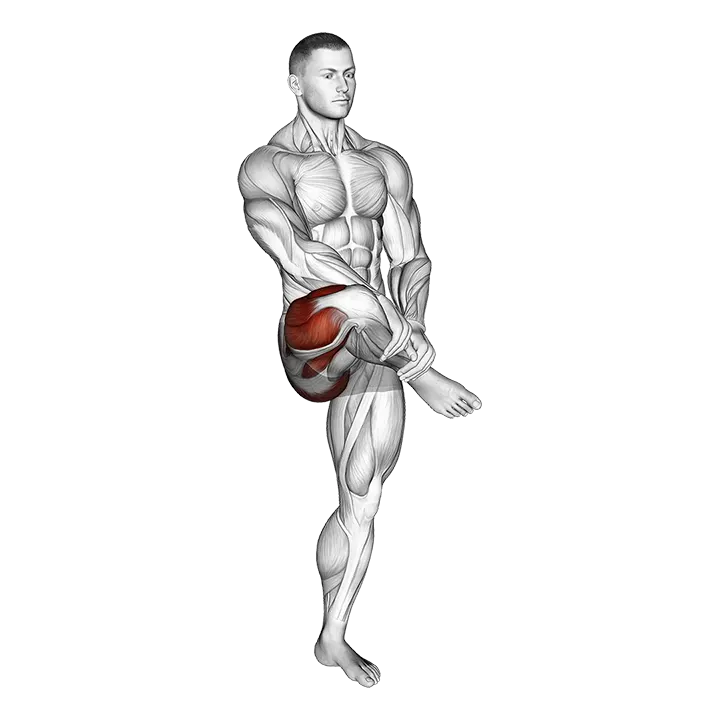
Standing Balance Outer Hip Stretch
- Músculo objetivo
- —
- Equipamiento
- Body weight
- Parte del cuerpo
- Hips, Thighs
- Tipo
- Stretching
The Standing Balance Outer Hip Stretch is a single-leg balance hold that targets the outer hip and lateral thigh area. By crossing one leg over the standing knee and sitting the hips back, it creates a deep stretch along the side of the hip and upper thigh. It is well suited for releasing tightness that builds from prolonged sitting, running, or lower-body training.
Cómo hacer el Standing Balance Outer Hip Stretch
- 1Stand tall with your feet hip-width apart and your arms relaxed at your sides.
- 2Shift your weight onto your left foot, pressing the entire sole evenly into the floor to create a stable base.
- 3Lift your right foot and cross the right ankle over the left thigh, just above the knee, so the right knee opens out to the side.
- 4Place your hands on your hips or extend them forward for balance.
- 5Hinge at the hips and slowly lower yourself as if sitting back into a chair, keeping your standing leg's knee tracking over its foot.
- 6Stop when you feel a clear stretch through the outer hip and lateral thigh of the crossed leg — do not push into pain.
- 7Hold the position for 20–40 seconds while breathing slowly and deeply, allowing the outer hip area to release with each exhale.
- 8Return to an upright position by pressing through the standing foot, uncross the right leg, and stand fully before switching sides.
- 9Repeat the stretch on the opposite side for the same duration.
Consejos de técnica
- Fix your gaze on a still point at eye level to help maintain balance throughout the hold.
- Keep the foot of the crossed leg flexed (toes pulled back) rather than pointed — this protects the knee joint and ensures the stretch targets the outer hip rather than the knee itself.
- Lean the torso forward only from the hips, not by rounding the lower back, to direct the stretch into the intended area.
- Use a wall, chair back, or doorframe for light fingertip support if balance is difficult — reducing the balance challenge lets you focus on achieving a deeper hip stretch.
- Breathe steadily throughout; exhaling during the hold encourages the surrounding tissue to release and allows the stretch to deepen gradually.
Errores comunes
- Placing the ankle directly on the knee rather than just above it: this puts compressive force on the knee joint and shifts the stretch away from the outer hip where it is intended.
- Rounding the lower back to lean forward: spinal flexion reduces the effectiveness of the hip hinge and can cause lower back discomfort, preventing the outer hip from being properly lengthened.
- Letting the standing knee collapse inward: allowing the knee to cave toward the midline compromises joint alignment and reduces balance stability, increasing the risk of a stumble or knee strain.
- Holding the breath: tensing up and breath-holding during the hold causes surrounding muscles to contract and resist the stretch, making it harder to achieve meaningful release in the outer hip area.
- Rushing through the hold: spending fewer than 20 seconds in the position does not give the tissue enough time to lengthen; a held stretch requires sustained duration to produce lasting mobility gains.
Preguntas frecuentes
What area does the Standing Balance Outer Hip Stretch target?
It stretches the outer hip and lateral thigh region. The crossed-leg position combined with the hip-hinge creates tension along the side of the hip on the crossed leg's side, releasing tightness that is common from sitting, running, or repetitive lower-body exercise.
How long should I hold this stretch?
Aim for 20–40 seconds per side for a meaningful release. If you are using it as part of a cool-down, two rounds per side is a reasonable starting point. Avoid bouncing or pulsing — a steady, sustained hold is more effective for improving flexibility than repeated short pulses.
What can I do if I cannot balance on one leg long enough to feel the stretch?
Place one hand lightly on a wall, sturdy chair, or countertop for support. Even minimal fingertip contact provides enough feedback to stabilize the hold. Over time, as the hip and thigh loosen and balance improves, you can gradually reduce how much you rely on the support.
Is it normal to feel the stretch in my knee rather than my hip?
Feeling it primarily in the knee usually means the ankle is resting on or very close to the knee joint rather than above it, or the foot of the crossed leg is not flexed. Move the ankle higher onto the lower thigh and dorsiflex the foot (pull toes toward the shin) to redirect the sensation into the outer hip area.
When is a good time to include this stretch in a workout?
It works best as part of a post-workout cool-down or a standalone mobility session when the muscles are already warm. Performing it after lower-body training — squats, lunges, running, or cycling — helps address outer hip tightness before it accumulates. Avoid using it as a pre-workout static stretch before high-intensity activity.







