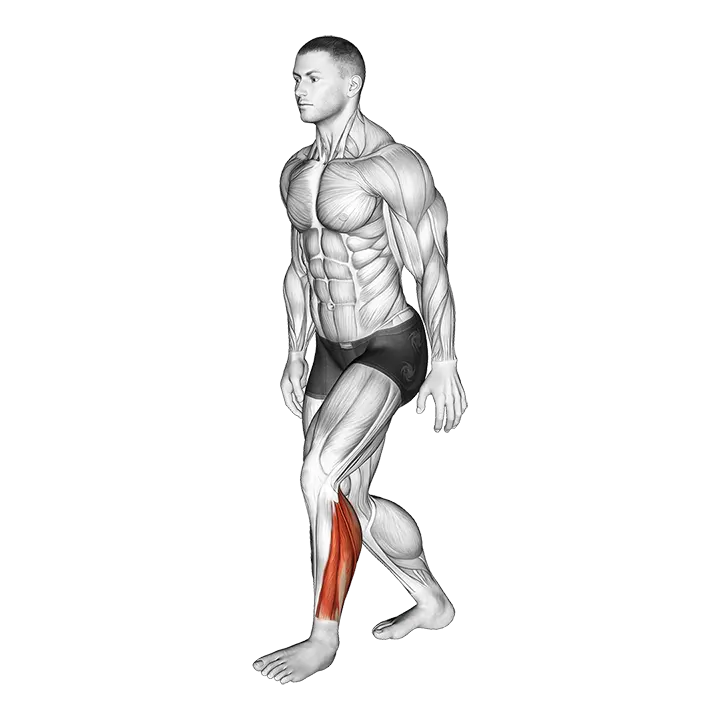
Standing Heel Back Achilles Stretch
- Músculo objetivo
- —
- Equipamiento
- Body weight
- Parte del cuerpo
- Calves
- Tipo
- Stretching
The Standing Heel Back Achilles Stretch is a bodyweight flexibility exercise that targets the Achilles tendon and the lower portion of the calf musculature by positioning the heel behind the body to create sustained dorsiflexion tension. It is particularly effective for reducing lower-leg tightness after running, jumping, or prolonged time in heeled shoes. No equipment is required, making it an accessible daily mobility drill for improving ankle range of motion and protecting the Achilles tendon from overuse strain.
Cómo hacer el Standing Heel Back Achilles Stretch
- 1Stand near a wall or stable surface and place one hand on it lightly for balance.
- 2Step one foot back roughly one to two feet, keeping the toes of the rear foot pointing straight ahead.
- 3Bend the rear knee slightly — approximately 10 to 20 degrees — rather than locking it straight; this position directs the stretch toward the Achilles tendon and lower calf rather than the gastrocnemius belly.
- 4Press the heel of the rear foot firmly into the floor and actively drive it back and downward as if trying to slide it away from you.
- 5Keep your torso upright and your hips squared forward throughout the hold.
- 6Continue pressing the heel back until you feel a focused stretch low in the calf, along the Achilles tendon just above the heel.
- 7Hold the position for 20–30 seconds, breathing steadily and allowing the tension to ease with each exhale.
- 8Return to a neutral standing position, then repeat on the opposite side.
- 9Complete 2–3 rounds per leg.
Consejos de técnica
- Keep the toes of the rear foot pointing straight ahead throughout the hold — rotating them outward shifts tension away from the Achilles tendon and distributes load unevenly across the tendon fibers.
- The slight bend in the rear knee is the key cue that separates this stretch from a gastrocnemius-focused straight-leg calf stretch. Maintain that bend consistently; even a small collapse into a straight knee changes the target.
- Press the heel back actively rather than simply leaning your torso forward. The sensation of driving the heel away from the body is what generates the targeted stretch on the Achilles tendon.
- Progress the depth gradually over the hold rather than forcing the range at the start. The Achilles tendon has limited blood supply and responds better to sustained, gentle tension than to aggressive end-range loading.
Errores comunes
- Fully straightening the rear knee — this shifts the primary stretch from the Achilles tendon and lower calf to the gastrocnemius belly higher up the leg. A slight knee bend must be maintained throughout to preserve the Achilles emphasis.
- Allowing the rear heel to lift off the floor — losing heel contact removes tension from the Achilles tendon entirely and defeats the purpose of the exercise. Press the heel actively into the ground for the full duration of the hold.
- Rotating the rear foot outward — external rotation of the foot changes the angle of pull on the tendon and creates asymmetrical strain across its medial and lateral fibers. The toes must remain pointing straight ahead.
- Cutting the hold short — the Achilles tendon is dense connective tissue that responds slowly. Holds shorter than 15 seconds do not give the tissue enough time to relax and lengthen; target at least 20 seconds per side.
- Overstretching by leaning too aggressively forward — excessive forward lean places high load on a low-elasticity structure rather than producing a gentle lengthening effect. Move only as far as you can with the heel flat and no sharp discomfort.
Preguntas frecuentes
What is the difference between an Achilles stretch and a calf stretch?
A standard calf stretch — performed with a straight rear knee — primarily targets the gastrocnemius, a muscle that crosses both the knee and the ankle. An Achilles stretch uses a bent-knee position to reduce gastrocnemius involvement and direct tension toward the lower calf and the Achilles tendon itself, which connects the calf muscles to the heel bone. The two stretches target the same region but with meaningfully different emphasis depending on knee angle.
How long should I hold the Standing Heel Back Achilles Stretch?
Hold each side for 20–30 seconds and complete 2–3 rounds per leg. The Achilles tendon is dense connective tissue that responds best to sustained, low-intensity tension rather than short bursts. If you are working on chronic tightness, gradually extending holds toward 45 seconds over several weeks can produce greater improvements in flexibility.
Is this stretch helpful for Achilles tendinopathy?
Gentle static stretching can be a useful supplementary tool in Achilles tendinopathy management, but the evidence-based first-line treatment is eccentric loading — specifically heel-drop exercises — not passive stretching alone. Use this stretch as a complement to a physiotherapist-guided program rather than a primary intervention if you have been diagnosed with tendinopathy.
When is the best time to do this stretch — before or after exercise?
Static stretches like this one are most effective after exercise, when the tissues are warm and more pliable. Performing prolonged static holds before high-intensity activity can temporarily reduce force output. Daily stretching on rest days after a short warm-up walk is also safe and beneficial for building lasting flexibility in the lower leg.
Can this stretch help with plantar fasciitis?
Calf and Achilles stretching is commonly included in plantar fasciitis management programs because tightness in the lower leg increases mechanical strain on the plantar fascia. The Standing Heel Back Achilles Stretch is a reasonable addition to such a routine, but consult a physiotherapist or sports medicine physician for a complete protocol tailored to the severity of your condition.







