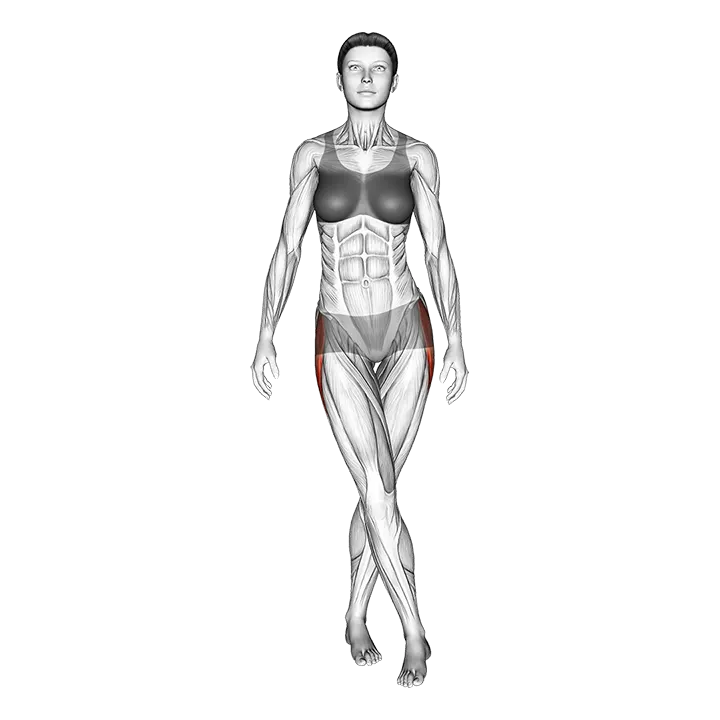
Standing Iliotibial Stretch
- Músculo objetivo
- —
- Equipamiento
- Body weight
- Parte del cuerpo
- Hips
- Tipo
- Stretching
The Standing Iliotibial Stretch is a bodyweight standing stretch that targets the iliotibial band — a thick band of connective tissue running along the outer thigh from the hip to the knee — along with the tensor fasciae latae and surrounding outer-hip structures. Performed by crossing one leg behind the other and shifting the hips laterally, it relieves tightness along the outer thigh and hip that commonly contributes to hip pain and IT band syndrome.
Cómo hacer el Standing Iliotibial Stretch
- 1Stand upright with your feet together and your arms relaxed at your sides.
- 2Cross your right foot behind your left foot, placing the right foot flat on the floor slightly to the left of the left foot.
- 3Straighten both legs and keep your torso tall throughout the movement.
- 4Shift your hips to the right by pushing them out to the side — you should feel a stretch along the outer left hip and thigh.
- 5For additional depth, extend your left arm overhead and reach it gently to the right, creating a lateral lean through the torso.
- 6Hold the stretched position for 20–30 seconds, breathing steadily and allowing the outer hip and IT band to release with each exhale.
- 7Return to the upright starting position by stepping your right foot back to center.
- 8Repeat on the opposite side — cross the left foot behind the right, shift hips to the left — completing 2–3 rounds per side.
Consejos de técnica
- Keep both feet flat on the floor throughout the hold. If the crossed foot lifts or rolls to its outer edge, the hip shift is compensated and the stretch moves away from the IT band.
- Focus the movement at the hips rather than the waist. Pushing the hip out to the side is what loads the IT band; bending sideways from the ribs instead reduces the effectiveness of the stretch.
- Keep the knee of the front leg soft rather than hyperextended. A slight micro-bend prevents joint strain while still allowing the IT band to be placed under tension.
- Breathe into the stretch and let the outer hip relax progressively — the IT band and TFL respond better to sustained, relaxed holds than to forced range of motion.
- If adding an overhead reach, keep the shoulder of the raised arm down and away from the ear to avoid creating neck tension that distracts from the hip stretch.
Errores comunes
- Bending sideways at the waist instead of pushing the hips out laterally — this targets the obliques rather than the IT band and TFL, producing a lateral trunk stretch rather than the intended outer-hip stretch.
- Placing the crossed foot too close to the standing foot — insufficient crossing means the hip shift is limited and the IT band is never placed under meaningful tension. Cross the foot far enough that you feel a clear pull along the outer thigh.
- Allowing the hips to rotate forward or backward during the hold — rotation shifts the stretch off the IT band and onto surrounding muscles. Keep the pelvis facing squarely forward throughout.
- Holding for too short a time — the IT band is dense connective tissue that requires sustained loading to respond. Holds shorter than 15 seconds rarely produce meaningful release; aim for at least 20 seconds per side.
- Locking the knees aggressively — forcing the knees into full hyperextension places unnecessary stress on the knee joint. Keep a soft, neutral knee position in both legs to maintain joint safety.
Preguntas frecuentes
What does the Standing Iliotibial Stretch target?
It primarily targets the iliotibial band, a thick band of connective tissue along the outer thigh, along with the tensor fasciae latae (TFL) muscle at the outer hip. It does not directly stretch a single named muscle in the traditional sense because the IT band is fascia rather than contractile muscle tissue.
How long should I hold an IT band stretch?
Hold each side for at least 20–30 seconds per round, as the IT band and TFL are dense structures that need sustained tension to release. Performing 2–3 rounds per side gives better results than a single brief hold. Over time, gradually working toward 45-second holds can help with persistent tightness.
Can the Standing Iliotibial Stretch help with IT band syndrome?
Regular stretching of the IT band and TFL is commonly recommended as part of IT band syndrome management to reduce lateral hip and knee tension. However, IT band syndrome is multifactorial — hip weakness and training load are often contributing factors — so stretching alone is rarely sufficient and should be combined with strengthening work and addressing root causes.
How often should I do this stretch?
Stretching the IT band daily or on most training days is generally safe and beneficial, particularly for runners, cyclists, and people who sit for extended periods. Two to three rounds per side held 20–30 seconds each is a practical starting frequency that can be adjusted based on how tight the outer hip feels.
Do I need any equipment for the Standing Iliotibial Stretch?
No equipment is needed — only bodyweight. If balance is difficult, standing near a wall or holding a doorframe lightly with one hand while performing the hip shift allows you to focus on the stretch without worrying about stability.







