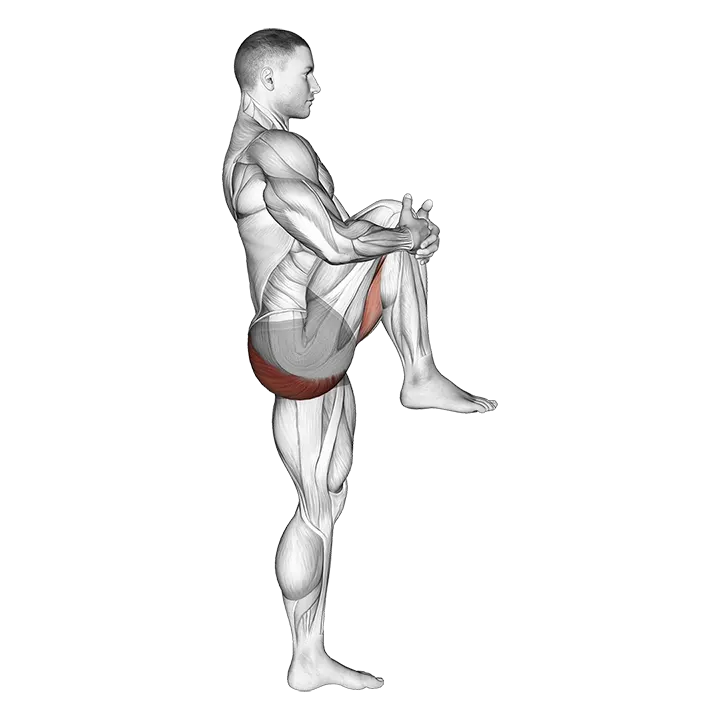
Standing Knee To Chest Stretch
- Músculo objetivo
- —
- Equipamiento
- Body weight
- Parte del cuerpo
- Hips
- Tipo
- Stretching
The standing knee to chest stretch is a bodyweight mobility exercise that targets the hip flexors and glutes by drawing one knee toward the chest while balancing on the opposite leg. It is an effective tool for relieving hip tightness, improving range of motion, and serving as a dynamic warm-up before lower-body training or running.
Cómo hacer el Standing Knee To Chest Stretch
- 1Stand tall with your feet hip-width apart and your arms relaxed at your sides.
- 2Shift your weight onto your right foot and engage your core to maintain an upright posture.
- 3Lift your left knee up toward your chest, keeping your standing leg slightly soft rather than locked.
- 4Clasp both hands just below your left knee — one hand on the shin, one on the back of the thigh.
- 5Gently pull the knee closer to your chest until you feel a stretch through the back of your hip and glute.
- 6Hold the position for 20–30 seconds while breathing steadily and keeping your torso tall.
- 7Slowly lower your left foot back to the floor with control.
- 8Repeat on the right side, performing the same number of holds per leg.
Consejos de técnica
- Keep your standing foot flat on the floor and avoid rising onto your toes, which reduces stability and shifts the stretch away from the hip.
- Focus on lengthening through the top of your head rather than rounding your back — a tall spine deepens the hip stretch.
- Breathe slowly and relax your hip on each exhale to gradually increase the range of motion.
- If balance is challenging, lightly touch a wall or chair with your free hand rather than compromising your posture to compensate.
- For a dynamic warm-up, perform the pull as a brief 1–2 second hold per rep and alternate legs in a slow marching pattern.
Errores comunes
- Rounding the lower back: Hunching forward to pull the knee higher reduces the stretch on the hip and places unnecessary stress on the lumbar spine — keep your chest up and back straight throughout.
- Locking the standing knee: Hyperextending the support leg reduces proprioceptive control and increases injury risk; keep a slight bend in the knee at all times.
- Pulling on the knee joint: Gripping directly on the kneecap rather than just below it forces the joint into an unnatural angle — always place your hands on the shin and back of the thigh.
- Holding your breath: Bracing and forgetting to breathe increases muscular tension and limits how far the hip can relax into the stretch; exhale deliberately during the hold.
- Rushing through the movement: Bouncing or quickly releasing the leg before the hip has time to respond prevents the stretch reflex from settling and reduces the mobility benefit.
Preguntas frecuentes
What muscles does the standing knee to chest stretch target?
The stretch primarily works the hip region — particularly the glutes and hip extensors of the raised leg, and the hip flexors and stabilizers of the standing leg. No external equipment is needed beyond your own body weight.
How long should I hold the standing knee to chest stretch?
For a static flexibility hold, aim for 20–30 seconds per side. For a dynamic warm-up, a brief 1–2 second hold per repetition for 8–10 reps each side is sufficient to activate the hips before exercise.
Can I do this stretch if I have tight hips or hip flexor pain?
Yes — the standing knee to chest stretch is gentle and well-suited for hip tightness. If you experience sharp pain rather than a mild stretching sensation, reduce the pull and consult a healthcare professional before continuing.
When should I do the standing knee to chest stretch — before or after a workout?
It works well both ways. Used dynamically before a workout it primes the hips for squats, lunges, or running; held statically after training it helps restore hip range of motion and reduce post-exercise tightness.
How can I improve my balance during this stretch?
Focus on a fixed point on the floor a few feet ahead of you and engage your core before lifting the knee. Keeping a slight bend in the standing knee also helps. A wall or sturdy chair nearby provides a light support option while you build single-leg balance.







