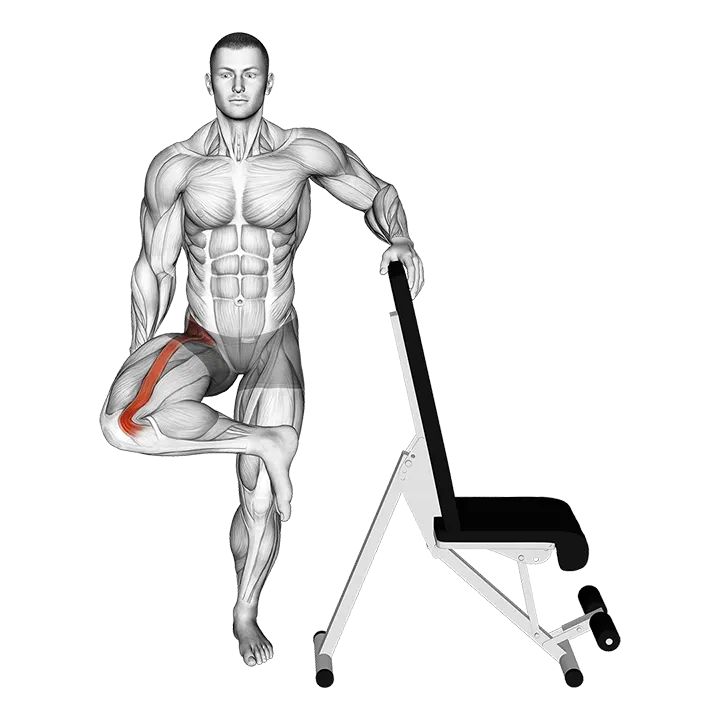
Standing Leg Resting Hip Stretch
- Músculo objetivo
- —
- Equipamiento
- Body weight
- Parte del cuerpo
- Hips
- Tipo
- Stretching
The Standing Leg Resting Hip Stretch is a bodyweight standing flexibility exercise that targets the deep hip rotators and outer glute area by placing one ankle across the opposite thigh in a figure-four position while hinging at the hips. Holding this position creates a controlled stretch through the hip joint that is particularly effective for relieving tightness from prolonged sitting. It requires no equipment and can be performed anywhere a stable surface is available for balance.
Cómo hacer el Standing Leg Resting Hip Stretch
- 1Stand upright near a wall, chair back, or other stable surface you can hold for balance.
- 2Shift your weight onto your left foot and slightly soften the left knee so it is not locked out.
- 3Lift your right foot and cross your right ankle over your left thigh, just above the knee, forming a figure-four shape with your legs.
- 4Flex your right foot gently — toes pulled back toward the shin — to protect the knee joint.
- 5Keeping your chest up and your spine neutral, slowly hinge forward at the hips by pushing your seat backward as if sitting into a chair.
- 6Continue lowering until you feel a distinct stretch deep in the right hip and outer glute. Stop before any discomfort appears in the knee.
- 7Hold the position for 20–40 seconds, breathing steadily and allowing the hip muscles to soften with each exhale.
- 8Push through your standing heel to return to an upright position and lower the right foot back to the floor.
- 9Repeat on the opposite side, completing 2–3 rounds per leg.
Consejos de técnica
- Flex the foot of the crossed leg throughout the hold — keeping the toes pulled back creates a stable ankle position that reduces rotational stress on the knee.
- Hinge from the hips rather than rounding through the lower back. Think of pushing your seat backward and keeping the chest lifted; a rounded spine reduces the stretch in the hip and increases strain on the lumbar region.
- Use the wall or chair lightly for balance only — do not pull or lean heavily on the support, as doing so shifts weight away from the standing leg and reduces the depth of the stretch.
- Let gravity do the work rather than forcing the knee of the crossed leg downward with your hand. The hip will open progressively as the muscles relax over the duration of the hold.
- If balance is a challenge, perform the stretch in front of a wall so you can rest both hands against it at chest height, which frees you to focus on the hip position rather than staying upright.
Errores comunes
- Rounding the lower back during the forward hinge — this shifts tension away from the hip rotators and onto the lumbar spine, reducing the effectiveness of the stretch while increasing injury risk. Keep the spine long and the chest lifted throughout.
- Placing the ankle too close to or directly on top of the knee — crossing the ankle just above the knee (lower thigh) rather than on it protects the knee from excessive lateral stress and keeps the stretch centered in the hip.
- Letting the ankle go limp — a relaxed, uninflexed foot allows the ankle to collapse inward and transmits unwanted torque into the knee. Keep the foot flexed for the entire hold.
- Cutting the hold too short — brief contact of a few seconds does not give the nervous system enough time to reduce protective muscle tension. Aim for at least 20 seconds per side to achieve meaningful relaxation of the hip rotators.
- Leaning to the side to compensate for tight hips — tilting the torso sideways toward the supporting leg is a sign the hip is not yet mobile enough to accept the full range of the stretch. Reduce the depth of the hinge instead, and work gradually toward a deeper position over time.
Preguntas frecuentes
What muscles does the Standing Leg Resting Hip Stretch target?
The stretch primarily targets the deep hip rotators and the outer glute region of the crossed leg. These muscles, which sit deep beneath the larger gluteal muscles, are commonly tight in people who sit for extended periods or run frequently. By placing the ankle over the opposite thigh and hinging forward, you create a stretch that reaches deeper into the hip than most standard glute stretches.
Is the Standing Leg Resting Hip Stretch the same as a standing figure-four stretch?
Yes — the two names describe the same movement. The "figure-four" label refers to the shape the legs form when one ankle is crossed over the opposite thigh: the number 4. "Leg resting" simply describes the position of the crossed foot resting on the standing leg. Both terms are widely used for this standing hip stretch.
Can I do this stretch if I have tight hips and cannot balance easily?
Yes. Stand directly in front of a wall and place both hands flat against it at chest height. This removes nearly all of the balance demand and lets you focus on the hip position and hinge depth. As hip mobility and single-leg balance improve over several weeks, you can transition to using just one hand on a chair back, and eventually no support at all.
How does the Standing Leg Resting Hip Stretch compare to the seated figure-four or lying pigeon pose?
All three target a similar area of the hip but differ in load and position. The lying pigeon pose is passive and uses the floor for full support, making it the gentlest option. The seated figure-four in a chair is moderately loaded. The standing version adds the weight of your body through the standing leg, which can deepen the stretch more quickly — but it also requires balance and enough hip mobility to hinge forward. Beginners often start with the floor or seated version before progressing to the standing variation.
When is the best time to do this stretch?
This stretch is most effective when the hips are already warm — after a workout, a brisk walk, or any activity that increases blood flow to the lower body. Static stretches like this one are generally more productive post-exercise than before it, as cold muscles are less pliable and more prone to strain. That said, performing it after a short five-minute warm-up walk on rest days is also beneficial for people dealing with chronic hip tightness.







