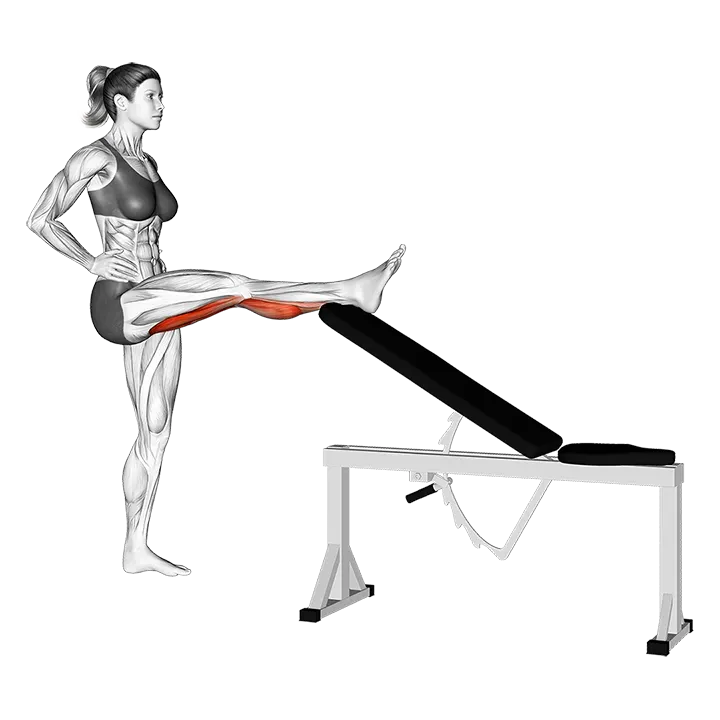
Standing Leg Up Hamstring Stretch
- Músculo objetivo
- —
- Equipamiento
- Body weight
- Parte del cuerpo
- Thighs
- Tipo
- Stretching
The standing leg up hamstring stretch targets the hamstrings — the muscles running along the back of the thigh — by propping one leg on an elevated surface and hinging forward at the hip. Performed with body weight only, it is an effective flexibility drill for reducing hamstring tightness, improving range of motion, and warming up or cooling down before and after lower-body training.
Cómo hacer el Standing Leg Up Hamstring Stretch
- 1Stand facing a stable elevated surface such as a bench, step, or chair seat at roughly hip height.
- 2Lift one leg and place your heel on the surface, keeping that leg straight and your toes pointing up toward the ceiling.
- 3Stand tall with your hips square, your hands resting lightly on your hips or on the elevated surface for balance.
- 4Inhale, then on the exhale hinge forward at the hip — not the lower back — leaning your chest toward your elevated leg.
- 5Keep your back flat and your elevated knee soft but extended as you feel the stretch build along the back of the thigh.
- 6Hold the stretched position for 20–30 seconds, breathing steadily and relaxing deeper into the stretch with each exhale.
- 7Return to upright by engaging your core and lifting your chest, then lower your leg to the floor.
- 8Repeat on the opposite leg for the same duration.
Consejos de técnica
- Initiate the forward lean from your hip joint, not your lower back — think of tilting your pelvis forward rather than rounding your spine.
- Keep your standing foot firmly planted and your standing knee slightly soft to maintain balance and avoid locking the joint.
- Flex the toes of the elevated foot toward you to increase tension through the hamstring and calf.
- Progress the stretch gradually — move only as far forward as you can while keeping a flat back; forcing depth risks straining the hamstring.
Errores comunes
- Rounding the lower back instead of hinging at the hip, which shifts load away from the hamstrings and places strain on the lumbar spine.
- Bending the elevated knee, which reduces hamstring tension and lets the hip flexors compensate — keep the leg as straight as your flexibility allows.
- Holding the breath and tensing up, which prevents the muscle from releasing; steady breathing allows the hamstring to lengthen more effectively.
- Choosing a surface that is too high, forcing the hips to tilt sideways and misaligning the stretch — start at a lower height and build up gradually.
- Bouncing or pulsing at the end range rather than holding steadily, which can trigger the stretch reflex and increase the risk of a muscle strain.
Preguntas frecuentes
What muscles does the standing leg up hamstring stretch target?
It primarily targets the hamstrings — the biceps femoris, semimembranosus, and semitendinosus — along the back of the elevated thigh. Flexing the toes upward also adds a mild stretch through the calf.
How high should the surface be when I prop my leg up?
Start with a surface at mid-thigh to hip height. A lower surface reduces intensity and is easier to keep a flat back on; raise it gradually as your flexibility improves rather than forcing a higher position from the start.
How long should I hold the stretch?
Hold each side for 20–30 seconds and repeat 2–3 times per leg. For general flexibility work, 2–3 sets held 30 seconds is a common target.
Is this stretch suitable for beginners?
Yes. Using a lower surface makes it very accessible, and it requires no equipment beyond a stable object to rest the heel on. Beginners should focus on maintaining a flat back rather than reaching for maximum depth.
When is the best time to do this stretch?
It works well as part of a cool-down after lower-body training when muscles are warm. As a pre-workout stretch, keep it brief and dynamic rather than holding a deep static position, which can temporarily reduce power output.







