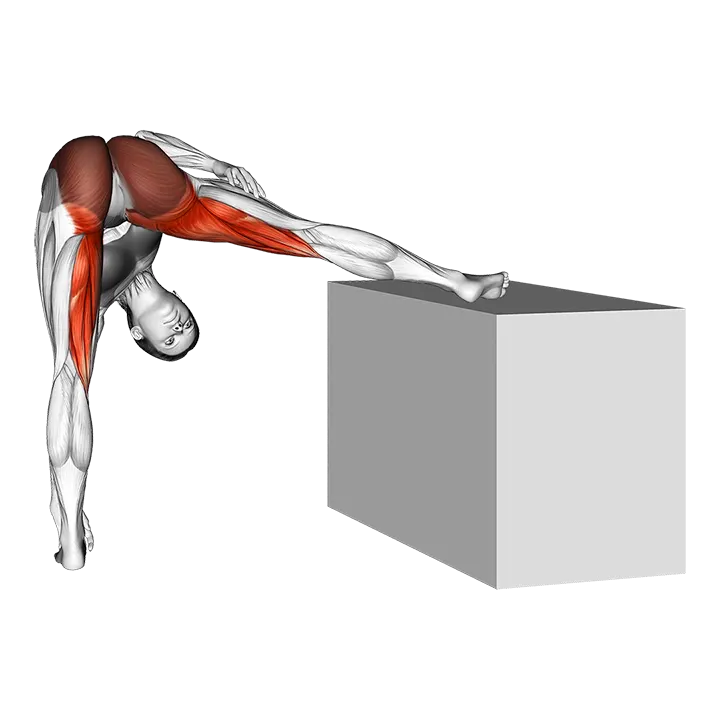
Standing Raised Leg Hip Adductor Stretch
- Músculo objetivo
- —
- Equipamiento
- Body weight
- Parte del cuerpo
- Hips
- Tipo
- Stretching
The Standing Raised Leg Hip Adductor Stretch is a bodyweight flexibility exercise that targets the inner thigh muscles (hip adductors) by elevating one leg on a surface and leaning laterally toward it. Holding the raised position opens the hip and progressively lengthens the adductor group, improving hip mobility and reducing tightness in the groin area.
Cómo hacer el Standing Raised Leg Hip Adductor Stretch
- 1Stand upright next to a stable elevated surface — a bench, step, or box at roughly hip height — and place your foot flat on it so your raised leg is extended out to the side.
- 2Square your hips forward and keep both legs as straight as is comfortable, with the toes of both feet pointing forward or slightly outward.
- 3Place your hands on your hips or lightly on the surface for balance.
- 4Keeping your torso upright and your core gently braced, slowly shift your weight toward the raised leg by leaning your hips sideways in that direction.
- 5You should feel a stretch along the inner thigh of either the raised leg, the standing leg, or both — this is normal and depends on individual flexibility.
- 6Hold the deepest comfortable position for 20–40 seconds, breathing steadily and allowing the muscles to relax with each exhale.
- 7Gently push through your standing foot to return to the start position, then switch legs and repeat on the other side.
Consejos de técnica
- Keep your hips level and facing forward throughout — avoid rotating the pelvis, which shifts the stretch away from the adductors.
- Use a surface height that allows you to feel a meaningful stretch without forcing your hip into an uncomfortable range; lower the surface if your hips hike up or twist.
- Breathe continuously and use each exhale to relax deeper into the stretch rather than forcing the range of motion.
- Hold a wall or the surface lightly if balance is a challenge — stability lets you focus on the stretch instead of not falling.
- Ease into the position gradually; the adductors can cramp if pulled aggressively without a warm-up.
Errores comunes
- Letting the hip of the raised leg hike up or rotate outward, which reduces adductor tension and can strain the hip joint.
- Rounding the lower back to get the leg higher, which places unnecessary stress on the lumbar spine instead of stretching the inner thigh.
- Using a surface that is too high before flexibility allows it, forcing the pelvis to tilt and reducing the effectiveness of the stretch.
- Holding your breath or tensing up, which causes the adductors to resist rather than release into the stretch.
- Bouncing or pulsing into the stretch instead of holding a steady position, which can trigger a protective muscle reflex and risk a strain.
Preguntas frecuentes
Which muscles does this stretch target?
It primarily stretches the hip adductors — the group of inner thigh muscles that pull the legs together. Depending on your position and flexibility, you may also feel it along the inner thigh of the standing leg.
How high should the surface be?
Start with a surface at roughly mid-thigh to hip height. As your flexibility improves you can use a higher surface, but always choose a height that lets you keep your hips square and your torso upright.
How long should I hold the stretch?
Hold each side for 20–40 seconds and perform 2–3 repetitions per leg. Longer holds of up to 60 seconds can further improve flexibility when done consistently as part of a cool-down.
When is the best time to do this stretch?
It is most effective after a workout when your muscles are warm. You can also do it as part of a dedicated mobility session; just warm up with 5–10 minutes of light movement beforehand if you are stretching cold.
I feel the stretch more in my standing leg than the raised leg — is that normal?
Yes. The standing leg's adductors are lengthened as the legs are spread apart, so feeling the stretch there is common. Both effects are beneficial and will balance out as your hip mobility improves.







