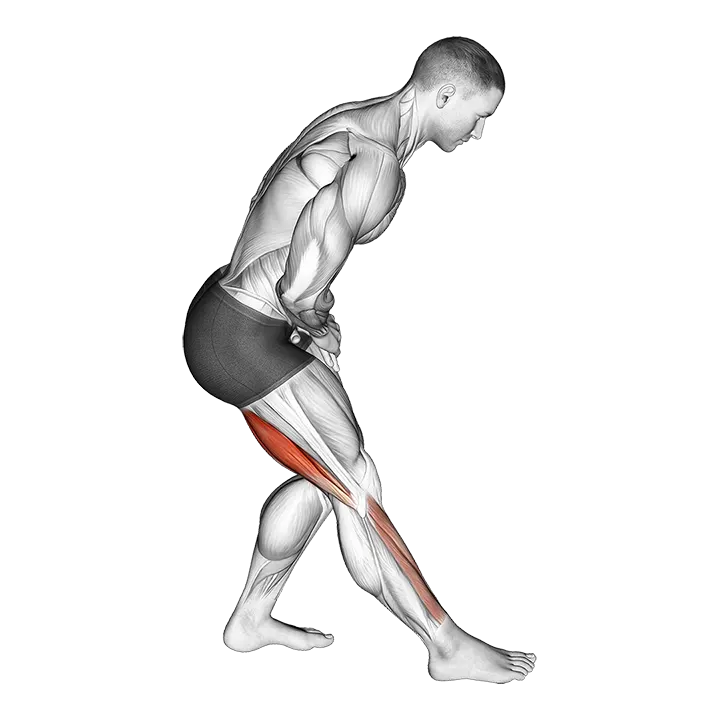
Standing Toe Down Hamstring Stretch
- Músculo objetivo
- —
- Equipamiento
- Body weight
- Parte del cuerpo
- Thighs
- Tipo
- Stretching
The Standing Toe Down Hamstring Stretch is a bodyweight flexibility exercise that targets the hamstrings along the back of the thigh. By pointing the toes downward while keeping the heel on the floor, you increase ankle plantarflexion, which draws the hamstring group into a deeper stretch than a standard standing position allows. It is well-suited as a warm-down drill or a daily mobility exercise for people with tight hamstrings from prolonged sitting or repetitive lower-body training.
Cómo hacer el Standing Toe Down Hamstring Stretch
- 1Stand tall with your feet together and your hands at your sides or lightly resting on a wall or chair for balance.
- 2Extend one leg forward and place the heel on the floor with the toes pointed downward toward the ground — the top of the foot faces up rather than the sole.
- 3Keep your extended leg straight, locking out the knee completely.
- 4Hinge at the hips, tilting your pelvis forward and keeping your back flat as you lean your chest toward the extended leg.
- 5Continue to hinge until you feel a distinct stretch running along the back of the thigh of the extended leg.
- 6Hold the position for 20–30 seconds, breathing steadily and releasing deeper into the stretch on each exhale.
- 7Return to an upright standing position to release the stretch.
- 8Repeat on the opposite leg, completing 2–3 rounds per side.
Consejos de técnica
- Hinge from the hips rather than rounding your lower back. A flat back keeps tension in the hamstrings; a rounded spine shifts load to the lumbar discs and reduces the stretch effectiveness.
- Actively press the heel into the floor while keeping the toes pointing down throughout the hold. Allowing the toes to drift upward reduces the plantarflexion angle and diminishes the additional stretch that defines this variation.
- Move only as far forward as you can while maintaining a straight leg and flat back. A modest lean with correct alignment stretches the hamstring more effectively than a deep lean with a bent knee or rounded spine.
- If balance is a concern, stand next to a wall and use one hand for light support. Avoid gripping hard — the support should allow you to focus on the hip hinge rather than stabilizing.
- Breathe out slowly during the hold and use each exhale to allow the hamstring to relax further into the stretch. Holding your breath or tensing through the movement limits the lengthening response.
Errores comunes
- Bending the extended knee — even a slight bend removes tension from the hamstrings. Keep the leg fully straight throughout the hold to maintain the stretch on the target muscle.
- Rounding the lower back instead of hinging at the hips — this transfers the sensation of stretch to the lumbar spine and away from the hamstrings, reducing effectiveness and adding unnecessary stress to the lower back.
- Letting the toes point upward (dorsiflexion) rather than downward — this is the defining feature of this variation. Toes pointing up reduces the additional hamstring tension that the plantarflexed position provides, making it a less effective stretch than intended.
- Bouncing or pulsing at the end range — ballistic movement in a stretched position can cause micro-tears in the muscle or trigger a protective reflex that tightens the hamstring. Hold the position steadily.
- Cutting the hold time short — less than 15 seconds does not give the nervous system enough time to allow the muscle to lengthen. Aim for at least 20 seconds per side to see a meaningful flexibility benefit.
Preguntas frecuentes
What muscles does the Standing Toe Down Hamstring Stretch work?
This stretch primarily targets the hamstring group — biceps femoris, semitendinosus, and semimembranosus — along the back of the thigh. The toe-down (plantarflexed) foot position adds a mild secondary stretch along the calf, but the hamstrings are the primary focus.
Why do the toes point down in this stretch?
Pointing the toes downward (plantarflexion) increases the overall length of the kinetic chain from the hip through the hamstrings. Because the hamstrings do not directly control the ankle, the plantarflexed position slightly alters the angle of pull and allows the hip hinge to drive a deeper stretch compared to a neutral or dorsiflexed foot.
How long should I hold a standing hamstring stretch?
Hold each side for 20–30 seconds per round and complete 2–3 rounds per leg. Static holds shorter than 15 seconds do not give the nervous system enough time to permit meaningful muscle lengthening, while very long holds of more than 60 seconds rarely provide additional benefit in a single session.
Is the Standing Toe Down Hamstring Stretch good for beginners?
Yes. It requires no equipment and the depth of the hip hinge can be adjusted to match your current flexibility. Beginners with tight hamstrings can start with a very small forward lean and gradually increase the range over several weeks as the muscles lengthen.
What are good alternatives to the Standing Toe Down Hamstring Stretch?
Common alternatives include the seated hamstring stretch (sitting on the floor with legs extended), the supine single-leg hamstring stretch (lying on your back and drawing one leg toward the chest with a straight knee), and the standing forward fold. The toe-down variation is unique in combining the upright hip hinge with the plantarflexed foot, so the seated or supine versions are better substitutes when balance is a concern.







