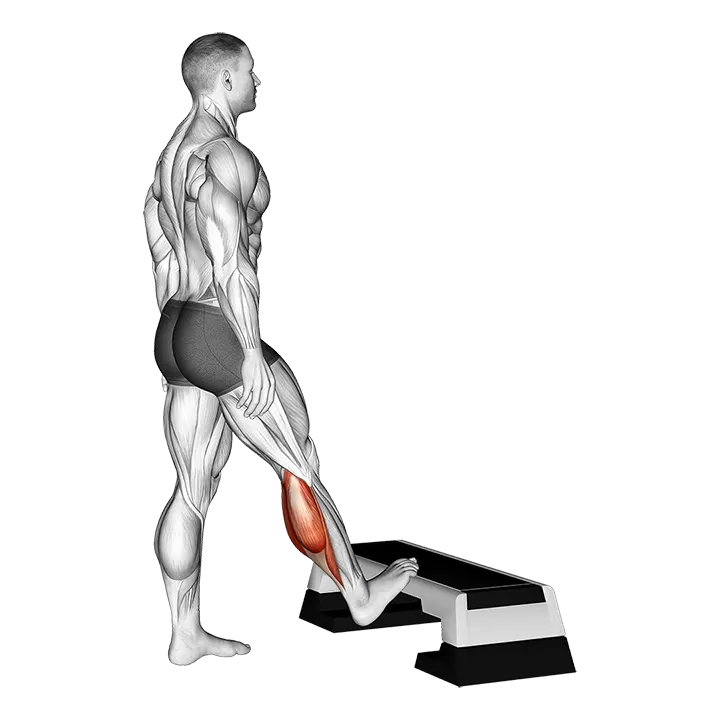
Standing Toe Up Calf Stretch
- Músculo objetivo
- —
- Equipamiento
- Body weight
- Parte del cuerpo
- Calves
- Tipo
- Stretching
The Standing Toe Up Calf Stretch places the toes against a wall or raised surface while keeping the heel flat on the floor, using dorsiflexion to lengthen the gastrocnemius and soleus muscles. It is an effective bodyweight stretch for improving ankle flexibility, relieving calf tightness, and reducing the risk of plantar fasciitis and Achilles tendon issues.
Cómo hacer el Standing Toe Up Calf Stretch
- 1Stand facing a wall or step, about half an arm's length away.
- 2Place the toes and ball of one foot against the wall or edge of a step, keeping the heel firmly on the ground.
- 3Keep the stretching leg straight to emphasise the gastrocnemius; soften the knee slightly to shift focus toward the soleus.
- 4Lean your body forward from the hips toward the wall until you feel a firm stretch through the back of the lower leg.
- 5Keep your back straight and your hips square — avoid rotating toward the stretching leg.
- 6Hold the stretch for 20–30 seconds, breathing steadily and relaxing into the position.
- 7Release, return to a neutral stance, and repeat on the opposite leg.
- 8Perform 2–3 holds per side.
Consejos de técnica
- Press the heel actively into the floor throughout the hold — lifting the heel reduces the stretch on the calf.
- Adjust the toe angle (higher on the wall = deeper stretch) to control intensity; start shallow and progress gradually.
- For a soleus-focused variation, bend the knee of the stretching leg 15–20 degrees while keeping the heel down.
- Perform this stretch after activity when muscles are warm, or use it as a morning routine to loosen tight calves.
- If balance is a challenge, lightly rest one hand on the wall rather than gripping it, to keep the stretch passive.
Errores comunes
- Lifting the heel off the floor: this collapses the dorsiflexion position and removes most of the stretch from the calf.
- Locking the knee too aggressively: forcing full knee extension can stress the joint; keep the leg straight but not hyperextended.
- Bending forward at the waist instead of leaning from the hips: rounding the lower back reduces calf tension and may cause discomfort in the spine.
- Rushing the hold: bouncing or holding for fewer than 15 seconds does not give connective tissue enough time to lengthen — sustain the stretch for at least 20 seconds.
- Ignoring the opposite leg: calf tightness is rarely perfectly symmetrical; always stretch both sides equally to avoid imbalances.
Preguntas frecuentes
What muscles does the Standing Toe Up Calf Stretch target?
The stretch primarily targets the gastrocnemius and soleus — the two main muscles of the calf. Keeping the knee straight emphasises the gastrocnemius, while bending the knee slightly shifts the focus to the deeper soleus.
How long should I hold the Standing Toe Up Calf Stretch?
Hold each stretch for 20–30 seconds and perform 2–3 repetitions per side. Research on static stretching suggests that 20–30 second holds are sufficient to improve flexibility and reduce muscle tightness.
Can this stretch help with plantar fasciitis?
Yes. Tight calf muscles increase tension on the plantar fascia, so regularly stretching the gastrocnemius and soleus can help reduce plantar fasciitis symptoms. Perform the stretch first thing in the morning and after prolonged periods of standing or walking.
Is the Standing Toe Up Calf Stretch safe for Achilles tendon issues?
Generally yes, but progress gradually. Gentle calf stretching is often recommended as part of Achilles tendinopathy rehabilitation; however, avoid pushing into sharp pain and consult a physiotherapist if you have an active injury.
Can I do this stretch without a wall?
Yes — the edge of a stair step works equally well, and in some cases allows a greater range of dorsiflexion than a flat wall. Stand near a handrail for balance and lower the heel gently off the edge until you feel the stretch.







