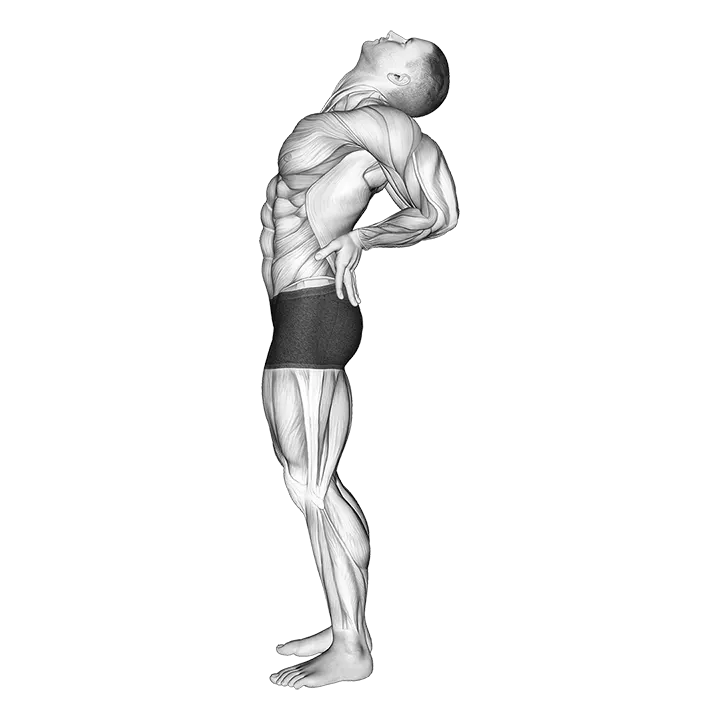
Static Position Standing
- Músculo objetivo
- —
- Equipamiento
- Body weight
- Tipo
- Stretching
Static Position Standing is a body-awareness exercise in which you hold a neutral, upright posture for a sustained period. It develops postural alignment, static balance, and calm, controlled breathing. The exercise is commonly used in rehabilitation, yoga, and as a reset position between more demanding movements.
Cómo hacer el Static Position Standing
- 1Stand on a flat surface with your feet hip-width apart and toes pointing forward.
- 2Distribute your weight evenly across both feet, pressing down through the heel, ball, and toes equally.
- 3Straighten your legs without locking the knees, keeping a very slight, soft bend.
- 4Lengthen your spine upward, stacking each vertebra naturally without forcing an arch or a rounding in the lower back.
- 5Draw your shoulders back and down, away from your ears, so the chest is open.
- 6Let your arms hang at your sides with palms facing the body and fingers relaxed.
- 7Align your head so the ears are directly over the shoulders, chin parallel to the floor, and gaze straight ahead.
- 8Breathe slowly and steadily through the nose, allowing the ribcage to expand with each inhale.
- 9Hold the position for the prescribed duration, then release and return to a relaxed standing posture.
Consejos de técnica
- Imagine a vertical line running from the crown of your head through your hips and down to the floor to cue upright alignment throughout the hold.
- Keep the jaw and facial muscles relaxed; tension in the face often signals unnecessary effort elsewhere in the body.
- Focus on slow nasal breathing rather than chest breathing to support a calm, stable posture.
- If balance is difficult, fix your gaze on a stationary point at eye level to reduce sway.
- Periodically scan your body from feet to head to notice and release any areas of unintended tension.
Errores comunes
- Locking the knees: Hyperextending the knee joint shifts load into the joint rather than the surrounding tissue and reduces proprioceptive feedback, increasing the risk of strain over time.
- Letting the shoulders creep upward: Elevated shoulders create tension in the neck and upper back that undermines the postural benefit of the exercise.
- Allowing the lower back to overarch: An exaggerated lumbar curve compresses the posterior spine and moves the pelvis out of a neutral position, defeating the alignment goal.
- Looking down at the floor: Dropping the chin shortens the back of the neck and shifts the head's center of gravity forward, placing undue load on the cervical spine.
- Holding the breath: Breath-holding increases internal pressure and tension; continuous, steady breathing is part of the exercise and should not be interrupted.
Preguntas frecuentes
What is the purpose of Static Position Standing?
The exercise trains the body to maintain neutral alignment without movement. Regular practice improves postural awareness, static balance, and the ability to breathe calmly under mild physical demand, making it useful in rehabilitation, yoga, and general fitness warm-up or cool-down routines.
How long should I hold the static standing position?
Beginners can start with 30 to 60 seconds and build toward two to three minutes as postural endurance improves. The focus should be on quality of alignment throughout the hold rather than simply increasing duration.
Can Static Position Standing help with back pain?
Practicing neutral spinal alignment in a low-demand context like static standing can reinforce the posture habits needed to reduce mechanical strain on the back. It is often included in rehabilitation programs, though anyone with existing back pain should consult a healthcare professional before beginning any exercise.
Is any equipment needed for this exercise?
No equipment is required. The exercise uses body weight only and needs nothing more than a flat, stable surface with enough space to stand upright.
How does Static Position Standing differ from simply standing?
Ordinary standing is usually unconscious and often involves habitual imbalances such as weight shifted to one leg, a forward head posture, or rounded shoulders. Static Position Standing is an intentional practice in which you actively align each segment of the body, hold it with awareness, and use controlled breathing, making it a deliberate training stimulus rather than a passive state.







