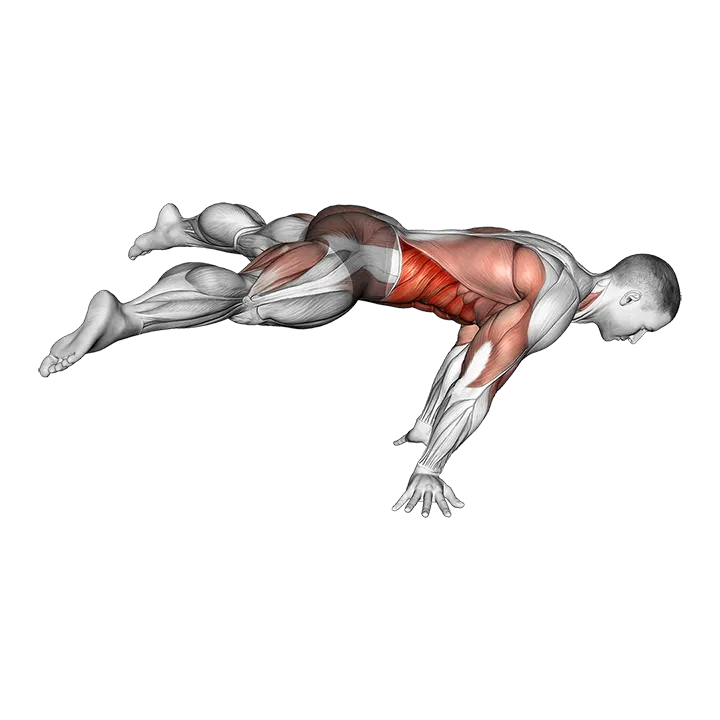
Straddle planche
- Músculo objetivo
- —
- Equipamiento
- Body weight
- Parte del cuerpo
- Waist
- Tipo
- Stretching
The straddle planche is an advanced bodyweight gymnastics skill in which you hold your body horizontal to the ground with legs spread wide, supporting yourself on your hands alone. It demands intense isometric engagement through the core and waist, combined with strong shoulder and wrist stability to maintain the horizontal position against gravity.
Cómo hacer el Straddle planche
- 1Place your hands flat on the floor, fingers pointing forward or slightly outward, at roughly shoulder width.
- 2Lean forward onto your hands, shifting your center of mass over your wrists while keeping your arms straight.
- 3Engage your core and tuck your hips under so your body forms a rigid line — do not let your hips sag.
- 4Spread your legs wide into a straddle position as you continue shifting your weight forward.
- 5Press firmly through your hands, protract your shoulder blades (push the floor away), and lift your feet off the ground simultaneously.
- 6Hold the horizontal position with your body parallel to the floor, legs straddled, arms locked, and core braced throughout.
- 7Lower back to the floor under control once you reach the end of your hold time.
Consejos de técnica
- Protract your scapulae (round and push your shoulders forward) to create the shelf of tension that keeps your torso from dropping.
- Point your toes and squeeze your legs outward in the straddle — active leg tension reduces the rotational demand on your core.
- Keep your gaze slightly forward rather than straight down; looking too far down causes the hips to drop.
- Build hold time in short, quality sets (3–10 seconds) rather than grinding through sloppy positions.
- Train wrist flexibility and wrist extension strength separately to handle the extreme loading angle.
Errores comunes
- Letting the hips drop below horizontal — this shifts load off the core and onto the lower back, increasing injury risk.
- Bending the elbows to compensate for insufficient lean — the arms must remain locked for a true planche; bent elbows disguise weakness and place asymmetric stress on the elbow joints.
- Insufficient scapular protraction — without pushing the floor away, the shoulders sink and the chest collapses, losing the rigid body position needed to stay airborne.
- Placing too much weight through the fingers rather than the base of the palm — this concentrates shear force on the finger tendons and can cause strain.
- Rushing progression before building the prerequisite shoulder and core strength, which leads to compensating with momentum rather than controlled isometric force.
Preguntas frecuentes
What muscles does the straddle planche work?
The straddle planche is a full-body isometric hold that places the highest demand on the core and waist musculature, which must resist gravity pulling the hips down. The shoulders, chest, and wrists work continuously to maintain the pushing position, while the hip flexors and inner thighs hold the straddle leg position.
How long should I be able to hold a straddle planche?
Even a clean 1–3 second hold demonstrates the skill. Most practitioners aim to build to a 5–10 second hold before calling the skill consistent. Sets are typically kept short to preserve form — grinding through a dropping position reinforces bad habits more than it builds strength.
What progressions lead up to the straddle planche?
Common progressions include the tuck planche (knees tucked to chest), advanced tuck planche (hips extended, back flat), and then the straddle planche before the full planche (legs together). Each step removes a bit of leverage assistance, steadily increasing the core and shoulder demand.
How often should I train the straddle planche?
Two to three sessions per week with at least one full rest day between sessions is a typical approach. Planche training is isometrically intensive and takes longer to recover from than most conventional strength work, so more frequency often leads to plateau or overuse injury rather than faster progress.
Do I need parallettes or can I do this on the floor?
Both surfaces work. The floor is the standard for planche training and requires no equipment. Parallettes raise your hands off the ground, which gives your legs slightly more clearance and can make the initial learning phase easier, but they are not required.







