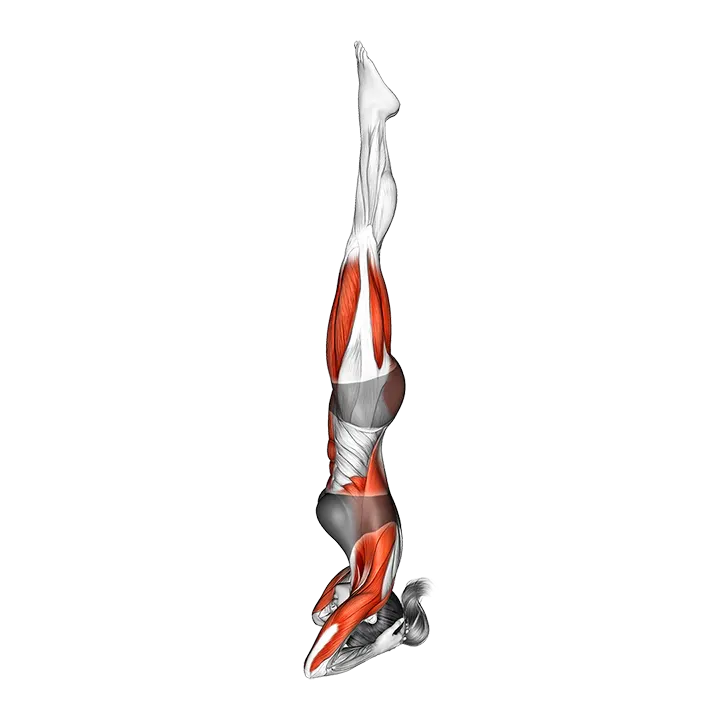
Supported Headstand Yoga Pose Sirsasana
- Músculo objetivo
- —
- Equipamiento
- Body weight
- Parte del cuerpo
- Stretching
- Tipo
- Stretching
The Supported Headstand Yoga Pose Sirsasana is a foundational yoga inversion in which you balance your body upside down on a base formed by your interlaced forearms and the crown of your head. The pose develops shoulder stability, core control, and body awareness while creating a gentle spinal decompression. Practicing against a wall is strongly recommended until you develop consistent balance and confidence in the position.
Cómo hacer el Supported Headstand Yoga Pose Sirsasana
- 1Kneel on a yoga mat and interlace your fingers firmly, placing your forearms on the mat shoulder-width apart to form a stable triangular base.
- 2Set the crown of your head (the very top, not the forehead or the back of the skull) on the mat inside your cupped hands, letting your palms cradle the back of your skull.
- 3Tuck your toes under and straighten your legs, walking your feet toward your face until your hips rise directly above your shoulders.
- 4Press your forearms firmly into the mat and actively lift the tops of your shoulders away from the floor, so the majority of your weight travels through your arms rather than your neck.
- 5Bend one knee and draw it toward your chest, then bring the other knee in to meet it, keeping both knees tucked and your core engaged.
- 6Slowly extend your legs upward toward the ceiling, pressing through your heels and keeping your body in one straight vertical line from wrists to feet.
- 7Breathe steadily and hold for 5–30 seconds, maintaining firm forearm pressure into the mat and an active engagement through your shoulders throughout.
- 8To come down, bend your knees back toward your chest, lower your feet to the mat with control, and rest in Child's Pose for several slow breaths before standing.
Consejos de técnica
- Bear most of your weight through your forearms and shoulders, not through your head and neck — the crown of the head makes light contact with the mat, but the arms do the real work.
- Practice with your mat about six inches from a wall so the wall can catch your heels if you lose balance; keep using it until you can hold the pose steadily for at least 30 seconds.
- Build the prerequisite strength through Dolphin Pose and forearm plank before attempting the full inversion — both exercises condition the shoulders and core in the same position.
- Keep your core actively drawn in and your lower ribs closed throughout the hold to prevent your lower back from arching, which shifts the load onto the spine rather than the musculature.
- Come down immediately if you feel any pain, pressure, or tingling in your neck or head — a correctly performed headstand should not compress the cervical spine.
Errores comunes
- Placing the head on the forehead or the back of the skull: contact anywhere other than the true crown misaligns the cervical spine and concentrates load on the neck, increasing the risk of injury.
- Letting the shoulders collapse toward the ears: dropping the shoulder girdle shifts all the weight onto the head and neck, removing the protective support the arms are meant to provide.
- Kicking or jumping into the position: swinging up with momentum sacrifices control, makes it easy to overshoot vertical, and can lead to a sudden uncontrolled fall.
- Holding the breath: breath retention creates full-body tension, reduces balance, and shortens the time you can safely sustain the inversion — keep the breath slow and even throughout.
- Skipping preparatory stages and attempting the pose without adequate shoulder or core strength, which leads to immediate collapse and puts the neck at risk of compression or strain.
Preguntas frecuentes
How long should I hold the Supported Headstand?
Beginners typically hold for 5–10 seconds and come down, gradually building toward 1–3 minutes over weeks or months of consistent practice. Always prioritize neck comfort and stability over duration — there is no benefit to staying up longer than you can do so with controlled form.
Is the Supported Headstand safe for everyone?
It is not appropriate for people with neck injuries, high blood pressure, glaucoma, detached retina, or certain other conditions. Consult a qualified yoga teacher and a healthcare provider before attempting the pose if any of those apply to you. Never attempt a headstand for the first time without an experienced teacher present.
Why do my forearms matter if it is called a headstand?
The name describes the point of contact, not the primary load bearer. In a well-executed Sirsasana the forearms and shoulder girdle carry the majority of your bodyweight. The head touching the mat provides a stable reference point, but pressing through your arms protects the cervical vertebrae and makes the pose sustainable.
What should I do if I lose balance and start to fall?
If you are near a wall, your heels will catch it. If you are away from the wall, tuck your chin and roll forward out of the pose like a somersault rather than stiffening and toppling sideways. Practicing controlled exits is a skill worth drilling on its own before spending time in the full inversion.
How do I know when I am ready to try a headstand without the wall?
A reliable sign is that you can hold the pose against the wall for 60 seconds with no weight on the wall — your heels just graze it for reassurance rather than leaning into it. At that point, set up in the center of the mat and practice tucking and extending with control.







