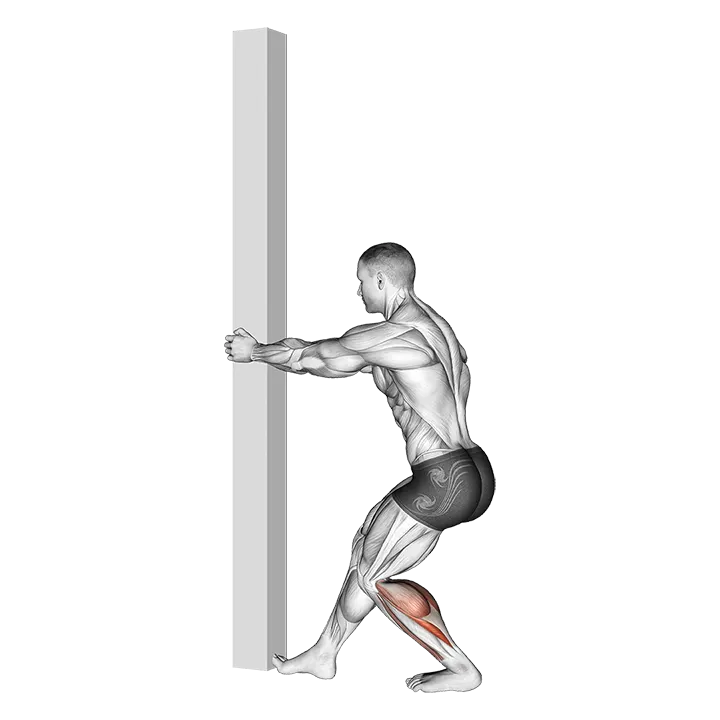
Tibial Stretch With Semi Flexed Knee
- Músculo objetivo
- —
- Equipamiento
- Body weight
- Parte del cuerpo
- Calves
- Tipo
- Stretching
The Tibial Stretch With Semi Flexed Knee is a bodyweight standing stretch that targets the tibialis anterior — the muscle running along the front of the shin — along with the surrounding soft tissue of the lower leg. Performed with the knee slightly bent and the top of the foot resting on the floor behind you, it effectively decompresses the anterior shin and is especially useful as a warm-up, cool-down, or recovery tool for runners and athletes.
Cómo hacer el Tibial Stretch With Semi Flexed Knee
- 1Stand upright near a wall or sturdy surface you can touch lightly for balance if needed.
- 2Shift your weight onto your left foot, keeping a soft, slight bend in the left knee.
- 3Step your right foot back and curl the toes under so the top of the right foot rests flat against the floor behind you.
- 4Allow the right knee to bend slightly — do not fully straighten or lock it — so the shin angle gently increases the stretch on the anterior lower leg.
- 5Press the top of the right foot into the floor while simultaneously pushing your right hip slightly forward to deepen the stretch along the front of the shin.
- 6Hold this position for 20–30 seconds, breathing steadily and relaxing into the stretch on each exhale.
- 7Release by lifting the foot off the floor, return to a neutral stance, and repeat on the opposite side.
Consejos de técnica
- Keep the standing knee soft — a rigid straight leg reduces stability and limits the hip-forward shift that deepens the stretch.
- Press the entire top surface of the foot into the floor evenly rather than letting it roll to one side, so the stretch stays centred on the tibialis anterior.
- Use a wall or chair back for light fingertip support rather than gripping hard; the goal is balance, not weight-bearing assistance.
- Progress depth gradually by pushing the hip of the stretching leg slightly forward — this lengthens the anterior compartment further without straining the ankle.
- Combine this stretch with calf stretches to address both the front and back of the lower leg for balanced ankle and shin mobility.
Errores comunes
- Fully locking the standing knee: a rigid standing leg reduces pelvic stability and makes it harder to shift the hip forward to load the stretch, limiting its effectiveness.
- Letting the foot roll outward: if the outer edge of the foot takes most of the pressure instead of the top, the stretch shifts away from the tibialis anterior and toward the lateral ankle structures, reducing the intended benefit.
- Rushing through the hold: holding for only 5–10 seconds is too brief to achieve lasting length in the anterior shin tissue; a minimum of 20 seconds per side is needed for a meaningful stretch response.
- Hyperextending the ankle: cranking the foot hard into extreme plantarflexion before the tissues are warm can stress the ankle joint and top-of-foot tendons, especially without a gradual warm-up.
- Neglecting the hip-forward shift: staying fully upright without nudging the hip forward keeps the stretch mild; many people miss the deeper portion of the stretch by not adding this subtle pelvic cue.
Preguntas frecuentes
When is the best time to perform the Tibial Stretch With Semi Flexed Knee?
This stretch works well both before and after activity. Before exercise, use it briefly (10–15 seconds per side) as part of a dynamic warm-up to improve ankle dorsiflexion and shin tissue readiness. After exercise, hold it longer (20–30 seconds per side) to aid recovery and reduce post-workout tightness in the anterior lower leg.
How long should I hold the Tibial Stretch With Semi Flexed Knee?
For general flexibility maintenance, hold each side for 20–30 seconds and perform 2–3 rounds. If you are targeting shin splint recovery or persistent anterior shin tightness, extending holds to 30–45 seconds and repeating 3 sets per side can be more effective. Always breathe steadily throughout — tension should feel moderate, never sharp or painful.
Can this stretch help with shin splints?
Yes, gentle stretching of the tibialis anterior can be a helpful component of shin splint management by relieving tension along the front of the lower leg. However, it should be performed pain-free — if pressing the foot into the floor causes sharp or worsening pain, stop and consult a healthcare professional before continuing. Stretching complements, but does not replace, load management and progressive return-to-activity protocols.
What muscles does the Tibial Stretch With Semi Flexed Knee actually target?
The primary target is the tibialis anterior, the muscle that runs along the outer front of the shin and controls dorsiflexion (pulling the foot upward). The stretch also reaches the extensor digitorum longus and extensor hallucis longus — the muscles along the top of the foot that extend the toes — and the anterior ankle capsule. Together these make up the anterior compartment of the lower leg.
Are there alternative stretches if I find this position uncomfortable?
Yes. A seated shin stretch performed by kneeling on a soft surface (hero pose / seiza position) stretches the same anterior compartment while eliminating single-leg balance demands. Alternatively, sitting on a chair and crossing the ankle over the opposite knee, then gently pressing the foot into plantarflexion with your hand, offers a supported version. These are useful if you have balance limitations or knee discomfort in the standing version.







