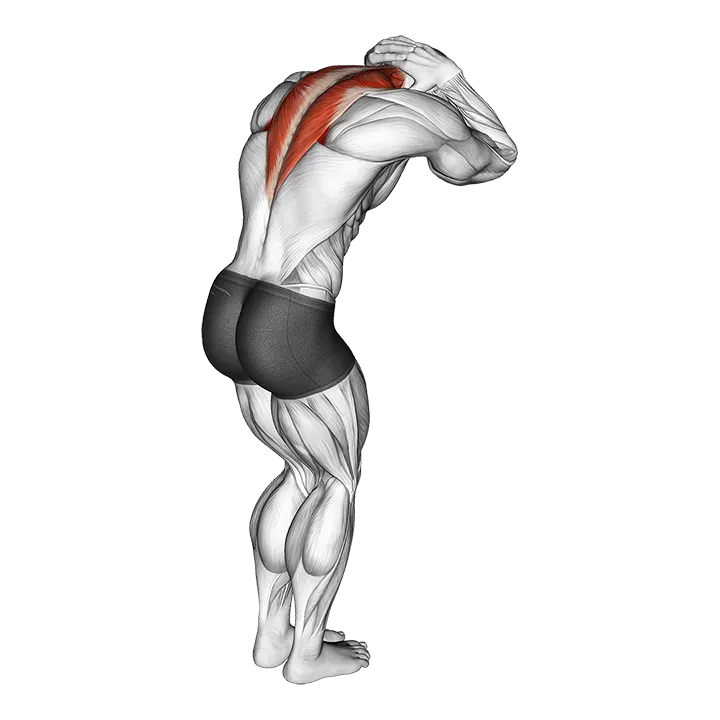
Trap and Neck Stretch
- Músculo objetivo
- —
- Equipamiento
- Body weight
- Parte del cuerpo
- Back
- Tipo
- Stretching
The Trap and Neck Stretch is a bodyweight mobility exercise that targets the upper trapezius, levator scapulae, and scalenes — the muscles most responsible for neck stiffness and upper-back tension. Performed seated or standing, it uses gentle lateral neck flexion and light hand pressure to lengthen these tissues. It is especially valuable for desk workers, overhead athletes, and anyone carrying chronic tension through the neck and shoulders.
Cómo hacer el Trap and Neck Stretch
- 1Sit tall in a chair or stand with your feet shoulder-width apart, spine neutral and shoulders relaxed away from your ears.
- 2Let your right arm hang at your side or rest your right hand behind your back to anchor the shoulder down.
- 3Slowly tilt your left ear toward your left shoulder, leading with the top of your head rather than jutting your chin forward.
- 4Once you feel a gentle pull along the right side of your neck and upper trap, stop and hold that position.
- 5Place your left hand lightly on the right side of your head — fingertips only — and allow the weight of your hand (not a pull) to deepen the stretch slightly.
- 6Hold for 20–30 seconds, breathing slowly and letting the muscles release with each exhale.
- 7To add a scalene bias, turn your nose slightly downward toward your left armpit and hold for an additional 10–15 seconds.
- 8Gently lift your head back to neutral, then repeat on the opposite side.
- 9Perform 2–3 holds per side, releasing all hand pressure before returning to neutral each time.
Consejos de técnica
- Keep the anchoring shoulder actively depressed — shrug it down and away from your ear before you begin tilting to maximize the length of the stretch.
- Use only the weight of your hand to add overpressure; actively pulling your head increases the risk of straining the cervical muscles rather than lengthening them.
- Breathe into the stretch: inhale to create space, then exhale and let your head drop a millimeter further as the muscles relax.
- Keep your chin slightly tucked throughout — avoid letting it poke forward, which compresses the posterior cervical joints instead of stretching the lateral muscles.
- If you feel tingling or numbness down your arm, release immediately; this signals nerve compression, not a productive stretch.
Errores comunes
- Pulling the head aggressively with the hand: forcing the range of motion activates the very muscles you are trying to lengthen and can strain the cervical ligaments.
- Letting the opposite shoulder rise: if the anchoring shoulder creeps up during the stretch, the upper trap shortens from the origin end and the effective stretch length is lost.
- Rotating the head instead of tilting it: lateral rotation changes the target from the upper trapezius and levator scapulae to the sternocleidomastoid, so the intended muscles are not adequately stretched.
- Holding the breath: breath-holding increases muscular tension throughout the body and prevents the neuromuscular relaxation needed for the stretch to be effective.
- Rushing through the hold: spending fewer than 20 seconds per side rarely produces lasting length changes — connective tissue requires sustained, low-load tension to remodel.
Preguntas frecuentes
How often should I do the Trap and Neck Stretch?
For general tension relief, 2–3 times daily works well — once in the morning, once mid-day if you sit for long periods, and once in the evening. For post-workout recovery or acute tightness, performing it immediately after training while tissues are warm can accelerate relief. Avoid stretching into pain; mild discomfort is normal but sharp or radiating sensations are not.
What muscles does the Trap and Neck Stretch actually target?
The primary muscles lengthened are the upper trapezius and levator scapulae, which run from the cervical vertebrae and skull down to the shoulder blade. Adding a slight downward chin rotation biases the scalenes, which attach to the first two ribs and are a common source of tension in people who breathe shallowly or carry stress in the chest and neck.
Can I do this stretch if I have a neck injury or cervical disc issue?
Consult a physical therapist or physician before attempting any cervical stretching if you have a diagnosed disc herniation, cervical stenosis, or recent neck injury. While gentle lateral neck flexion is generally low-risk, individual anatomy and pathology vary significantly, and a clinician can determine whether this stretch is appropriate and how much range of motion is safe for your situation.
Why does my neck feel tight again shortly after stretching?
Short-lived relief is common when the underlying cause — sustained posture, forward head position, or muscle imbalance — remains unchanged. Pair this stretch with strengthening exercises for the deep cervical flexors and mid-trapezius (e.g., chin tucks, band pull-aparts) to address the root cause. Also assess your workstation setup, as a monitor placed too low or too far is a frequent driver of recurring upper-trap tightness.
Is the Trap and Neck Stretch safe during pregnancy?
Gentle lateral neck stretching is generally considered safe during pregnancy, but avoid lying flat on your back after the first trimester when performing any complementary exercises. Perform this stretch seated and avoid deep overpressure, as ligament laxity caused by relaxin can make joints more susceptible to overstretching during pregnancy. Discuss any new exercise routine with your healthcare provider.







