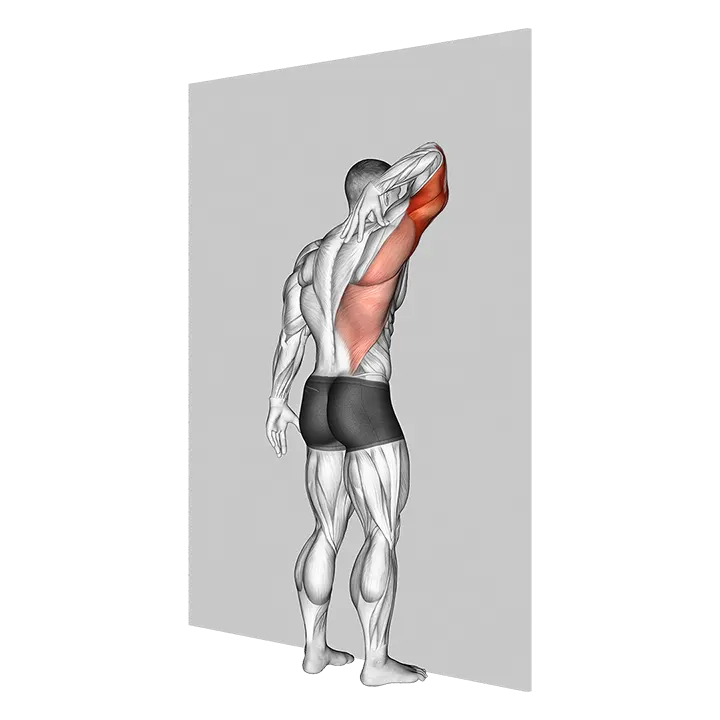
Triceps Stretch Against Wall
- Músculo objetivo
- —
- Equipamiento
- Body weight
- Parte del cuerpo
- Upper Arms
- Tipo
- Stretching
The Triceps Stretch Against Wall is a static flexibility drill that targets the triceps and the soft tissue along the back of the upper arm. By pressing the elbow against a wall and gently rotating away, you create a controlled lengthening of the triceps without requiring any equipment. It fits well into a post-workout cool-down or as a brief mobility break between upper-body sets.
Cómo hacer el Triceps Stretch Against Wall
- 1Stand facing a wall at roughly arm's length away.
- 2Raise one arm overhead and bend the elbow so your forearm drops behind your head, palm facing inward.
- 3Place the back of the bent elbow against the wall at approximately shoulder height or slightly above.
- 4Slowly rotate your upper body away from the wall, keeping the elbow pressed against it, until you feel a stretch along the back of the upper arm.
- 5Keep your core lightly braced and your shoulders level throughout the movement.
- 6Breathe steadily and hold the stretched position for 20 to 30 seconds.
- 7Gently rotate back toward the wall to release the stretch.
- 8Lower your arm and repeat on the opposite side.
Consejos de técnica
- Keep the pressing elbow at or slightly above shoulder height so the stretch reaches the full length of the triceps.
- Rotate your torso gradually — a small rotation often produces a strong stretch, so avoid forcing the range.
- Maintain a neutral neck; do not let your head drop forward or pull to one side.
- Breathe slowly and continuously throughout the hold to help the muscle relax into the stretch.
- Use a doorframe if a flat wall makes elbow placement awkward — the edge gives a more defined contact point.
Errores comunes
- Placing the elbow too low on the wall: positioning the elbow below shoulder height shifts tension away from the triceps and reduces the effectiveness of the stretch.
- Shrugging the shoulder of the working arm: elevating the shoulder closes the shoulder joint and limits how deeply the triceps can lengthen.
- Rotating too quickly or forcefully: jerking the torso away from the wall creates a ballistic pull that can strain the elbow or shoulder rather than producing a safe static stretch.
- Holding the breath: breath-holding increases muscular tension and works against the relaxation needed to deepen a static stretch.
- Letting the lower back arch excessively: overarching to compensate for limited shoulder mobility loads the lumbar spine unnecessarily; engage the core to keep the trunk stable.
Preguntas frecuentes
How long should I hold the Triceps Stretch Against Wall?
Hold each side for 20 to 30 seconds, which is the standard duration for a static stretch to begin producing meaningful changes in muscle extensibility. Repeat one to three times per side depending on your goals and available time.
When is the best time to do this stretch?
It is most beneficial as part of a post-workout cool-down after upper-body training, when the muscles are warm and pliable. It can also be used between sets as an active recovery drill or during a standalone mobility session.
Can this stretch help with elbow pain?
Tight triceps can contribute to tension around the elbow joint, and regular stretching may help relieve that tension. However, if you have existing elbow pain or injury, consult a healthcare professional before using this or any stretch to address it.
What is the difference between this stretch and an overhead triceps stretch done without a wall?
Using the wall provides a fixed anchor for the elbow, which allows you to use gentle body rotation to control the stretch intensity rather than relying on your other hand to pull the elbow. This can make the stretch easier to modulate and reduces stress on the shoulder of the assisting arm.
Do I need any equipment to perform this stretch?
No equipment is needed beyond a flat wall or sturdy doorframe. The stretch relies entirely on body weight and body rotation to create tension in the triceps.







