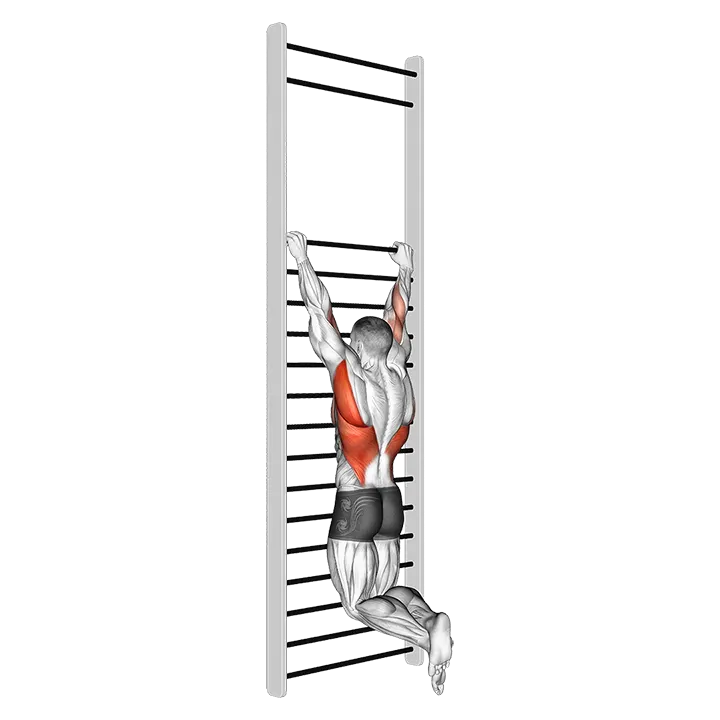
Two Handed Hang Back Stretch (with Training Wall Bars)
- Músculo objetivo
- —
- Equipamiento
- Body weight
- Parte del cuerpo
- Back
- Tipo
- Stretching
The two-handed hang back stretch is a bodyweight decompression exercise performed on wall bars that targets the entire back, including the lats and thoracic spine. By gripping a bar above head height and letting gravity elongate the spine, it relieves compression between vertebrae and improves spinal mobility. It is especially effective as a cool-down or recovery tool after heavy loading exercises.
Cómo hacer el Two Handed Hang Back Stretch (with Training Wall Bars)
- 1Stand facing the wall bars and select a bar at a height that allows you to grip it comfortably with both arms fully extended overhead.
- 2Grip the chosen bar with both hands using an overhand grip, hands shoulder-width apart.
- 3Step your feet slightly forward so your body is angled slightly away from the wall bars, with your weight partly suspended through your arms.
- 4Bend your knees slightly and allow your hips to sink downward, letting your body weight decompress the spine.
- 5Relax your shoulders away from your ears and let your upper back round naturally, feeling a stretch through the lats and mid-back.
- 6Breathe slowly and deeply, allowing the back muscles to release further with each exhale.
- 7Hold the stretched position for 20–40 seconds, maintaining a controlled, passive hang.
- 8To finish, engage your core, straighten your legs, and step back toward the wall to relieve the load before releasing the bar.
Consejos de técnica
- Choose a bar height where your feet still maintain light contact with the floor — this lets you control how much of your body weight is loaded through your hands and back.
- Focus on relaxing the entire back rather than actively pulling; the goal is passive elongation, not a strength move.
- Keep your breathing steady and diaphragmatic throughout the hold — exhaling deeply helps the spinal muscles release further into the stretch.
- If you feel any sharp or radiating pain, step closer to the bars immediately to reduce the load and consult a health professional before continuing.
- Progress gradually: start with shorter holds of 15–20 seconds and increase duration as your grip strength and back mobility improve.
Errores comunes
- Shrugging the shoulders up toward the ears — this prevents the thoracic spine and lats from fully decompressing; consciously let the shoulders hang heavy.
- Holding the breath — breath-holding creates tension in the back muscles and reduces the effectiveness of the stretch; breathe slowly throughout.
- Choosing a bar that is too high so feet leave the floor completely — without foot contact you lose the ability to control load, increasing strain on the shoulder joints.
- Rushing the hold — spending fewer than 15 seconds in the position does not give the connective tissue enough time to respond; aim for at least 20–30 seconds per set.
- Releasing the bar abruptly — dropping away from the bar without re-engaging the core first can cause a sudden jolt to the lumbar spine; always step in slowly before letting go.
Preguntas frecuentes
What muscles does the two-handed hang back stretch target?
The stretch primarily decompresses and lengthens the latissimus dorsi, thoracic erectors, and the muscles surrounding the thoracic and lumbar spine. It also provides a mild stretch to the shoulder girdle and the muscles between the shoulder blades.
How long should I hold the two-handed hang back stretch?
Aim for 20–40 seconds per hold and perform 2–3 sets. Beginners can start with shorter 15-second holds and build duration as comfort and grip strength improve.
Is this stretch safe for people with lower back pain?
Many people find spinal decompression stretches helpful for relieving mild back tightness, but anyone with a diagnosed disc injury, nerve impingement, or acute back pain should consult a physiotherapist before attempting this exercise.
When is the best time to do this stretch in a workout?
It works best at the end of a session as a cool-down after compound back or pulling exercises, or on active recovery days. Avoid performing it as a warm-up before heavy lifts, as the passive elongation can temporarily reduce spinal stiffness needed for stability.
Can I do this stretch if I don't have wall bars?
A pull-up bar or any fixed horizontal bar at the right height can substitute for wall bars. The key difference is that wall bars allow you to keep your feet on the rungs to control the load, so adjust the amount of body weight you let hang accordingly when using a free-standing bar.







