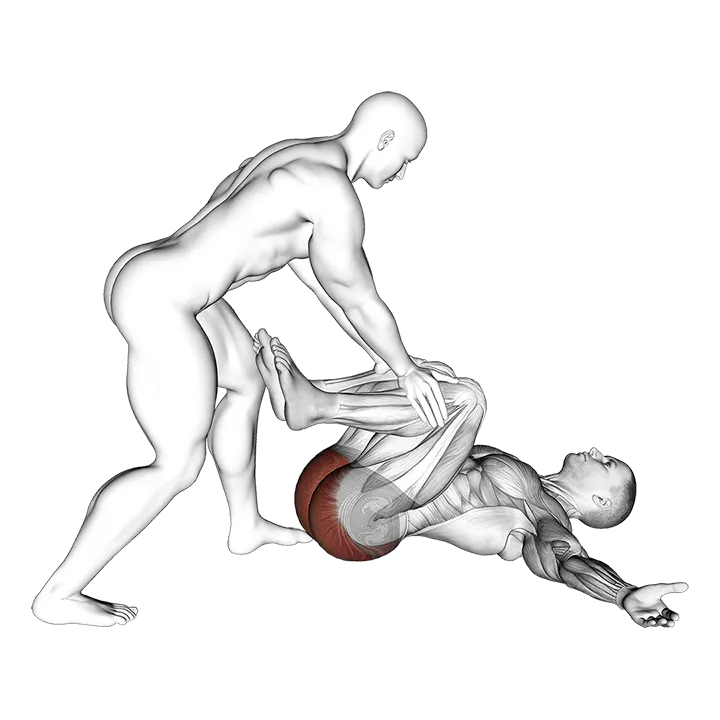
Assisted Lying Hip Stretch In Supine Position
- Target muscle
- —
- Equipment
- Body weight
- Body part
- Hips
- Type
- Stretching
The assisted lying hip stretch in supine position is a body-weight flexibility drill for the hips, where the stretch is felt deep in the hip and glute region. Lying on your back, you draw one bent knee across and toward your chest — with help from a partner or your own hands — to open up the hip further than you could relax into on your own. It is a good way to ease tight hips and improve hip mobility after training or long periods of sitting.
How to do the Assisted Lying Hip Stretch In Supine Position
- 1Lie flat on your back on the floor or a mat with both legs extended and your head and shoulders relaxed.
- 2Keep the leg you are not stretching flat on the floor with the knee straight and the foot relaxed.
- 3Bend the working leg and draw the knee up toward your chest, taking hold of the shin or behind the thigh with your hands.
- 4Guide the bent knee gently up and across toward the opposite shoulder until you feel a stretch deep in the hip and glute.
- 5If a partner is assisting, let them apply slow, light pressure on the knee while you stay relaxed.
- 6Keep your hips, lower back, and shoulders flat against the floor as the knee is drawn in.
- 7Hold the position and breathe slowly, letting the hip relax into the stretch without forcing it.
- 8Release the leg slowly under control, then switch sides and repeat with the other leg.
Form tips
- Pull the knee only to the point of a mild, comfortable stretch — never into sharp pain in the hip or knee.
- Keep your lower back and tailbone pressed gently into the floor so the movement opens the hip instead of rounding the spine.
- Breathe out as you draw the knee in and stay relaxed; tension in the hip limits how far it will release.
- Increase the range gradually over several breaths rather than yanking the knee into a deep stretch right away.
- If a partner assists, communicate clearly so they apply only slow, gentle pressure.
Common mistakes
- Pulling the knee in too hard or too fast, which can strain the hip instead of stretching it.
- Lifting the hips or rounding the lower back off the floor, which cheats the stretch and stresses the spine.
- Letting the resting leg bend or rise off the floor, which lets the pelvis tilt and softens the stretch.
- Holding your breath and tensing up, which makes the hip resist releasing into the stretch.
- Cranking on the knee joint instead of guiding from the thigh, which loads the knee rather than opening the hip.
Frequently asked questions
What does the assisted lying hip stretch in supine position work?
It stretches the hip region, opening up the hips and glutes. Drawing the bent knee up and across your body is what places the lengthening tension deep in the hip.
Where should I feel this stretch?
You should feel it deep in the hip and glute of the working leg as a gentle pull. You should not feel sharp pain in the knee or lower back.
How long should I hold the stretch?
Hold it for about 20–30 seconds per side and repeat two or three times on each leg. Ease a little deeper with each round as the hip relaxes.
Is this hip stretch good for beginners?
Yes. It uses only your body weight and you control the depth, so it is a safe way for beginners with tight hips to stretch gently, with or without a partner.
Can I do this stretch without a partner?
Yes. You can guide the bent knee up and across with your own hands for a controlled stretch; a partner simply lets you stay relaxed while they apply the light pressure.







