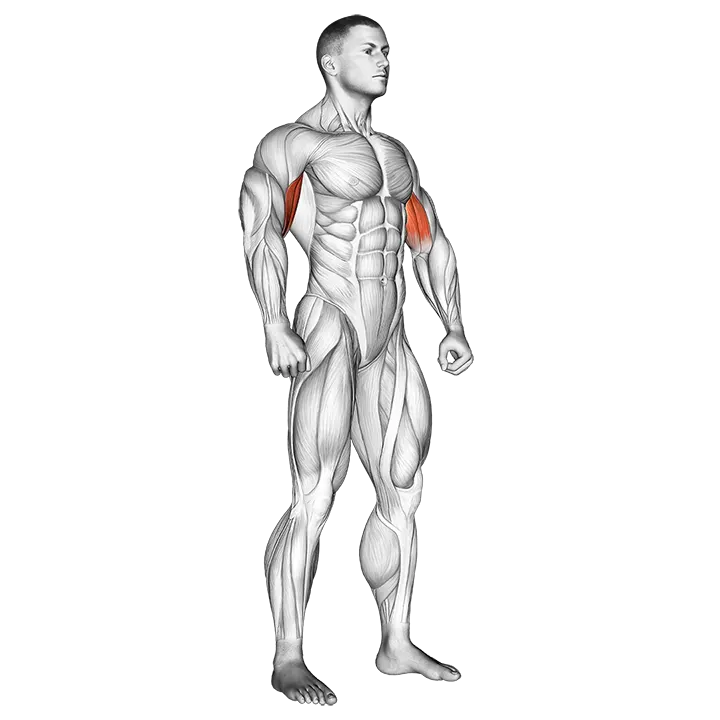
Body muscle. Side front view
- Target muscle
- —
- Equipment
- Body weight
- Body part
- Full body
Body muscle. Side front view is a full-body anatomy reference rather than a single movement — a side-front perspective on the major muscle groups you train with bodyweight work. Use it to learn where the muscles you work sit across the front and side of the body, so you can picture which areas a given exercise targets and train the whole body with no equipment.
How to do the Body muscle. Side front view
- 1Study the side-front view to orient yourself: the front of the torso, the side of the trunk, and the limbs are all visible from this angle.
- 2Identify the front-of-body groups — the chest, the front of the shoulders, the abdominals down the midline, and the fronts of the thighs.
- 3Trace the side groups — the side of the shoulders, the obliques along the waist, and the outer hips and thighs.
- 4Note how these groups connect, since most bodyweight movements load several of them at once rather than one in isolation.
- 5Pick a bodyweight exercise and map it onto the view — locate which front or side muscles it should work.
- 6Set up with a braced, neutral spine and stack your joints so load travels through the working muscles you identified.
- 7Move through a controlled range of motion, feeling tension in those target areas rather than swinging or using momentum.
- 8Use this reference between sets to check your mind-muscle connection, then return to it as you add new bodyweight movements.
Form tips
- Treat this as a learning aid: match each bodyweight exercise to the front or side muscles it should load before you start training.
- Brace your core and keep a neutral spine on every full-body movement so force transfers cleanly through the working muscles.
- Progress bodyweight work by adding reps, slowing the tempo, or increasing range of motion rather than chasing speed.
- Train both the front and the side of the body over a week so no group from this view is neglected.
- Warm up the joints and work within a pain-free range, since bodyweight training still loads muscles and connective tissue.
Common mistakes
- Treating this as a specific exercise — it is an anatomy reference, so there is no rep to perform, only muscles to learn.
- Focusing only on the front-of-body muscles you can see in a mirror and neglecting the side groups, which leaves the obliques and outer hips underdeveloped.
- Losing the brace and letting the spine round during full-body movements, which shifts load off the target muscles and onto the back.
- Using momentum instead of muscular tension on bodyweight reps, which reduces the work each muscle does and raises injury risk.
- Assuming bodyweight means low effort and skipping a warm-up, which leaves muscles and joints unprepared for load.
Frequently asked questions
What does the body muscle side front view show?
It is a full-body anatomy reference from a side-front angle, showing the major muscle groups across the front and side of the body — chest, shoulders, abdominals, obliques, and the fronts and outer thighs — so you can see where the muscles you train sit.
Is this a specific exercise?
No. It is a reference view of full-body anatomy, not a movement with sets and reps. Use it to learn muscle locations and match them to the bodyweight exercises you actually perform.
What equipment do I need?
None — this is a bodyweight reference. It is meant to support full-body training you can do with no equipment, using your own body as the resistance.
How do I use this view in my training?
Before a bodyweight exercise, find the front or side muscles it should work on the view, then focus on feeling tension there as you move. Reviewing it helps build the mind-muscle connection across the whole body.







