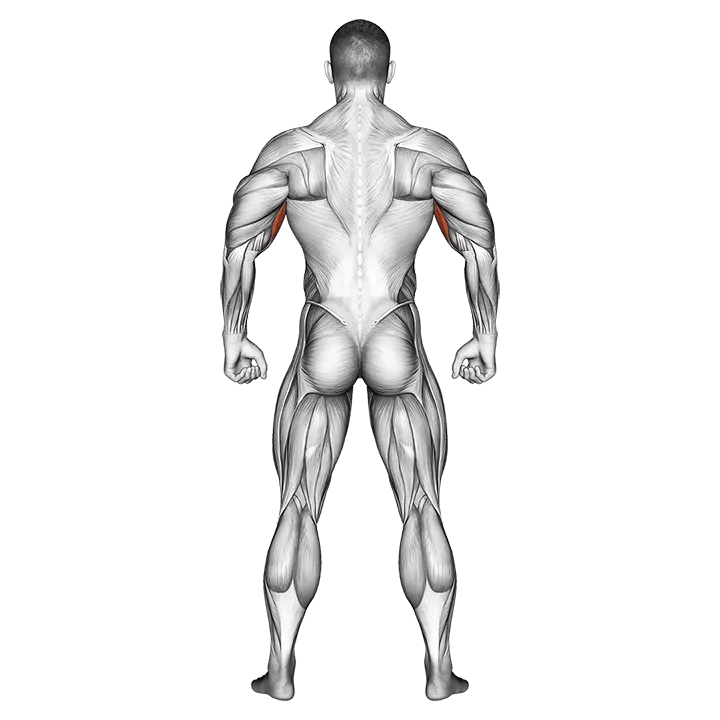
Body muscles. Back view
- Target muscle
- —
- Equipment
- Body weight
- Body part
- Full body
Body muscles, back view is an anatomy-reference entry rather than a single movement — a labeled map of the major muscles you see from behind, including the trapezius, latissimus dorsi, erector spinae, glutes, hamstrings, and calves. Use it to learn where each posterior muscle sits and to plan balanced, full-body training that doesn't neglect the back of the body.
How to do the Body muscles. Back view
- 1Start at the top of the back view and locate the trapezius, the broad diamond running from the base of your skull across the upper back to the mid-spine.
- 2Move outward to the deltoids on the back of the shoulders and the rotator-cuff region beneath them that stabilizes the shoulder joint.
- 3Trace the latissimus dorsi, the large wing-shaped muscles sweeping from the mid-back down to the waist, that drive pulling and rowing patterns.
- 4Follow the erector spinae running vertically alongside the spine — the column that extends the back and keeps your posture upright.
- 5Drop to the glutes (gluteus maximus, medius, and minimus), the powerhouse of hip extension that you train with bridges, squats, and deadlifts.
- 6Identify the hamstrings down the back of each thigh, responsible for bending the knee and assisting hip extension.
- 7Finish at the calves (gastrocnemius and soleus) at the back of the lower leg, which raise the heel and push you off the ground.
- 8Use the full map to check your program covers every posterior region, then pick exercises that load each one across the week.
Form tips
- Read this diagram as a planning tool: most people over-train the muscles they can see in the mirror, so use the back view to make sure your posterior chain gets equal attention.
- Group the muscles into pulls (traps, lats, rear delts), spine (erector spinae), and lower body (glutes, hamstrings, calves) when you build a weekly split.
- Learn the general location of each muscle, not just its name — feeling where a muscle should work makes the mind-muscle connection during real lifts much easier.
- Pair this with the front-view map so you train opposing muscle groups in balance and avoid posture-related imbalances.
Common mistakes
- Treating a reference diagram as a workout — this is a labeled anatomy map, not a movement, so it builds knowledge rather than strength on its own.
- Neglecting the posterior chain because it's out of sight, which leads to rounded posture, weak hip extension, and a higher injury risk.
- Assuming the back is one muscle — the upper traps, lats, and erector spinae have different jobs and need different exercises to develop fully.
- Confusing muscle names with their function, so training ends up unbalanced; knowing where each muscle sits helps you choose the right movement for it.
Frequently asked questions
What muscles are shown in the body back view?
The major posterior muscles: the trapezius and rear deltoids in the upper back and shoulders, the latissimus dorsi across the mid-back, the erector spinae along the spine, and the glutes, hamstrings, and calves down the back of the lower body.
Is this a workout or a reference diagram?
It's a reference diagram. It labels the muscles visible from behind so you can learn their location and plan training; it isn't a single exercise you perform.
Why is training the back of the body important?
The posterior chain — back, glutes, hamstrings, and calves — drives posture, hip extension, and pulling strength. Because these muscles are hidden from view, they're easy to under-train, which can cause imbalances and back pain.
How do I use this map to plan my training?
Check that your weekly program includes a movement for each region shown: a vertical pull and a row for the upper back and lats, a hinge for the erector spinae and hamstrings, hip work for the glutes, and calf raises for the lower leg.







