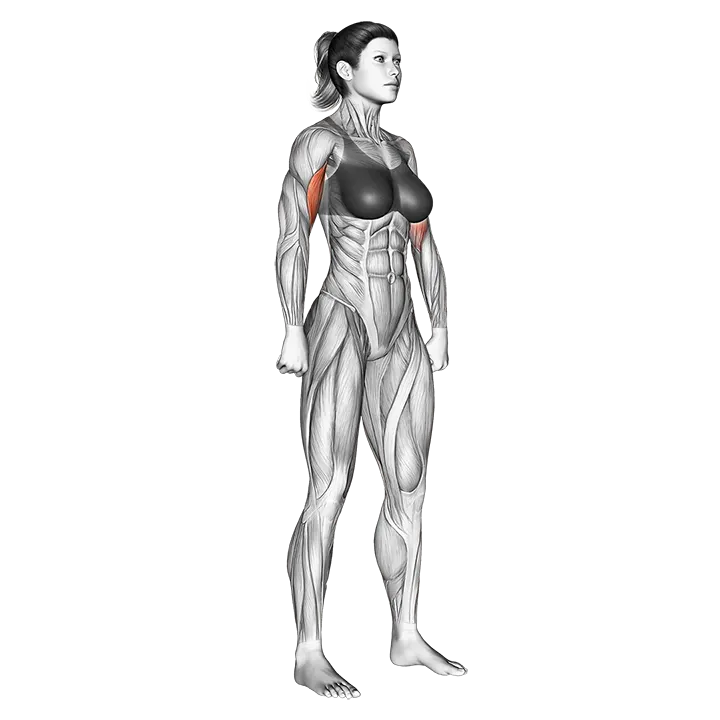
Body muscles. Female. Side view
- Target muscle
- —
- Equipment
- Body weight
- Body part
- Full body
This is an anatomical reference illustration showing the major muscle groups of the female body from a side (lateral) view, not an exercise. It lays out how the neck, shoulders, chest, back, core, hips, and legs stack up along the body's profile, helping you learn the muscular system and build a clearer mind-muscle connection for your training.
How to do the Body muscles. Female. Side view
- 1Start at the top and identify the neck and upper traps, the muscles running from the base of the skull down to the shoulder line.
- 2Move to the shoulder and identify the deltoid, the rounded muscle capping the joint; from the side you can see its front, side, and rear portions.
- 3Identify the chest (pectoralis major) on the front of the rib cage and the latissimus dorsi sweeping down the back, the two large muscles that frame the torso in profile.
- 4Identify the core along the midsection: the rectus abdominis at the front and the obliques on the side wall of the trunk.
- 5Identify the glutes (gluteus maximus and medius), the muscles forming the curve of the hip and seat.
- 6Identify the quadriceps on the front of the thigh and the hamstrings on the back of the thigh.
- 7Identify the calves (gastrocnemius and soleus) on the back of the lower leg.
- 8Trace the whole profile from head to heel to see how each group connects into the next along the side of the body.
Form tips
- Use the side view to see depth relationships a front view hides, such as how the lats wrap behind the chest and how the hamstrings sit behind the quads.
- Knowing where a muscle sits and which way its fibers run improves your mind-muscle connection, so you can focus tension on the intended group during a movement.
- Compare this lateral reference with front and back views to build a full three-dimensional map of the muscular system rather than a flat picture.
- Use correct muscle names (deltoid, latissimus dorsi, gluteus maximus) when planning training so you can target areas precisely and read coaching cues accurately.
Common mistakes
- Treating this diagram as an exercise to perform, when it is only a labeled anatomical reference for learning the female muscular system.
- Assuming a side view shows a different set of muscles for women than for men; the muscle groups are the same, and this is simply a female figure in profile.
- Confusing the lats and the obliques because they sit close together on the side of the torso, when the lats are a back muscle and the obliques are part of the core.
- Believing muscles can be 'toned' into a new shape; you can grow or lean out a muscle, but its underlying anatomy and fiber direction stay fixed.
Frequently asked questions
Is this an exercise or just a muscle diagram?
It is an anatomical reference illustration, not an exercise. It shows the major muscle groups of the female body from the side so you can learn and locate them; there is no movement to perform.
Which muscles are visible from a side view of the body?
From the side you can see the neck and traps, the deltoid, the chest and latissimus dorsi framing the torso, the abdominals and obliques, the glutes, the quadriceps and hamstrings, and the calves.
Are female and male muscles different in this side view?
The muscle groups themselves are the same in both. This figure is simply drawn as a female body in profile; the names, locations, and functions of the muscles do not differ by sex.
Why is knowing muscle anatomy useful for training?
Understanding where each muscle sits and how its fibers run helps you target the right area, improve your mind-muscle connection, and follow coaching cues, which makes your training more precise and effective.







