
Dead Bug with Stability Ball
- Target muscle
- —
- Equipment
- Stability ball
- Body part
- Waist
- Type
- Strength
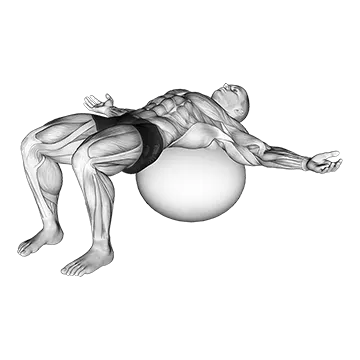

The dead bug with stability ball is a core-stability exercise that targets the deep abdominals and rectus abdominis while training the waist to resist extension. You lie on your back and press a stability ball between an opposite hand and knee, so bracing against the ball keeps your trunk rigid as your free arm and leg reach out. It builds anti-extension control and a stronger, more stable midsection.
How to do the Dead Bug with Stability Ball
- 1Lie on your back with your arms extended toward the ceiling and your hips and knees bent to 90 degrees, shins parallel to the floor.
- 2Place the stability ball between your hands and knees, pressing your right hand and left knee (or both hands and knees) into it to hold it in place.
- 3Flatten your lower back into the floor by drawing your ribs down and bracing your abdominals.
- 4Keeping the ball pinned, slowly extend your free arm overhead and your opposite leg straight out until both hover just above the floor.
- 5Pause briefly, keeping your lower back glued to the floor and the ball held firmly.
- 6Return the extended arm and leg to the start under control without losing tension on the ball.
- 7Repeat on the other side, then alternate for the prescribed reps.
Form tips
- Move slowly and with control — the goal is core stability, not speed or momentum.
- Keep your lower back pressed flat into the floor for the entire set; that contact is the cue you are bracing correctly.
- Exhale as you extend the arm and leg to help your abs lock the rib cage down.
- Maintain steady pressure on the ball so your trunk stays braced and the ball never rolls away.
Common mistakes
- Letting the lower back arch and lift off the floor, which removes tension from the deep core and strains the spine.
- Rushing the reps with momentum instead of controlled movement, so the core stops doing the stabilizing work.
- Holding your breath and bracing only with your diaphragm, which reduces the abdominal tension that protects your back.
- Extending the leg too low too soon, which makes the lower back pop up before you have the strength to hold it down.
Frequently asked questions
What muscles does the dead bug with stability ball work?
It mainly works the deep core and rectus abdominis in the waist, training them to resist extension. Pressing the stability ball between hand and knee adds extra bracing demand on the abs.
Why use a stability ball for the dead bug?
Pinning a stability ball between an opposite hand and knee forces you to keep constant abdominal tension. That added bracing makes the core work harder than the bodyweight dead bug.
Is the dead bug with stability ball good for beginners?
Yes. It is low-impact and easy to scale — keep the extended leg higher or take a shorter range until you can hold your lower back flat through the full movement.
How many sets and reps should I do?
Aim for 2–3 sets of 8–12 slow, controlled reps per side. Stop a set once you can no longer keep your lower back pressed into the floor.