
Back Extension on Exercise Ball
- Target muscle
- Erector Spinae
- Equipment
- Stability ball
- Body part
- Back
- Type
- Strength
The back extension on an exercise ball is a bodyweight strength exercise that targets the erector spinae, the muscles running along your spine that straighten and stabilize your lower back. Draping your torso over a stability ball, you extend up against gravity, making it an accessible way to build lower-back strength and endurance without any loaded equipment.
How to do the Back Extension on Exercise Ball
- 1Kneel behind a stability ball and drape your torso over it so the ball sits under your hips and lower stomach.
- 2Walk your feet back and brace them wide against the floor or a wall for a stable base.
- 3Let your upper body curl down over the ball and place your hands lightly behind your head or crossed over your chest.
- 4Brace your core and squeeze your glutes, then extend your spine to lift your chest and shoulders up until your body forms a straight line from head to heels.
- 5Pause briefly at the top with your back straight, avoiding any overarching beyond a neutral line.
- 6Lower your torso back over the ball under control, keeping the movement smooth.
- 7Complete your reps, then carefully step off the ball and stand up.
Form tips
- Move slowly and under control in both directions so the erector spinae does the work instead of momentum.
- Keep your neck in line with your spine by looking down at the floor rather than craning your head up.
- Set your feet wider apart to make balancing on the ball easier, especially as a beginner.
- Exhale as you extend up and inhale as you lower to keep your core braced throughout.
Common mistakes
- Hyperextending at the top and arching the lower back past neutral, which compresses the spine and risks lower-back strain.
- Using momentum to bounce off the ball, which removes tension from the erector spinae and reduces the benefit.
- Placing the ball too high under the chest, which limits your range of motion and makes the lift unstable.
- Yanking on the head with the hands, straining the neck instead of letting the back muscles do the work.
Frequently asked questions
What muscles does the back extension on an exercise ball work?
It primarily targets the erector spinae, the muscles running along your spine that extend and stabilize your lower back. The glutes and hamstrings help stabilize the position.
Is the back extension on an exercise ball good for beginners?
Yes. It is a bodyweight movement with no loaded equipment, and the ball supports your torso, making it a gentle way to start building lower-back strength. Set your feet wide for extra stability.
How many sets and reps should I do?
For most people, 2–3 sets of 10–15 controlled reps works well. Since the lower back responds to endurance work, prioritize clean form over speed or heavy volume.
Should I feel this in my lower back?
Yes — you should feel the erector spinae along your spine working as you extend up. Avoid sharp pain or pinching; if you feel that, you are likely overarching at the top.
Related exercises
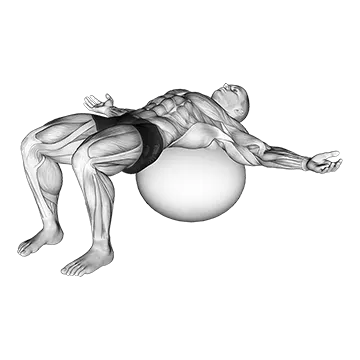 Back RelaxationBack
 Exercise Ball Back Extension With Arms ExtendedBack
 Exercise Ball Back Extension With Hands Behind HeadBack
 Exercise Ball Back Extension With Knees Off GroundBack
 Exercise Ball Back Extension With RotationBack
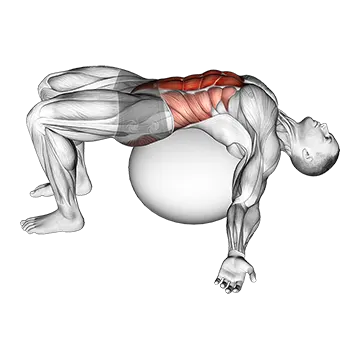 Exercise Ball Back StretchBack
 Exercise Ball HugBack
 45 degrees Back ExtensionHips