
Exercise Ball Back Extension With Arms Extended
- Target muscle
- Erector Spinae
- Synergist muscles
- Gluteus Maximus
- Equipment
- Stability ball
- Body part
- Back
- Type
- Strength

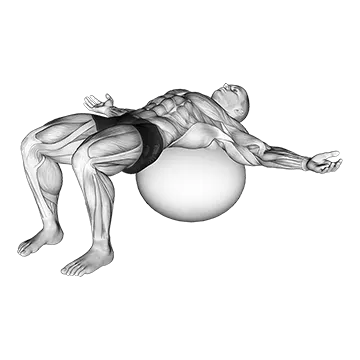



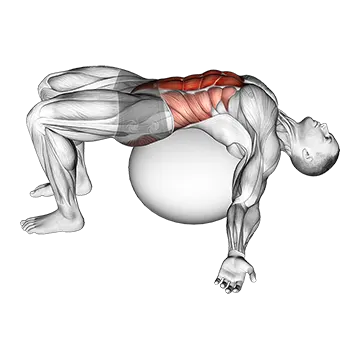

The exercise ball back extension with arms extended is a bodyweight movement that strengthens the lower back, primarily targeting the erector spinae along the spine, with the glutes (gluteus maximus) assisting as you extend. Performed face-down over a stability ball with your arms reaching overhead, it builds spinal endurance and posterior-chain control without loading the spine.
How to do the Exercise Ball Back Extension With Arms Extended
- 1Kneel behind a stability ball and lean forward so your hips and lower abdomen rest on top of it, with your torso draped over the front of the ball.
- 2Walk your feet back and brace your toes against the floor, spreading them to about shoulder-width for a stable base.
- 3Extend your arms straight out overhead so your body forms a long line from your hands to your heels.
- 4Let your torso curve gently over the ball into the starting position, keeping your neck in line with your spine.
- 5Brace your core and squeeze your glutes, then extend your back to lift your chest and arms upward until your body is straight.
- 6Pause briefly at the top without arching past a straight line, feeling the contraction in your lower back and glutes.
- 7Lower under control back over the ball to the starting position.
- 8Complete your reps, then carefully walk your hands down to the floor and step off the ball.
Form tips
- Move slowly and under control in both directions so the erector spinae does the work rather than momentum.
- Keep your neck neutral by looking down and slightly forward, not craning it up at the top.
- Widen your feet for more stability and bring them closer together to make the exercise harder.
- Position the ball under your hips, not your chest, so your lower back has full range to extend.
- Exhale as you lift and inhale as you lower to keep your bracing consistent.
Common mistakes
- Hyperextending the spine past a straight line at the top, which compresses the lower back and risks strain.
- Using momentum to swing the torso up, which takes tension off the erector spinae and reduces the benefit.
- Letting the head drop or crane back instead of staying neutral, which stresses the neck.
- Placing the ball too high under the chest, which limits range of motion and shifts work away from the lower back.
- Rushing the reps so the glutes and lower back never fully contract at the top.
Frequently asked questions
What muscles does the exercise ball back extension with arms extended work?
It primarily targets the erector spinae, the muscles running along your spine, with the gluteus maximus assisting as you extend your hips and back to the top position.
Why are the arms extended overhead in this version?
Reaching your arms overhead lengthens the lever of your upper body, which increases the demand on the erector spinae and makes the back extension harder than keeping your hands by your chest.
Is this exercise good for beginners?
Yes. It is a low-load, bodyweight movement that builds lower-back endurance safely. Beginners can keep their feet wide for stability and start with their hands by their chest before progressing to arms extended overhead.
How many sets and reps should I do?
For building lower-back endurance, 2 to 3 sets of 10 to 15 controlled reps works well. Focus on a smooth tempo and a solid squeeze at the top rather than chasing high reps.
Should I feel this in my lower back?
Yes, you should feel the work in your lower back (erector spinae) and glutes. If you feel it mainly in your neck or sharp pain in your spine, you are likely craning your head or hyperextending at the top.