
Exercise Ball Back Extension With Knees Off Ground
- Target muscle
- Erector Spinae
- Synergist muscles
- Gluteus Maximus
- Equipment
- Stability ball
- Body part
- Back
- Type
- Strength

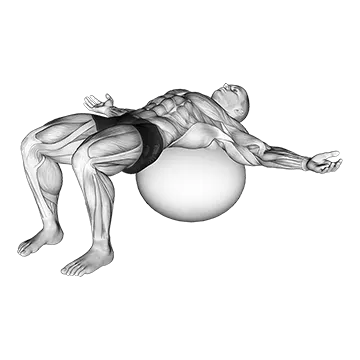



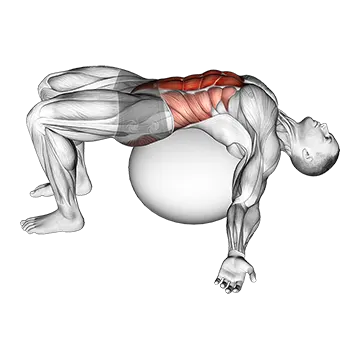


The exercise ball back extension with knees off ground is a bodyweight lower-back exercise that primarily targets the erector spinae, with the glutes (gluteus maximus) assisting at the top. Lying prone over a stability ball with your knees lifted so your torso and legs balance over the ball, you raise and lower your upper body to build spinal-extension strength and core stability.
How to do the Exercise Ball Back Extension With Knees Off Ground
- 1Kneel behind a stability ball and lean forward so your hips and lower abdomen rest on top of it, with the ball positioned under your pelvis.
- 2Walk your hands forward on the floor and brace through your arms as you straighten your legs and lift your knees off the ground.
- 3Set your feet hip-width apart against the floor or a wall for support, and let your torso fold over the ball so your upper body hangs toward the floor.
- 4Place your hands lightly behind your head or cross them over your chest, and brace your core to stabilize over the ball.
- 5Raise your upper body by extending your spine and squeezing your glutes until your torso forms a straight line with your legs.
- 6Pause briefly at the top without arching past neutral, keeping your neck in line with your spine.
- 7Lower your torso back over the ball under control until you feel a gentle stretch through your lower back.
- 8Complete your reps, then lower your knees back to the floor and step away from the ball.
Form tips
- Lead the movement with your lower back and glutes rather than swinging from momentum, raising and lowering with a slow, controlled tempo.
- Keep your gaze toward the floor and your chin tucked so your neck stays neutral throughout the set.
- Widen your foot stance or brace your feet against a wall for a more stable base, since lifting your knees removes a key point of contact.
- Stop the upward phase at a straight torso-to-leg line; you do not need to hyperextend to work the erector spinae.
- Start with bodyweight only and master your balance on the ball before adding any load or increasing reps.
Common mistakes
- Hyperextending the spine at the top, which compresses the lower-back joints instead of loading the muscles safely.
- Using momentum to fling the torso up, which removes tension from the erector spinae and makes the rep less effective.
- Letting the head drop or crane upward, which strains the neck and breaks the straight-line position of the spine.
- Positioning the ball too far up the chest or too low on the thighs, which reduces stability and shifts the work away from the lower back.
- Holding your breath through the rep instead of bracing your core, which weakens trunk stability over the ball.
Frequently asked questions
What muscles does the exercise ball back extension with knees off ground work?
It primarily works the erector spinae (the muscles running along your lower and mid-back), with the gluteus maximus assisting as you extend your spine at the top of each rep.
Why lift the knees off the ground for this exercise?
Lifting your knees removes a point of contact so your torso and legs balance over the ball, increasing the demand on your erector spinae and core stability compared with keeping your knees down.
Is this exercise good for beginners?
It is suitable once you are comfortable balancing on a stability ball. Beginners should start with knees down or feet braced against a wall, then progress to lifting the knees as their balance and back strength improve.
How many sets and reps should I do?
For most lifters, 2-3 sets of 10-15 controlled reps works well. Because this is a lower-back movement, prioritize smooth form and a full range over chasing high rep counts.
Where should I feel this exercise?
You should feel it working through your lower back (erector spinae) and your glutes at the top of each rep. Sharp pain or pinching in the spine usually means you are hyperextending or going too fast.