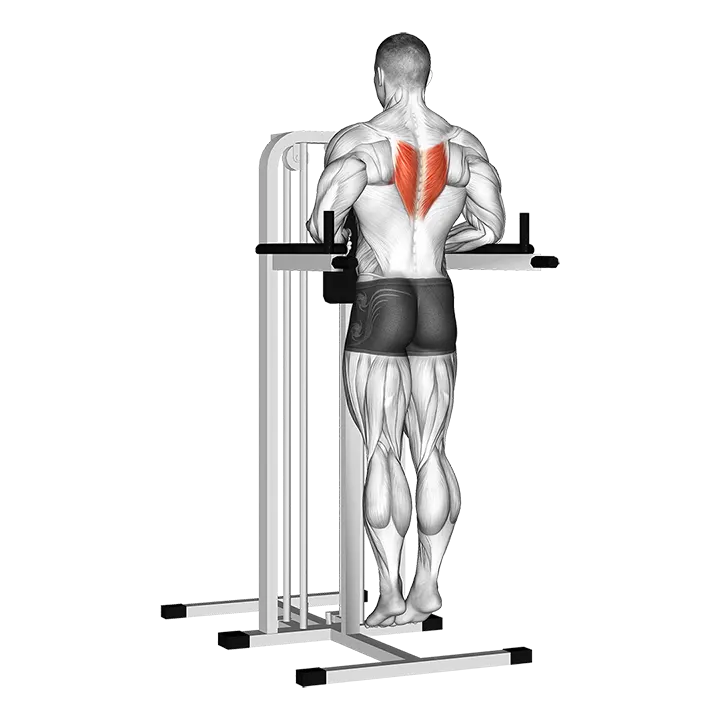
Depression In Parallel Bars Stretch
- Target muscle
- —
- Equipment
- Body weight
- Body part
- Back
- Type
- Stretching
The depression in parallel bars stretch is a bodyweight mobility drill that decompresses the shoulder girdle and stretches the upper back. Supporting yourself on parallel (dip) bars with straight arms, you let your shoulders rise toward your ears, then actively pull them back down — a scapular depression hold that opens up the upper traps, lats, and the muscles around the shoulder blades.
How to do the Depression In Parallel Bars Stretch
- 1Set up between sturdy parallel or dip bars, gripping one bar in each hand with your palms facing inward.
- 2Press down through your hands to lift your feet off the floor, supporting your full bodyweight with your arms straight and locked.
- 3Relax your shoulders and let them rise up toward your ears, allowing your body to sink slightly between the bars.
- 4Feel the gentle stretch and decompression across the tops of your shoulders and your upper back.
- 5Now actively depress your shoulders — pull your shoulder blades down and away from your ears without bending your elbows.
- 6Hold the depressed position for 2–3 seconds, keeping your chest tall and your neck long.
- 7Breathe slowly and cycle between the relaxed (shrugged) and the depressed position for the desired time.
- 8Lower your feet gently back to the floor to finish, then step off the bars under control.
Form tips
- Keep your arms fully straight throughout — this is a shoulder and scapular movement, not an arm or elbow exercise.
- Move slowly and deliberately between the shrugged and depressed positions so you feel the muscles working, not just hang passively.
- Exhale as you pull your shoulders down and inhale as you let them rise, syncing the stretch with your breath.
- Choose bars that are stable and rated for your bodyweight, and ease into the hang rather than dropping onto straight arms.
- You should feel a comfortable stretch and decompression around the upper back and shoulders — never a sharp pinch in the joint.
Common mistakes
- Bending the elbows to push up, which turns the hold into a dip and removes the scapular depression you are trying to train.
- Hanging completely limp at the bottom, which can overstress the shoulder joints instead of stretching them under control.
- Shrugging the shoulders up and forgetting to actively pull them back down, so you only get the passive half of the movement.
- Holding your breath and tensing the neck, which creates tension and works against the decompression you want.
- Jumping or dropping onto locked-out arms, which can strain the shoulders before you have set a stable position.
Frequently asked questions
What does the depression in parallel bars stretch work?
It stretches and decompresses the shoulder girdle and upper back — the muscles across the tops of the shoulders, the upper traps, and the lats and tissue around the shoulder blades — by training active scapular depression while you support your bodyweight on the bars.
Where should I feel this stretch?
You should feel a gentle stretch and a sense of decompression across the tops of your shoulders and through your upper back as you let them rise, and the upper-back muscles working as you pull your shoulders down. You should not feel a sharp pinch inside the shoulder joint.
Is this stretch good for beginners?
Yes, as long as you can comfortably support your bodyweight on parallel bars with straight arms. Start with short holds, keep the movement slow and controlled, and build up gradually.
How long should I hold the depression position?
Hold the depressed position for about 2–3 seconds, then let your shoulders rise again, cycling slowly for 20–40 seconds. Repeat for 2–3 rounds as part of a warm-up or mobility routine.
What is the difference between this and a dip?
A dip bends and straightens the elbows to push your bodyweight up, working the chest and triceps. This stretch keeps the arms straight the whole time and only moves the shoulder blades up and down, so it targets scapular mobility and decompression rather than pressing strength.







