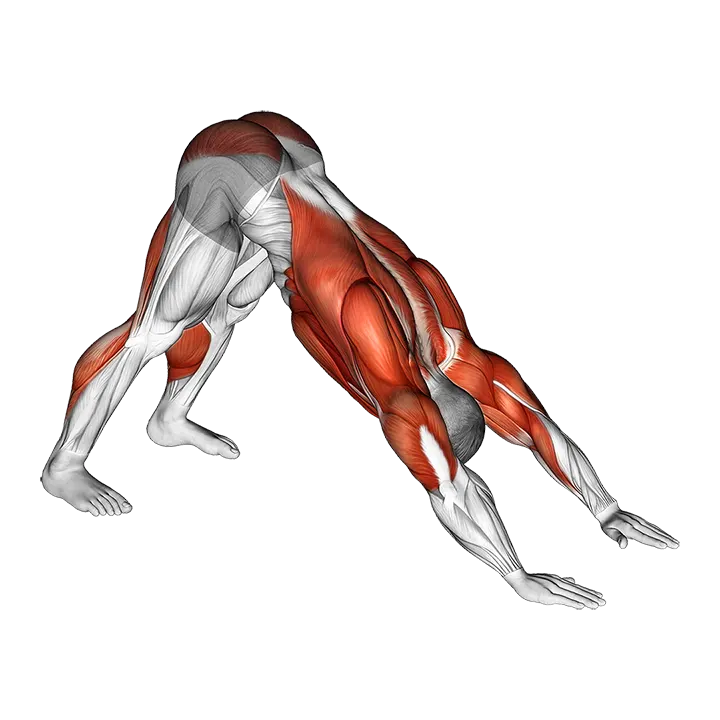
Downward Facing Dog
- Target muscle
- —
- Equipment
- Body weight
- Body part
- Back, Chest, Hips, Shoulders, Thighs, Upper Arms
- Type
- Stretching
Downward Facing Dog (Adho Mukha Svanasana) is a bodyweight yoga pose that forms an inverted V shape to stretch and lengthen the back, shoulders, chest, and the thighs through the hamstrings and calves, while opening the hips and engaging the upper arms. It's a calming, full-body stretch used as a reset between poses and to decompress the spine.
How to do the Downward Facing Dog
- 1Start on your hands and knees with your wrists under your shoulders and your knees under your hips, fingers spread wide.
- 2Press evenly through your palms and the bases of your fingers, then tuck your toes under so the balls of your feet contact the floor.
- 3Exhale and lift your hips up and back, straightening your legs to draw your body into an inverted V shape.
- 4Lengthen your spine by reaching your hips toward the ceiling and your chest gently back toward your thighs.
- 5Rotate your shoulders outward to draw them away from your ears, keeping your upper arms active.
- 6Let your heels sink toward the floor without forcing them, allowing the stretch to spread through your hamstrings and calves.
- 7Hold the pose while breathing evenly through your nose, keeping your weight balanced between your hands and feet.
- 8To release, exhale and lower your knees back to the floor, returning to hands and knees to rest.
Form tips
- Spread your fingers wide and press through the knuckles and fingertips so your weight spreads across the whole hand rather than pooling in your wrists.
- Keep a micro-bend in your knees if your hamstrings are tight — it lets you lengthen the spine instead of rounding the back.
- Externally rotate your shoulders and draw them down away from your ears to open the chest and protect the neck.
- Prioritize a long, straight spine over getting your heels flat; the heels lower naturally as the calves and hamstrings release.
- Breathe slowly and evenly, easing a little deeper on each exhale without ever pushing into pain.
Common mistakes
- Rounding the upper back to reach the floor, which collapses the spinal length the pose is meant to create and reduces the back stretch.
- Forcing the heels flat before the hamstrings and calves are ready, which makes you round the spine and strains the lower legs.
- Shrugging the shoulders up toward the ears, which compresses the neck and blocks the chest and shoulder opening.
- Dumping your weight forward into the wrists instead of shifting it back toward the hips, which overloads the wrist joints.
- Holding your breath while you settle in, which tightens the muscles and works against the release.
Frequently asked questions
What muscles does Downward Facing Dog stretch?
It lengthens the back and spine, the shoulders and chest, and the thighs through the hamstrings and calves, while opening the hips. The arms and shoulders stay engaged to support the inverted V shape.
Why can't I get my heels to the floor?
Tight hamstrings and calves keep most people's heels lifted, which is completely normal. Keep a slight bend in the knees and focus on a long spine — the heels settle lower over time as those muscles release, so never force them down.
Is Downward Facing Dog good for beginners?
Yes. It's one of the most accessible yoga poses and a common resting position. Beginners can bend the knees and shorten the hold, building length and comfort gradually instead of straining.
How long should I hold the pose?
Hold for roughly 5 to 10 slow breaths, about 30 seconds to a minute. Stay only as long as your breath remains easy and you feel a gentle stretch rather than any pain or pinching.







