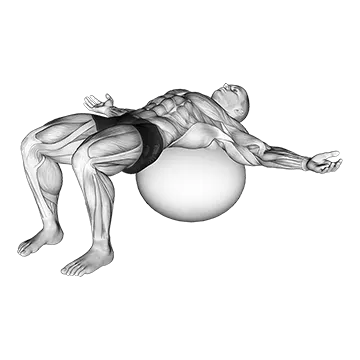
Exercise Ball One Legged Diagonal Kick Hamstring Curl
- Target muscle
- Gluteus Maximus
- Synergist muscles
- Gastrocnemius, Sartorius
- Equipment
- Stability ball
- Body part
- Hips
- Type
- Strength



The exercise ball one legged diagonal kick hamstring curl is a single-leg, bodyweight strength exercise that primarily targets the glutes (gluteus maximus), with the calves (gastrocnemius) and hip flexors (sartorius) assisting. Rolling a stability ball in and out with one foot while the other kicks diagonally builds posterior-chain strength, hip stability, and balance.
How to do the Exercise Ball One Legged Diagonal Kick Hamstring Curl
- 1Lie flat on your back on the floor with your arms by your sides, palms down for stability.
- 2Place one heel and calf on top of a stability ball, keeping that knee slightly bent. Extend the other leg straight up toward the ceiling at a slight diagonal angle.
- 3Brace your core and press through the heel on the ball to lift your hips until your body forms a straight line from shoulders to the working knee.
- 4Holding the bridge, dig your heel into the ball and curl it toward your glutes by bending the working knee.
- 5At the same time, kick the free leg diagonally away from your midline, keeping your hips level and square.
- 6Pause briefly at the top, feeling the contraction in your glute and hamstring on the working side.
- 7Slowly roll the ball back out and return the free leg to its starting position, keeping your hips raised throughout.
- 8Complete all reps on one side, then lower your hips, switch the ball to the other leg, and repeat.
Form tips
- Keep your hips lifted and level for the whole set — let the working glute, not your lower back, hold the bridge.
- Move slowly and under control; the ball rewards smooth tempo and punishes jerky reps with wobble.
- Press firmly through the heel on the ball to keep it stable and bias the glute and hamstring.
- Engage your core throughout to stop the diagonal kick from twisting or dropping your hips.
- Start with both feet on the ball to learn the curl, then progress to the single-leg version once your balance is solid.
Common mistakes
- Letting the hips sag toward the floor between reps, which removes tension from the glutes and shifts strain to the lower back.
- Rushing the roll so the ball skids out of control, costing balance and turning a strength move into a flail.
- Swinging the free leg too hard or out of plane, which twists the pelvis and breaks hip alignment.
- Curling only a few inches instead of bringing the ball close to the glutes, cutting the range and the glute and calf contraction.
- Pushing through the toes instead of the heel, which lets the ball slip and reduces glute and hamstring involvement.
Frequently asked questions
What muscles does the exercise ball one legged diagonal kick hamstring curl work?
It primarily works the glutes (gluteus maximus), with the calves (gastrocnemius) and a hip flexor (sartorius) assisting as you curl the ball and kick the free leg.
Is this exercise good for beginners?
It is fairly advanced because of the single-leg balance. Beginners should first master the two-legged stability ball hamstring curl, then move to this diagonal kick variation once their hips stay level and stable.
How many sets and reps should I do?
Aim for 2–3 sets of 8–12 controlled reps per leg. Because it is bodyweight and balance-driven, prioritize clean form and full range over chasing higher rep counts.
Where should I feel this exercise?
You should feel it mainly in the glute of the leg on the ball, with the back of the working leg and the calf assisting. If you feel it mostly in your lower back, lower your hips and re-brace your core.
What is a good alternative if I find this too hard?
Switch to the standard two-legged stability ball hamstring curl. Keeping both feet on the ball removes the balance demand while still training the glutes, hamstrings, and calves.