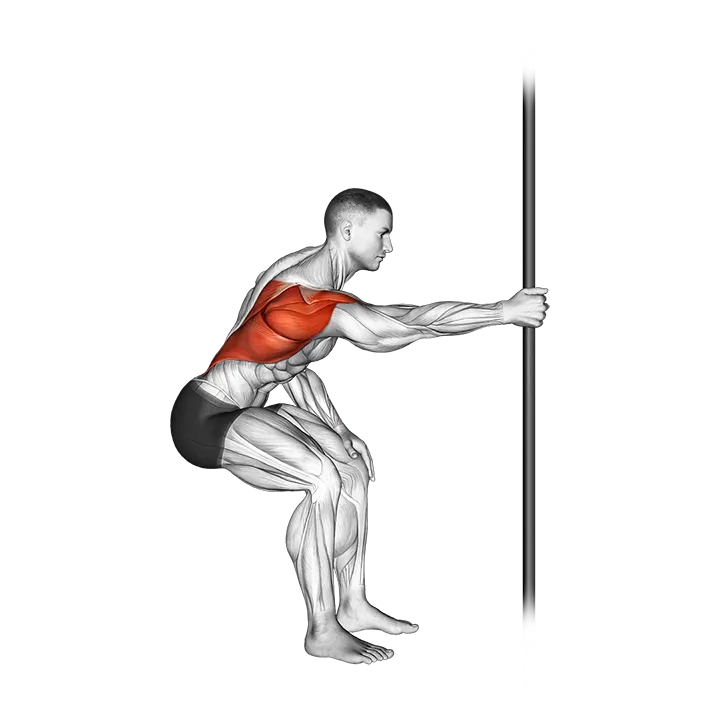
Fixed Bar Back Stretch
- Equipment
- Body weight
- Body part
- Back
- Type
- Stretching
The fixed bar back stretch is a bodyweight stretch that uses an overhead fixed bar to decompress and lengthen the back. By hanging or leaning back from the bar, it targets the lats (latissimus dorsi) and the shoulder-blade muscles — teres major, teres minor, infraspinatus, and the lower fibers of the trapezius. It's a simple way to open up the upper back and improve overhead mobility.
How to do the Fixed Bar Back Stretch
- 1Stand facing a fixed bar set at about shoulder to overhead height and grip it with both hands roughly shoulder-width apart.
- 2Step your feet back slightly and let your arms straighten as you settle your weight away from the bar.
- 3Hinge at the hips and sink your chest down between your arms, letting your back round gently and your shoulder blades spread apart.
- 4Allow your hips to drift back so you feel a long, even stretch through your lats and the muscles around your shoulder blades.
- 5Relax your neck and let your head hang naturally between your arms, keeping your shoulders away from your ears.
- 6Breathe slowly and deeply, easing a little deeper into the stretch on each exhale without forcing it.
- 7Hold the position for 20–30 seconds while staying relaxed and still.
- 8To release, step your feet back under your body, bring your chest upright, and let go of the bar with control.
Form tips
- Move into and out of the stretch slowly and hold it steady — never bounce or use ballistic movements, which can strain the back and shoulders.
- Adjust how far you step back and how much weight you shift to control the intensity; the more you lean away, the deeper the lat stretch.
- Keep your grip relaxed and your shoulders pulled down away from your ears so the stretch stays in your back, not your neck.
- Exhale as you ease deeper, and stop at the first point of strong tension rather than pushing into pain.
- Choose a sturdy, secure fixed bar and keep your feet planted so you stay stable throughout the hold.
Common mistakes
- Bouncing or pulsing to force more range, which puts sharp, uncontrolled load on the back and shoulders and can cause strain.
- Holding your breath and tensing up, which prevents the muscles from relaxing and limits how much they actually lengthen.
- Shrugging the shoulders up toward the ears, which shifts tension into the neck and traps instead of the lats and shoulder blades.
- Pulling into a stretch that's painful rather than a comfortable tension, increasing the risk of overstretching.
- Rushing out of the position by standing up abruptly instead of stepping the feet back under you with control.
Frequently asked questions
What muscles does the fixed bar back stretch work?
It stretches the lats (latissimus dorsi) and the shoulder-blade muscles — teres major, teres minor, infraspinatus, and the lower fibers of the trapezius. Together these open up the upper back and the area around the shoulder blades.
How long should I hold the fixed bar back stretch?
Hold each repetition for about 20–30 seconds while breathing slowly. You can repeat it 2–3 times, easing slightly deeper as the muscles relax.
Is the fixed bar back stretch good for beginners?
Yes. It's a gentle bodyweight stretch with no spotter needed — beginners can simply lean less of their weight away from the bar to keep the stretch light and comfortable.
When should I do this stretch?
It works well as part of a cool-down after back, pulling, or overhead work, or any time your upper back feels tight. Keep the movement controlled and avoid any bouncing.







