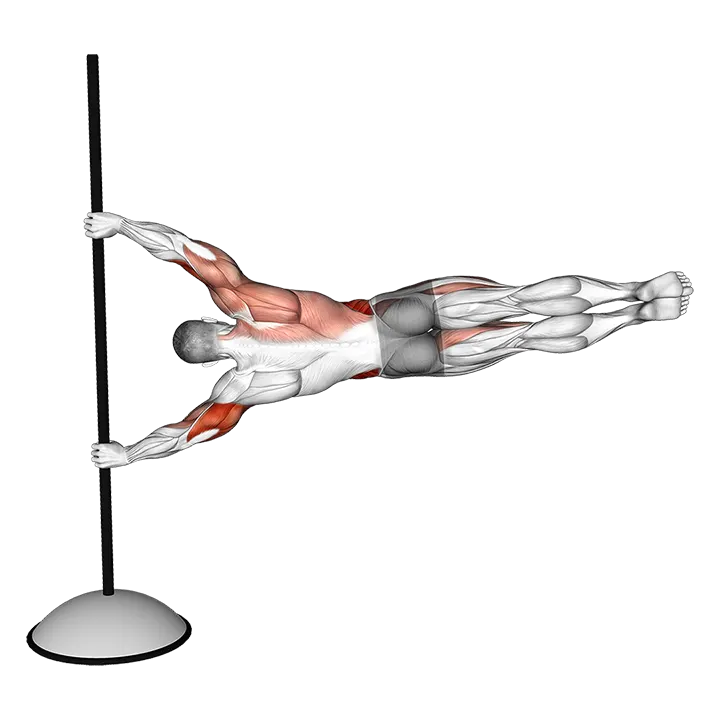
Flag
- Target muscle
- —
- Equipment
- Body weight
- Body part
- Upper Arms, Waist
- Type
- Stretching
The flag, often called the human flag, is an advanced bodyweight isometric hold that challenges the obliques and core through the waist while the upper arms and shoulders fight to keep the body suspended sideways off a vertical pole. You grip a vertical bar with both hands and hold your body horizontal to the ground, making it a demanding test of full-body tension and stability.
How to do the Flag
- 1Stand alongside a sturdy vertical pole or bar that can support your full body weight.
- 2Reach up and grip the pole with your top hand in an overhand grip, arm fully extended overhead.
- 3Place your bottom hand below it in an underhand grip, roughly shoulder-width apart, so the top arm will pull and the bottom arm will push.
- 4Brace your core hard and squeeze your glutes, then drive through the bottom arm and pull with the top arm to lift your hips and legs off the floor.
- 5Raise your body until it is as close to horizontal as you can control, keeping your torso, hips, and legs in one straight line.
- 6Hold the position with your obliques and waist tight, breathing in short, controlled breaths.
- 7Lower under control back toward the floor, then reset and repeat for the desired number of holds.
Form tips
- Build up to the full hold with progressions such as the vertical flag (body upright), tuck flag (knees pulled in), and single-leg flag before extending both legs fully horizontal.
- Keep total-body tension: brace the core, squeeze the glutes, and keep the legs straight so the body stays rigid like a plank turned sideways.
- Split the work between the arms — the bottom arm pushes against the pole while the top arm pulls, and both must stay engaged the whole hold.
- Train short, quality holds (5–10 seconds) with full tension rather than long, sagging ones that lose the straight-line position.
Common mistakes
- Letting the hips sag below the line of the body, which collapses the position and shifts strain onto the lower back.
- Relying only on the top (pulling) arm and forgetting to push hard with the bottom arm, which makes the hold unstable and quickly fails.
- Bending the knees or piking at the waist instead of holding a straight line, which is easier but no longer a true flag.
- Attempting the full horizontal hold before building grip, oblique, and shoulder strength through progressions, which risks losing the position and falling.
Frequently asked questions
What muscles does the flag work?
The flag is a full-body isometric hold that heavily works the core and obliques through the waist, while the upper arms and shoulders work hard to keep the body suspended sideways from the pole.
Is the flag good for beginners?
No — the full human flag is an advanced skill. Beginners should build toward it with easier progressions like the vertical flag, tuck flag, and single-leg flag before attempting a full horizontal hold.
How do I progress to a full human flag?
Work in stages: start with the vertical flag, then the tuck flag with knees pulled in, then a single-leg flag, and finally extend both legs to horizontal as your core and shoulder strength improve.
How long should I hold the flag?
Quality beats duration. Aim for short, fully braced holds of around 5–10 seconds with a perfectly straight body, repeating for several sets rather than holding a sagging position longer.
Do I need any equipment for the flag?
Only your body weight and a solid vertical pole or bar that can support you. A secure scaffold pole, sturdy vertical bar, or fixed upright is ideal; make sure it will not move or flex under load.







