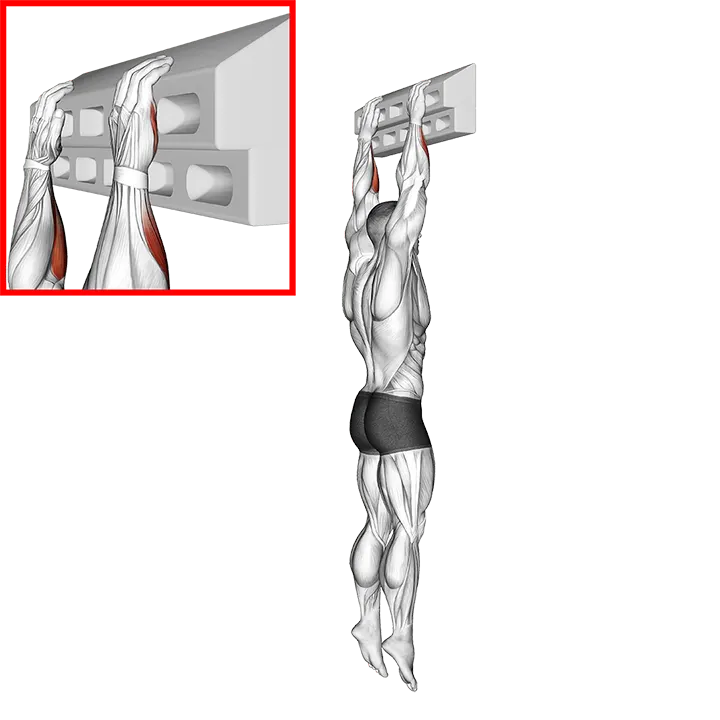
Handboard Slope Hang
- Target muscle
- —
- Equipment
- Body weight
- Body part
- Forearms
- Type
- Stretching
The handboard slope hang is a bodyweight isometric grip exercise that builds forearm and finger-flexor strength by hanging from a sloping (sloper) hold on a hangboard with an open-hand grip. Because there is no positive edge to crimp on, friction and an open palm do the work, making it a staple for developing grip endurance and the contact strength that climbers and lifters rely on.
How to do the Handboard Slope Hang
- 1Set the hangboard at a height that lets you reach the sloper holds with your arms fully extended overhead while your feet are still on the floor.
- 2Place both hands flat over the slope with your fingers spread and slightly relaxed, keeping the palm and pads in broad contact with the surface (an open-hand grip — no crimping).
- 3Drive your fingertips down and pull your thumbs toward your palm to maximize friction against the sloping hold.
- 4Engage your shoulders by pulling them down and back, then lift your feet so your full body weight hangs from the holds.
- 5Keep your arms slightly bent rather than fully locked out, and hold a tight, motionless hang.
- 6Maintain the hang for your target time, breathing steadily and resisting the urge to let your hands slide off the slope.
- 7Lower your feet back to the floor under control to unload the holds, then step down and shake out your forearms.
- 8Rest fully between hangs to let the forearm and finger flexors recover before the next set.
Form tips
- Keep an open-hand grip with the fingers spread; pressing your palm into the slope adds friction and shares the load across the whole hand.
- Hang with active shoulders — pulled down and slightly engaged — instead of dead-hanging from loose, shrugged shoulders, to protect the shoulder joint.
- Start with short holds and add a few seconds at a time; grip and finger tissue adapt slowly, so progress gradually.
- If your full bodyweight is too much, keep one foot or a toe lightly on the floor to scale the load down.
Common mistakes
- Trying to crimp or curl your fingertips over the slope, which has no positive edge — this slips and strains the finger pulleys instead of building open-hand strength.
- Dead-hanging with completely relaxed, shrugged shoulders, which puts the load on passive shoulder structures rather than keeping the joint stable.
- Holding for too long or too often without rest, overloading the tendons and pulleys of the forearm and fingers and inviting strain.
- Letting the hands gradually slide off the slope and cutting the hang short instead of actively driving the palm and pads into the surface.
Frequently asked questions
What muscles does the handboard slope hang work?
It mainly trains the forearm and finger flexors that close and stabilize the open hand, building grip and contact strength. As a bodyweight hang, the shoulders and upper back also work to keep you stable on the holds.
How is a slope hang different from hanging on an edge?
A sloper has no positive edge to grip, so you can't crimp — you rely on an open-hand grip and friction from the palm and finger pads. Edges let you pull on a defined lip, while slopes train a more open, friction-based hold.
Is the handboard slope hang good for beginners?
Yes, if you scale the load. Keep a foot or toe on the floor to reduce bodyweight, use short holds, and rest fully between sets. Grip tissue adapts slowly, so build up time and load gradually.
How long should I hang and how many sets?
A common approach is several hangs of roughly 5–10 seconds each with full rest between them. Stop before your grip fails completely, and keep total volume modest so the forearm and finger tendons recover between sessions.







