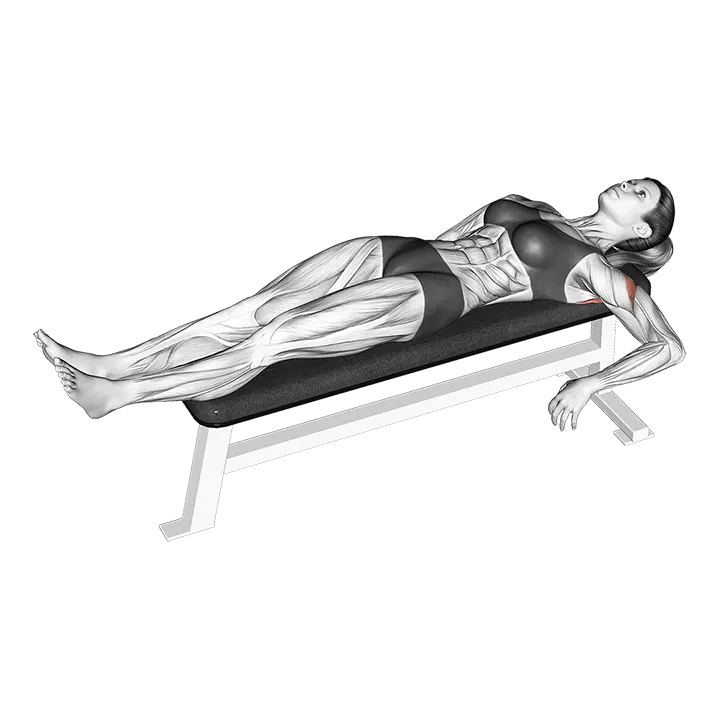
Internal Shoulder Rotation Stretch
- Target muscle
- —
- Equipment
- Body weight
- Body part
- Shoulders
- Type
- Stretching
The internal shoulder rotation stretch is a bodyweight mobility exercise that lengthens the internal rotator muscles of the shoulder — particularly the subscapularis — and improves range of motion in the glenohumeral joint. It is commonly used to counteract tightness from pressing movements, overhead work, or prolonged sitting.
How to do the Internal Shoulder Rotation Stretch
- 1Stand tall or sit upright with your spine neutral and your feet hip-width apart.
- 2Raise one arm out to the side to shoulder height, then bend the elbow to 90° so your forearm points straight up.
- 3Keeping the upper arm parallel to the floor, slowly rotate the forearm forward and downward so it moves toward the floor in front of you.
- 4Stop when you feel a gentle stretch across the back of the shoulder or in the shoulder joint — do not force the range.
- 5Hold the end position for 20–30 seconds while breathing steadily and allowing the shoulder to relax into the stretch.
- 6Slowly return the forearm to the upright starting position with control.
- 7Complete all reps on one side, then repeat on the other arm.
Form tips
- Keep the upper arm level throughout the movement — letting it drop toward your body changes the stretch angle and reduces effectiveness.
- Use only a gentle, sustained tension. If you feel sharp or pinching pain in the front of the shoulder, reduce the range immediately.
- Breathe out as you rotate into the stretch to help the muscles relax and allow greater range of motion.
- Progress gradually over sessions — shoulder internal rotation mobility improves slowly and should never be forced.
- Perform this stretch after a warm-up or at the end of a workout when soft tissue is pliable.
Common mistakes
- Rotating too far too quickly, which can impinge soft tissue at the front of the shoulder joint instead of creating a productive stretch.
- Letting the elbow drop below shoulder height, which removes tension from the target area and makes the stretch ineffective.
- Holding the breath and tensing up, which prevents the muscles from releasing and limits the achievable range.
- Compensating with the torso by leaning away from the working arm, which creates a false sense of range without actually mobilizing the shoulder.
Frequently asked questions
What does the internal shoulder rotation stretch target?
It targets the internal rotator muscles of the shoulder, primarily the subscapularis, along with the surrounding joint capsule. Stretching these structures improves glenohumeral mobility and reduces stiffness from pressing or repetitive overhead activities.
How long should I hold the internal shoulder rotation stretch?
Hold each rep for 20–30 seconds. For mobility improvement, perform 2–3 holds per side and aim to include it in your routine at least 3–4 times per week. Static stretches held under 15 seconds produce little lasting change.
When is the best time to do this stretch?
After a workout or light warm-up, when muscles are warm. Performing it on cold tissue reduces effectiveness and may increase the risk of irritating the joint. It works well as part of a post-training cool-down or a standalone mobility session.
Can this stretch help with shoulder pain from bench pressing?
Tightness in the internal rotators can contribute to shoulder discomfort during pressing movements. Regularly stretching these muscles may reduce that tension, but persistent or sharp shoulder pain should be evaluated by a physiotherapist before continuing loading exercises.
Is the internal shoulder rotation stretch the same as a sleeper stretch?
No — the sleeper stretch is performed lying on your side and primarily targets the posterior shoulder capsule. The internal shoulder rotation stretch is done upright and focuses on lengthening the internal rotators themselves, making them complementary rather than interchangeable.







