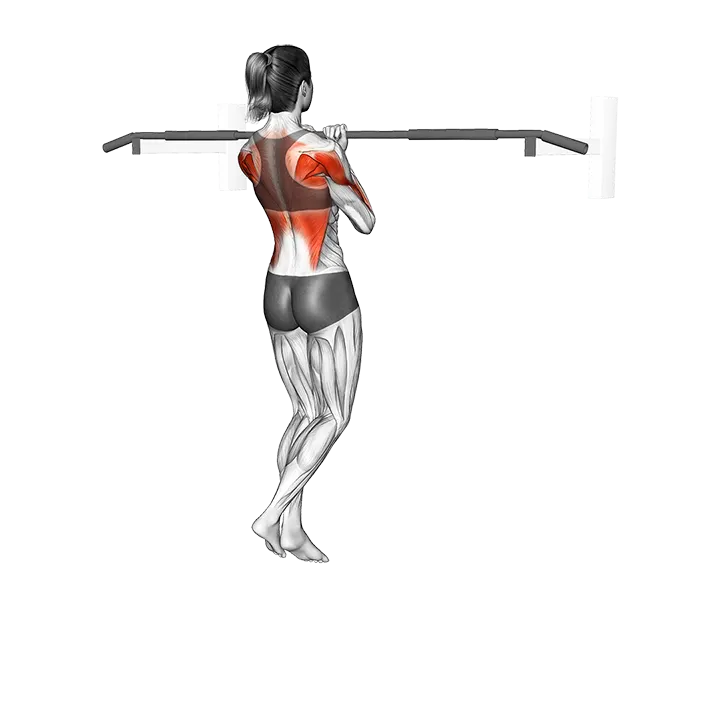
Isometric Hold Close Grip Chin-up
- Target muscle
- —
- Equipment
- Body weight
- Body part
- Back
- Type
- Strength
The isometric hold close grip chin-up is a bodyweight strength exercise that combines a supinated, narrow-grip chin-up with a static hold at the top position. It intensely targets the latissimus dorsi, biceps, and rhomboids while building grip endurance and upper-back stability. It is particularly effective for developing the strength and muscular endurance needed to progress to more advanced pulling movements.
How to do the Isometric Hold Close Grip Chin-up
- 1Grip the pull-up bar with both hands close together (4–6 inches apart), palms facing toward you in a supinated grip.
- 2Hang at full arm extension with your shoulders slightly retracted, core braced, and legs crossed or straight to minimize swinging.
- 3Initiate the pull by depressing your shoulder blades and driving your elbows down and back toward your hips.
- 4Continue pulling until your chin rises clearly above the bar, keeping your chest tall and your body in a slight hollow position.
- 5At the top, hold this position isometrically — chin above the bar, elbows fully flexed, muscles fully contracted — for the prescribed duration (5–30 seconds).
- 6Focus on squeezing the lats and biceps throughout the hold; breathe steadily and avoid letting the chin drop or the elbows flare.
- 7After completing the hold, lower yourself in a slow, controlled manner back to a dead hang over 3–5 seconds.
- 8Reset your position and repeat for the prescribed number of sets.
Form tips
- Keep your shoulder blades pulled down and back throughout the hold — letting them shrug up toward your ears reduces lat engagement and puts stress on the neck.
- Breathe in a controlled pattern during the static hold; exhaling slowly helps you maintain tension without losing core stability.
- Use a slight hollow-body position (ribs down, core tight) rather than arching aggressively, so force transfers cleanly through the lats instead of the lower back.
- If you cannot maintain chin-over-bar for the target duration, shorten the hold time and build up gradually rather than allowing form to break down.
- Pair this exercise with full-range chin-up sets — the isometric hold builds lock-off strength, while full reps develop the complete movement pattern.
Common mistakes
- Dropping the chin below the bar immediately: Allowing the chin to fall below bar height as soon as the hold begins defeats the purpose of the isometric stimulus and shifts tension away from the lats and biceps — keep the chin clearly above the bar for the full duration.
- Flaring the elbows out: Letting the elbows drift out to the sides during the hold externally rotates the shoulder and reduces lat activation; keep the elbows tucked close to the torso and pointing down toward the floor.
- Holding the breath: Breath-holding causes a rapid spike in blood pressure and accelerates fatigue; practice steady, controlled breathing throughout the static hold.
- Using momentum to reach the top: Kipping or swinging into the top position means you never fully contract the target muscles under control, limiting strength adaptation and increasing joint stress — pull slowly and deliberately.
- Descending too quickly: Dropping out of the hold without a slow eccentric phase wastes a valuable training stimulus and increases the risk of biceps tendon strain; always lower yourself under control.
Frequently asked questions
How long should I hold the top position in an isometric hold close grip chin-up?
Beginners should start with 5–10 second holds and focus on perfect form before extending duration. Intermediate trainees typically target 15–20 second holds, while advanced athletes can work toward 30 seconds or more. It is better to perform multiple shorter holds with full contraction than one long hold where form deteriorates.
What muscles does the isometric hold close grip chin-up work?
The primary movers are the latissimus dorsi and biceps brachii, which are under continuous tension throughout the hold. The rhomboids, rear deltoids, and lower trapezius assist in keeping the shoulder blades retracted and depressed. The forearm flexors and core are also heavily engaged to maintain the position.
Is this exercise suitable for beginners?
This exercise is best suited for those who can already perform at least 3–5 full chin-ups with good form, since you must be strong enough to pull yourself to the top and maintain the hold safely. Beginners should first build base pulling strength with assisted chin-ups or negative (eccentric) chin-ups before adding isometric holds.
How does the close grip differ from a wide grip for this hold?
A close, supinated (underhand) grip places the biceps in a mechanically advantageous position and allows a more natural elbow path, making it slightly easier to reach and hold the top position compared to a wide overhand grip. The close grip also emphasizes the inner portion of the lats and the brachialis alongside the biceps.
How should I program isometric hold close grip chin-ups in my workout?
Treat each hold as one set. A common approach is 3–5 sets of maximum-duration holds with 90–120 seconds of rest between sets, performed at the beginning of a back session when fresh. You can also add a single hold to the top of each regular chin-up set to increase time under tension without adding extra sets.







