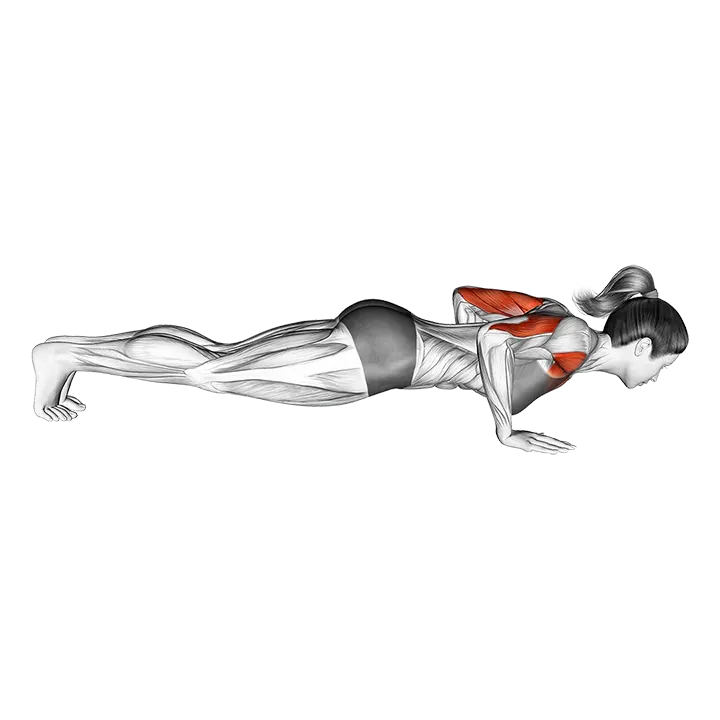
Isometric Hold Push-up
- Target muscle
- —
- Equipment
- Body weight
- Body part
- Chest
- Type
- Strength
The Isometric Hold Push-up is a bodyweight chest exercise that adds a deliberate pause at a fixed point in the push-up range of motion. This increases time under tension, building strength in the pectorals while also challenging the shoulders and triceps. It is particularly effective for breaking through strength plateaus and improving control at weak points in the movement.
How to do the Isometric Hold Push-up
- 1Start in a high plank position with hands placed slightly wider than shoulder-width, arms fully extended, and your body forming a straight line from head to heels.
- 2Engage your core, squeeze your glutes, and keep your neck neutral — eyes looking slightly ahead of your hands.
- 3Begin lowering yourself by bending your elbows at roughly a 45-degree angle from your torso.
- 4Stop and hold at your chosen position — bottom (chest near floor), midpoint (elbows at 90 degrees), or just above the floor — for the prescribed duration (typically 2–5 seconds).
- 5Breathe steadily throughout the hold; do not hold your breath.
- 6After completing the hold, press the floor away and push yourself back up to the starting position with full extension.
- 7Reset your body position at the top before beginning the next repetition.
Form tips
- Choose a consistent hold position for all reps in a set — switching positions between reps reduces the targeted stimulus.
- Keep your hips level throughout the hold; sagging or piking breaks tension and shifts load away from the chest.
- Use a slower, controlled descent into the hold rather than dropping quickly, so you arrive at the position under tension.
- Start with shorter hold durations (2–3 seconds) and progress gradually to avoid form breakdown under fatigue.
- Place a rolled towel or yoga block under your chest as a tactile target if you want a consistent bottom-position hold.
Common mistakes
- Letting the hips sag during the hold — this compresses the lower back and removes tension from the chest and core.
- Holding the breath — breath-holding spikes internal pressure and accelerates fatigue; maintain steady, controlled breathing.
- Flaring the elbows out wide — extreme elbow flare places excessive stress on the shoulder joints and reduces chest engagement.
- Rushing through the hold — counting too fast or ending the hold early defeats the purpose of increased time under tension.
- Losing shoulder blade position — allowing the scapulae to wing outward during the hold destabilizes the shoulder girdle and reduces force transfer.
Frequently asked questions
Where should I hold during an isometric hold push-up?
The most common positions are the bottom (chest close to the floor), the midpoint (elbows at roughly 90 degrees), and just short of full lockout at the top. Each position targets a slightly different point of the strength curve; beginners typically start at the midpoint where the leverage is most manageable.
How long should I hold during an isometric hold push-up?
A hold of 2–5 seconds per rep is effective for most people. Longer holds (5–10 seconds) dramatically increase difficulty and are better suited to those who can already perform many standard push-ups with good form.
Are isometric hold push-ups good for building chest muscle?
Yes. The extended time under tension forces the pectorals to sustain contraction longer than in a standard push-up, which is a well-established driver of hypertrophy and strength gains. They are especially useful for targeting sticking points in the chest press movement pattern.
How many reps should I do of isometric hold push-ups?
Because each rep takes longer, lower rep ranges (4–8 reps per set) are typical. Focus on maintaining perfect form throughout; quality of the hold matters more than rep count.
Can beginners do isometric hold push-ups?
Beginners can perform this variation from an incline (hands elevated on a bench or wall) to reduce the load, making the holds more manageable. Build up from a 2-second hold and progress to the floor position as strength improves.







