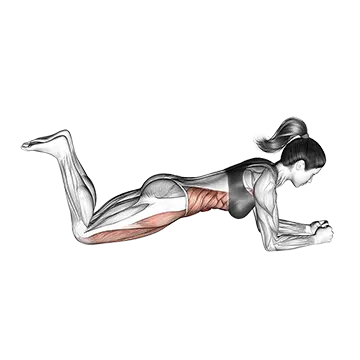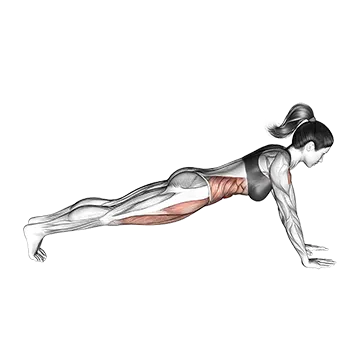
Knee Touch Crunch
- Target muscle
- Rectus Abdominis
- Synergist muscles
- Obliques
- Equipment
- Body weight
- Body part
- Waist
- Type
- Strength

The knee touch crunch is a bodyweight core exercise that targets the rectus abdominis — the front of the abdominal wall — with the obliques assisting to stabilize and rotate through the movement. It combines a standard crunch with a knee drive, increasing the range of contraction and making it effective for building core strength and improving mid-section muscle definition.
How to do the Knee Touch Crunch
- 1Lie flat on your back on a mat with your knees bent to roughly 90°, feet flat on the floor, and hands lightly touching the sides of your head without pulling on your neck.
- 2Press your lower back gently into the mat to brace your core before you begin.
- 3Draw one knee toward your chest as you simultaneously curl your upper body off the mat, lifting your shoulder blades clear of the floor.
- 4Reach your opposite elbow toward the rising knee until they make contact or come as close as your flexibility allows.
- 5Hold the contracted position for a brief moment, keeping your core tight.
- 6Lower your upper body and return your foot to the floor with control, keeping tension in your abs rather than letting them fully relax.
- 7Repeat the movement on the same side for the desired reps, or alternate sides each rep depending on your chosen variation.
Form tips
- Initiate the movement from your abs, not your neck — your hands are there only for light support, not to yank your head forward.
- Keep your lower back pressed into the mat throughout the set to maintain tension on the rectus abdominis and protect your lumbar spine.
- Exhale at the top of the crunch when your abs are fully contracted, and inhale as you lower back down.
- Move slowly and deliberately — a controlled tempo keeps constant tension on the abs and reduces momentum cheating.
- Keep your chin slightly tucked, as if holding a tennis ball under it, to keep your cervical spine neutral.
Common mistakes
- Pulling on the neck with your hands, which strains the cervical spine and transfers effort away from the abs.
- Using momentum to swing the torso up rather than contracting the abs, which shortens the effective range of motion and reduces core engagement.
- Letting your lower back arch off the mat at the start of each rep, which shifts stress to the hip flexors and lumbar spine instead of the rectus abdominis.
- Barely lifting the shoulder blades off the floor, which limits the contraction and means the abs are doing very little work.
- Rushing through reps — a fast, bouncy pace reduces time under tension and increases the risk of straining the neck or lower back.
Frequently asked questions
What muscles does the knee touch crunch work?
The knee touch crunch primarily works the rectus abdominis — the long muscle running down the front of your abdomen. The obliques act as synergists, helping to stabilize your torso and assist with any rotational component during the movement.
How is the knee touch crunch different from a regular crunch?
A regular crunch keeps your feet flat and only lifts the upper body. The knee touch crunch adds a knee drive toward the elbow, increasing the range of ab contraction and adding a coordination challenge that also engages the obliques more.
How many reps should I do per set?
For most people, 12–20 reps per set is a productive range for core endurance and hypertrophy. Focus on controlled, full contractions rather than chasing high rep counts with poor form.
Can I do knee touch crunches every day?
Your abs recover relatively quickly, but daily high-volume ab training can lead to accumulated fatigue. Two to four sessions per week with adequate rest between them is sufficient for most goals.
Is the knee touch crunch suitable for beginners?
Yes. It requires no equipment and the movement pattern is straightforward. Beginners should start with a slow tempo and focus on keeping the lower back flat and avoiding neck strain before increasing reps or adding sets.