
Kneeling plank
- Target muscle
- Rectus Abdominis
- Synergist muscles
- Deltoid Anterior, Gluteus Maximus, Iliopsoas, Obliques, Pectoralis Major Clavicular Head, Pectoralis Major Sternal Head, Serratus Anterior, Tensor Fasciae Latae
- Equipment
- Body weight
- Body part
- Waist
- Type
- Strength
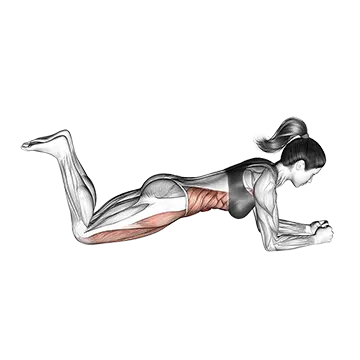

The kneeling plank is a beginner-friendly core hold that targets the rectus abdominis while engaging the obliques, hip flexors (iliopsoas), glutes, serratus anterior, and front shoulder and chest fibers to stabilize the spine. By resting on the knees instead of the toes, it reduces the lever arm and overall difficulty, making it an ideal starting point for building the bracing endurance needed to progress to a full plank.
How to do the Kneeling plank
- 1Kneel on the floor and lower your forearms so your elbows are directly beneath your shoulders, with your forearms parallel and shoulder-width apart.
- 2Extend your hips so your torso forms a straight line from your knees to the top of your head.
- 3Tuck your pelvis slightly and brace your core — draw your navel in and squeeze your glutes to lock the position.
- 4Keep your neck neutral by looking at a point on the floor about 15 cm in front of your hands rather than up or down.
- 5Hold the position for the target duration, breathing steadily — inhale through the nose, exhale through the mouth without releasing the brace.
- 6To finish, lower your hips back to the floor under control and rest in a kneeling position before repeating.
Form tips
- Press your forearms actively into the floor throughout the hold — this engages the serratus anterior and prevents your chest from sagging toward the ground.
- Check that your hips are neither raised too high nor sagging: your torso from knee to shoulder should be parallel to the floor.
- Build duration gradually — aim for 3 sets of 20–30 seconds before progressing to a full plank on the toes.
- If your lower back aches, re-check your pelvic tuck and reduce the hold time; pain signals a loss of bracing, not a need to push harder.
Common mistakes
- Letting the hips sag toward the floor, which overloads the lower back and removes tension from the abs — maintain a straight line from knees to shoulders.
- Piking the hips up too high, which shifts the load off the core and turns the hold into a resting position rather than an active exercise.
- Holding the breath, which spikes intra-abdominal pressure and causes premature fatigue — keep breathing steadily while maintaining the brace.
- Placing the elbows too far forward or back instead of directly under the shoulders, which destabilizes the position and strains the shoulder joint.
- Looking up or craning the neck, which disrupts cervical alignment and creates unnecessary tension in the upper traps — keep the gaze neutral.
Frequently asked questions
What muscles does the kneeling plank work?
The kneeling plank primarily targets the rectus abdominis. The obliques, iliopsoas, gluteus maximus, serratus anterior, tensor fasciae latae, and the clavicular and sternal heads of the pectoralis major all act as synergists to stabilize the position.
Is the kneeling plank good for beginners?
Yes — resting on the knees shortens the lever arm compared to a full plank, making it significantly easier to maintain correct spinal alignment. It is an ideal starting exercise for people who cannot yet hold a full plank with proper form for at least 20 seconds.
How long should I hold a kneeling plank?
Start with 3 sets of 15–20 seconds, resting 30–60 seconds between sets. Once you can hold clean form for 30 seconds per set, work toward 45–60 seconds before progressing to the full (toe-supported) plank.
What is the difference between a kneeling plank and a full plank?
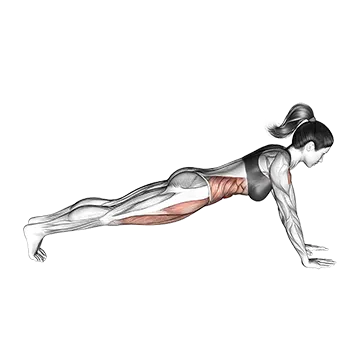
A full plank is supported at the toes, creating a longer lever from feet to shoulders and demanding significantly more core and glute strength to prevent hip sag. The kneeling plank is supported at the knees, reducing that lever and overall load — making it the recommended progression step before the full plank.
Where should I feel the kneeling plank?
You should feel a sustained tension across your entire midsection — primarily the front of the abdomen — along with mild effort in your glutes and shoulders. If you feel it predominantly in your lower back, your hips are likely sagging and you need to re-brace and tuck the pelvis.