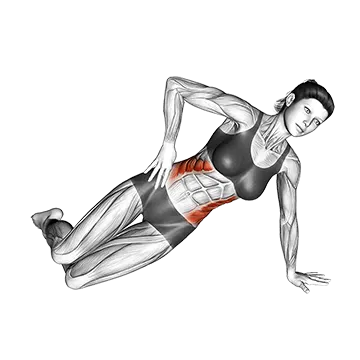
Leg Bench Side Bridge
- Target muscle
- Obliques
- Synergist muscles
- Adductor Brevis, Adductor Longus, Gracilis, Iliopsoas, Pectineous, Serratus Anterior, Tensor Fasciae Latae
- Equipment
- Body weight
- Body part
- Waist
- Type
- Strength
The Leg Bench Side Bridge is a body-weight isometric strength exercise that targets the obliques while engaging synergists including the serratus anterior, tensor fasciae latae, iliopsoas, adductor brevis, adductor longus, gracilis, and pectineous. Elevating the feet on a bench increases the lateral load on the core, making this an effective progression for building waist stability and lateral trunk strength.
How to do the Leg Bench Side Bridge
- 1Place a flat bench beside you and lie on your side on the floor, positioning your feet and lower legs on top of the bench with your hip still resting on the floor.
- 2Stack your feet on top of each other and rest your lower elbow directly beneath your shoulder, forearm flat on the floor and perpendicular to your torso.
- 3Place your top hand on your hip or extend it toward the ceiling for balance.
- 4Brace your core and squeeze your obliques, then drive your hip off the floor until your body forms a rigid straight line from head to feet.
- 5Hold your neck in a neutral position — do not crane it upward or let it drop toward the floor.
- 6Keep your hips fully extended and avoid letting them sag or pike upward during the hold.
- 7Breathe steadily throughout the hold; do not hold your breath.
- 8Hold the bridge position for the target duration (e.g., 20–45 seconds), then lower your hip under control.
- 9Complete all reps or time on one side before switching to the opposite side.
Form tips
- Think of pressing your bottom forearm into the floor and pushing your hip toward the ceiling simultaneously — this dual tension locks the obliques in hard.
- Squeeze the adductors by pressing your top foot down into the bottom foot; this stabilises the hip stack and recruits the inner-thigh synergists.
- Keep your serratus anterior engaged by actively pushing your shoulder away from your ear rather than letting it shrug up toward it.
- Visualise your body as a plank — any bend at the waist or hips reduces oblique activation and shifts load to passive structures.
- Progress by increasing hold duration before adding difficulty; quality tension for 20 seconds beats a sagging 45-second hold.
Common mistakes
- Allowing the hips to sag toward the floor — this removes tension from the obliques and puts excessive stress on the lumbar spine and shoulder joint.
- Piking the hips too high — hiking the hip upward shortens the oblique range of engagement and turns the exercise into a compensation pattern rather than a true lateral bridge.
- Letting the supporting shoulder collapse inward — a collapsing shoulder fails to activate the serratus anterior and can impinge the rotator cuff over time.
- Holding the breath throughout the set — breath-holding spikes intra-abdominal pressure unnecessarily and accelerates fatigue; controlled breathing sustains the hold longer.
- Turning the torso to face the floor — rotating out of true lateral alignment reduces oblique recruitment and shifts work to the hip flexors including the iliopsoas.
Frequently asked questions
What is the difference between a regular side bridge and a Leg Bench Side Bridge?
In a standard side bridge the feet rest on the floor, level with the supporting elbow. Placing the legs on a bench raises the lower support so the body tilts head-down, driving a greater share of your bodyweight through the bottom shoulder and hip. That extra demand on the obliques and lateral stabilisers makes it a harder progression.
How long should I hold the Leg Bench Side Bridge?
Beginners should aim for 15–20 seconds per side with strict form. Intermediate trainees typically work in the 30–45 second range, and advanced trainees can push to 60 seconds or more. Always prioritise form over duration.
Can the Leg Bench Side Bridge help with lower back pain?
Strengthening the obliques and lateral core musculature can improve spinal stability and reduce the risk of lower back issues. However, if you currently have lower back pain, consult a healthcare professional before attempting this exercise.
How do I make the Leg Bench Side Bridge easier if I cannot hold proper form?
Regress to a standard floor side bridge with feet stacked or with the bottom knee bent. Build the hold duration to 30–45 seconds on the floor variation before reintroducing the bench elevation.
How many sets and reps should I do for the Leg Bench Side Bridge?
Because this is an isometric hold, sets are measured in time rather than reps. Two to four sets of 20–45 seconds per side, with 60–90 seconds of rest between sets, is a practical starting point for most training programmes.