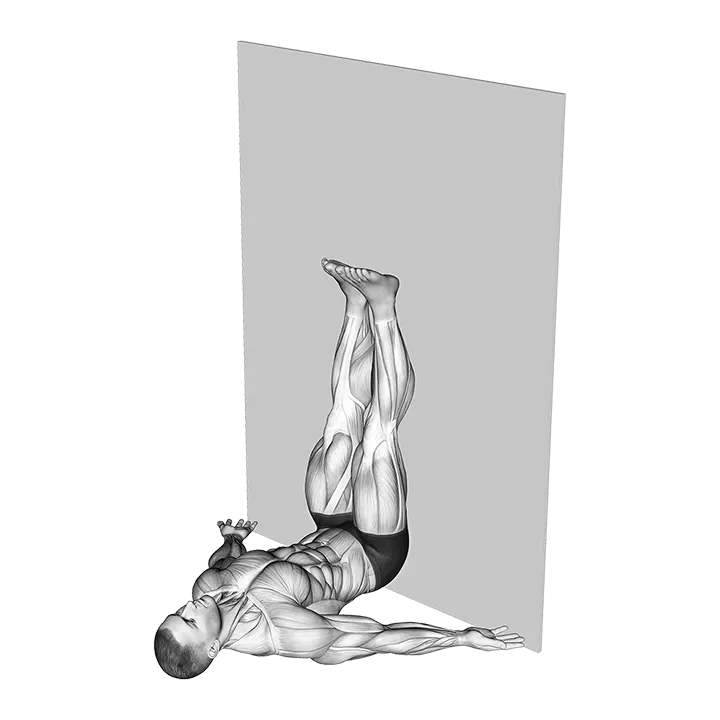
Legs-Up The Wall Yoga Pose
- Target muscle
- —
- Equipment
- Body weight
- Body part
- Stretching
- Type
- Stretching
Legs-Up The Wall is a passive, restorative yoga pose in which you lie on your back with both legs extended vertically against a wall. Held without muscular effort, it encourages circulation, relieves tension in the lower back and legs, and promotes a calming effect on the nervous system.
How to do the Legs-Up The Wall Yoga Pose
- 1Place your mat perpendicular to a clear section of wall so that the short edge nearly touches the baseboard.
- 2Sit sideways with one hip touching the wall, then swing your legs up the wall as you lower your torso onto the mat so you end up lying on your back with your legs extended vertically.
- 3Scoot your hips as close to the wall as is comfortable, or allow a small gap if that feels better for your lower back.
- 4Straighten your legs and let them rest passively against the wall, feet relaxed and hip-width apart.
- 5Rest your arms on the floor beside you, palms facing up, and allow your shoulders and upper back to fully release into the mat.
- 6Close your eyes, breathe slowly and evenly, and let your whole body become heavy against the floor.
- 7Hold the position for 2–10 minutes, adjusting your distance from the wall if you feel any discomfort in the hamstrings or lower back.
- 8To exit, bend your knees and bring them toward your chest, then roll gently onto one side and pause before pressing yourself up to seated.
Form tips
- If your hamstrings feel strained, move your hips a few centimetres back from the wall so there is a slight gap between your sitting bones and the baseboard.
- Place a folded blanket or towel under your lower back if the floor feels uncomfortable or if you want a mild supported extension in the lumbar spine.
- Keep your chin slightly lower than your forehead so that the back of your neck stays long and relaxed.
- Breathe slowly and deliberately throughout the hold — focusing on a long exhale helps deepen the calming response.
- Transition out slowly: rushing upright after an inversion can cause a brief drop in blood pressure and light-headedness.
Common mistakes
- Sitting too close to the wall with tight hamstrings, which causes the lower back to round and lift off the floor and reduces the restorative benefit.
- Tensing the legs and pressing them actively into the wall, which turns a passive rest pose into an effortful one and defeats its purpose.
- Letting the head tilt back so the chin points toward the ceiling, which compresses the cervical spine and creates neck discomfort over time.
- Staying in the pose too briefly — less than two minutes rarely allows the nervous system to settle — or too long without checking in on any numbness or tingling in the feet.
- Standing up immediately after coming out of the pose, which can cause light-headedness; always pause on your side for several breaths first.
Frequently asked questions
How long should I hold Legs-Up The Wall?
Two to ten minutes is the typical range. Beginners can start with two to three minutes and build up gradually. If you notice tingling or numbness in the feet, come out of the pose sooner.
Is this pose suitable for people with lower back pain?
Many people find it relieves mild lower back tension, but individual responses vary. If your lower back arches uncomfortably off the floor, move your hips a few centimetres away from the wall or place a folded blanket under the lumbar region. Avoid the pose if you have a recent or acute back injury without guidance from a healthcare provider.
Who should avoid this pose?
People with glaucoma, serious eye conditions, uncontrolled high blood pressure, or those who are pregnant should consult a healthcare provider before practising inverted poses.
Can I do this pose every day?
Yes. Because it is passive and low-intensity, daily practice is generally well tolerated. It is often used as an end-of-day wind-down or as part of a cooldown after more vigorous activity.
What is the difference between a tight and a loose hamstring setup?
If your hamstrings are tight, keeping a gap of 5–15 cm between your hips and the wall allows your legs to rest more vertically without pulling the pelvis into a tuck. As your flexibility improves over weeks of practice, you can gradually move closer to the wall.







