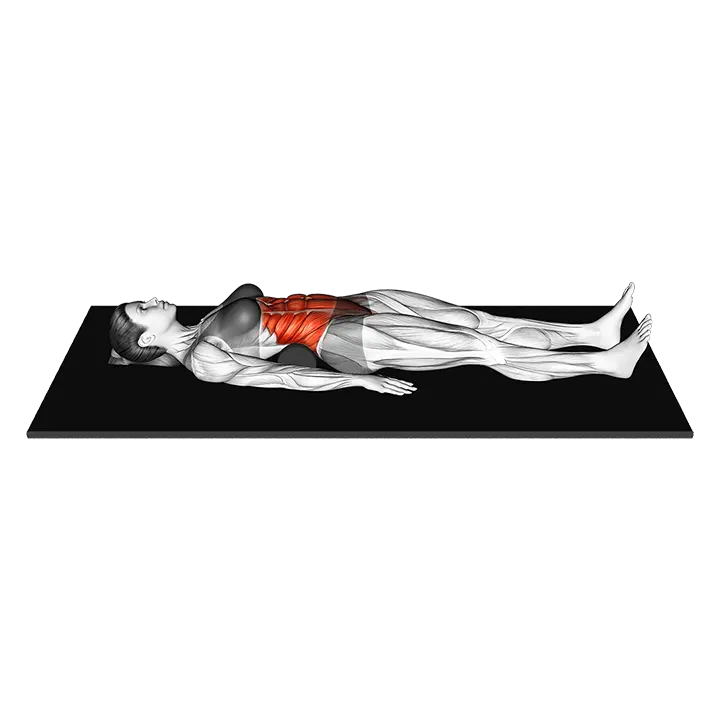
Lower Trunk Flexor Stretch
- Target muscle
- —
- Equipment
- Body weight
- Body part
- Waist
- Type
- Stretching
The Lower Trunk Flexor Stretch is a bodyweight waist-stretching exercise that lengthens the muscles along the front of the abdomen and lower trunk, including the hip flexors and anterior core, through a gentle spinal extension or side-bend position. It is used in warm-up and cool-down routines to counteract prolonged forward-flexed postures and improve lumbar mobility.
How to do the Lower Trunk Flexor Stretch
- 1Lie face-down on a mat with your hands placed flat on the floor just outside your shoulders, elbows bent.
- 2Press your palms into the floor and slowly begin to extend your elbows, lifting your chest and upper abdomen off the mat.
- 3Keep your hips and pelvis in contact with the floor — the stretch comes from spinal extension, not from lifting your hips.
- 4Raise your torso to the height that produces a comfortable stretch in your lower abdominals and front of the waist — this may be a low prop-on-forearms position or a higher cobra-style extension.
- 5Hold your shoulder blades gently together and down; do not shrug toward your ears.
- 6Hold the stretch for 20–30 seconds, breathing slowly and allowing your lower trunk to soften with each exhale.
- 7Lower yourself back to the floor with control and rest before repeating.
Form tips
- Stop the extension at the point of a comfortable stretch — you should feel lengthening in the front of the waist, not compression or pain in the lower back.
- Keep your glutes relaxed during the stretch; clenching them rotates the pelvis posteriorly and reduces the stretch in the front of the trunk.
- If a full cobra is too intense, stay on your forearms in a sphinx position to reduce the range of spinal extension.
- Breathe into your belly on each inhale to enhance the stretch along the anterior trunk.
Common mistakes
- Pushing into pain in the lower back rather than a gentle stretch in the front of the trunk — reduce the height of the extension immediately if you feel lumbar discomfort.
- Lifting the hips off the floor, which shifts the stretch away from the lower trunk flexors and into the hip flexors instead.
- Shrugging the shoulders toward the ears, which creates neck tension and reduces the thoracic extension needed for the stretch.
- Holding the breath — this increases tension throughout the trunk and prevents the anterior muscles from releasing.
Frequently asked questions
What muscles does the Lower Trunk Flexor Stretch target?
It lengthens the muscles along the front of the lower trunk — primarily the rectus abdominis and external obliques — along with the hip flexors. No single target muscle is listed because the stretch is distributed across the anterior trunk and waist.
Is this stretch safe for people with lower-back pain?
A gentle version (sphinx on forearms) is often recommended for certain types of lower-back discomfort, but it is not appropriate for all conditions. Consult a physiotherapist before performing spinal extension stretches if you have an existing back injury.
How long should I hold the Lower Trunk Flexor Stretch?
Hold for 20–30 seconds per rep and perform 2–3 repetitions. Focus on slow, relaxed breathing rather than maximum depth.
What is a good alternative to this stretch?
The cobra yoga pose and the upward-facing dog are very similar movements. Standing backbends or the camel pose can also stretch the lower trunk flexors if lying down is uncomfortable.
Can I do this stretch every day?
Yes — as a low-load bodyweight stretch, it is suitable for daily use, particularly as a counter-stretch after long periods of sitting or forward-flexed activity.







