
Lying Elbow to Knee
- Target muscle
- Obliques
- Synergist muscles
- Rectus Abdominis
- Equipment
- Body weight
- Body part
- Waist
- Type
- Strength

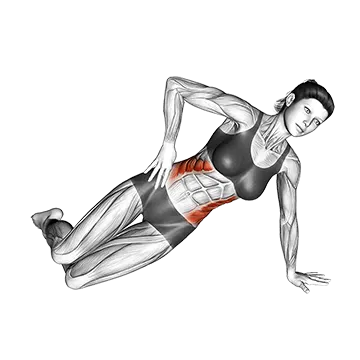

The Lying Elbow to Knee is a bodyweight core exercise that primarily targets the obliques while engaging the rectus abdominis as a synergist. Performed flat on your back, you rotate one elbow toward the opposite knee in a controlled crunch motion. It is well suited for building rotational core strength and improving oblique definition without any equipment.
How to do the Lying Elbow to Knee

- 1Lie flat on your back on a mat with your knees bent and feet flat on the floor, hip-width apart.
- 2Place both hands loosely behind your head with your elbows wide, letting your fingertips support your head without pulling on your neck.
- 3Engage your core by drawing your navel toward your spine. This is your starting position.
- 4Exhale and curl your right elbow toward your left knee simultaneously, rotating through your torso rather than just your elbow.
- 5At the same time, draw your left knee in toward your right elbow to meet it at the midpoint.
- 6Hold the contracted position for one count, feeling the squeeze in your left oblique.
- 7Inhale and lower your elbow and foot back to the starting position with control.
- 8Repeat on the opposite side — left elbow to right knee — to complete one full rep.
- 9Continue alternating sides for the desired number of repetitions.
Form tips
- Drive the rotation from your ribcage, not your elbow — think of bringing your shoulder across rather than simply bending your arm.
- Keep your lower back gently pressed into the mat throughout the movement to avoid straining the lumbar spine.
- Move slowly and with control; momentum reduces oblique activation and makes the exercise less effective.
- Keep your chin off your chest and your gaze toward the ceiling to maintain a neutral neck position.
Common mistakes
- Pulling on the neck with your hands — this puts stress on the cervical spine instead of loading the obliques. Keep your hands light behind your head.
- Using momentum to swing the elbow across — swinging reduces time under tension and shifts the work away from the obliques.
- Only moving the elbow without rotating the torso — true oblique engagement requires rotating through the ribcage, not just bending the arm.
- Letting the lower back arch off the mat — a lifted lumbar spine compresses the low back; keep it pressed down throughout each rep.
- Rushing through the alternating motion — short, fast reps sacrifice range of motion and muscle activation; aim for a full rotation on every rep.
Frequently asked questions
What muscles does the Lying Elbow to Knee work?
The primary muscles worked are the obliques, which drive the rotational crunch motion. The rectus abdominis acts as a synergist, helping flex the spine as you curl up on each rep.
What is the difference between the Lying Elbow to Knee and a bicycle crunch?
Both exercises are very similar in movement pattern. The main difference is that the bicycle crunch involves extending the non-working leg straight out while you rotate, adding a greater hip flexor demand. The Lying Elbow to Knee keeps both feet closer to the floor, placing slightly more isolated focus on the obliques.
How many reps and sets should I do?
For core endurance and definition, 3 sets of 12–20 reps per side is a good starting range. For strength, aim for 3–4 sets of 8–12 reps with a slower, more controlled tempo. Rest 30–60 seconds between sets.
Can beginners do the Lying Elbow to Knee?
Yes. This is a beginner-friendly exercise because it requires no equipment and the range of motion is easy to control. Focus on the rotation coming from your torso and keep the movement slow until the pattern feels natural.
Why do I feel this in my neck instead of my obliques?
This usually means you are pulling your head forward with your hands or leading with your chin. Relax your grip behind your head, keep your chin up slightly, and focus on rotating your shoulder toward the opposite knee rather than crunching forward.