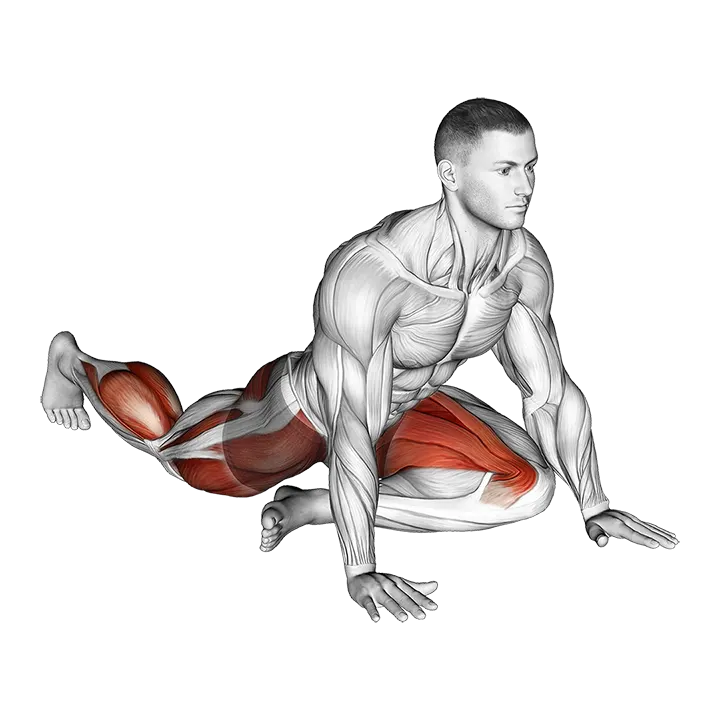
Lying Leg Tuck Hip Stretch
- Target muscle
- —
- Equipment
- Body weight
- Body part
- Hips, Thighs
- Type
- Stretching
The lying leg tuck hip stretch is a floor-based bodyweight stretch that targets the hips and thighs by drawing one knee toward your chest while lying on your back. It requires no equipment and is well suited for releasing tension in the hip area after lower-body training or prolonged sitting.
How to do the Lying Leg Tuck Hip Stretch
- 1Lie flat on your back on a mat or firm surface with both legs extended and your arms resting at your sides.
- 2Bend your right knee and slide your right foot along the floor toward your hips until the sole is flat on the ground.
- 3Reach both hands around your right shin or behind your right thigh, whichever allows a comfortable grip.
- 4Gently draw your right knee toward your chest, stopping when you feel a mild to moderate stretch in the hip and thigh of that leg.
- 5Keep your left leg relaxed and extended on the floor throughout the movement.
- 6Press the back of your head, your shoulders, and your lower back gently into the mat to keep your torso stable.
- 7Hold the position for 20 to 30 seconds, breathing steadily and allowing the hip and thigh to relax with each exhale.
- 8Slowly release your grip and return your right leg to the starting position.
- 9Repeat the stretch on your left side, holding for the same duration.
Form tips
- Focus on relaxing the hip and thigh rather than forcing the knee closer to your chest — the stretch should feel gentle, not painful.
- Use each exhale to release a little more tension, letting gravity and the weight of your leg deepen the stretch gradually.
- Keep the opposite leg extended and grounded rather than letting it lift or roll outward.
- If reaching your shin is uncomfortable, loop a towel or strap around your thigh to maintain your grip without straining your arms.
- Move into and out of the stretch slowly to avoid startling the muscles and reducing the effectiveness of the hold.
Common mistakes
- Pulling the knee too aggressively in an attempt to feel a deeper stretch, which can strain the hip joint and reduce muscle relaxation.
- Allowing the lower back to arch off the mat, which shifts tension away from the hip and may cause discomfort in the lumbar spine.
- Holding your breath during the hold, which keeps the muscles tense and limits how much the stretch can develop.
- Letting the extended leg rotate outward or lift off the floor, which reduces the stability of your base and can skew the stretch.
- Rushing through the hold without giving the muscles enough time to relax — less than 15 seconds is generally too brief to be effective.
Frequently asked questions
How long should I hold this stretch?
Hold each side for 20 to 30 seconds as a starting point. If you are working on improving flexibility, you can extend the hold to 45 to 60 seconds. The key is to stay relaxed rather than to hold longer while tense.
Is this stretch good for tight hips?
Yes. Drawing the knee toward the chest while lying down is a straightforward way to address tightness in the hip area. Because you are on your back, the position is stable and easy to control, making it accessible even when your hips feel quite restricted.
When should I do hip stretches like this one?
This stretch is most effective as part of a cool-down after lower-body exercise or at the end of a long period of sitting. Stretching cold, tight muscles aggressively is not recommended, so avoid forcing the range immediately before a workout.
What is a good alternative to the lying leg tuck hip stretch?
A standing knee-to-chest stretch works the same area and can be done without getting on the floor. A supine figure-four stretch (also called a piriformis stretch) is another option if you want to vary the angle and address a slightly different portion of the hip.
How often should I do this stretch?
Daily is fine for most people. Stretching the hips once or twice a day, particularly after sitting for long periods or after exercise, can help maintain and gradually improve range of motion over time.







