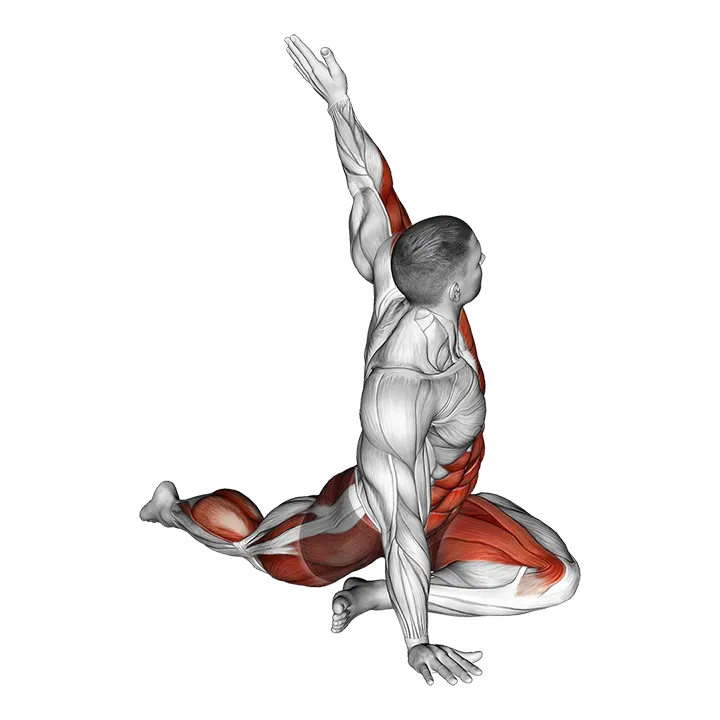
Lying Leg Tuck Hip Twist to Left Stretch
- Target muscle
- —
- Equipment
- Body weight
- Body part
- Chest, Hips, Thighs, Waist
- Type
- Stretching
The Lying Leg Tuck Hip Twist to Left Stretch is a bodyweight flexibility exercise that opens the chest, hips, thighs, and waist through a controlled spinal rotation. Performed on the floor, it uses gravity and a tucked-leg position to deepen a lateral twist to the left, making it an effective cooldown or mobility drill for easing tightness through the torso and lower body.
How to do the Lying Leg Tuck Hip Twist to Left Stretch
- 1Lie flat on your back on a mat with your legs extended and your arms out to the sides at shoulder height, palms facing down.
- 2Draw both knees toward your chest, keeping your feet together and your shins roughly parallel to the floor.
- 3Keeping your upper back and both shoulders pressed firmly into the mat, slowly lower your tucked knees to the left toward the floor.
- 4Allow your hips to rotate with the movement so your knees travel as close to the floor as your flexibility permits without forcing them down.
- 5Turn your head gently to the right to increase the rotational stretch through the chest and waist, or keep your gaze at the ceiling for a milder version.
- 6Hold the position for 20–40 seconds, breathing slowly and deeply. With each exhale, let your knees sink a little further to the left.
- 7On an inhale, engage your core and draw your knees back to center.
- 8Extend your legs briefly and reset before repeating, or transition to the opposite side to balance the stretch.
Form tips
- Keep both shoulders anchored to the mat throughout — lifting a shoulder reduces the rotational tension through the chest and waist and shifts strain to the neck.
- Let the weight of your legs do the work; press nothing forcefully. Gravity and breath will deepen the twist over the hold.
- Breathe into the tightness: inhale to create space, exhale to relax further into the rotation.
- If your knees cannot reach the floor, place a folded blanket or pillow under them to support the position and hold without straining.
- Keep your knees stacked and your feet together to maintain even pressure through both hips and thighs.
Common mistakes
- Letting the top shoulder peel off the mat, which collapses the spinal rotation into a side lean and reduces the stretch on the chest and waist.
- Forcing the knees to the floor with the opposite hand, which can overload the lumbar spine and sacroiliac joint rather than allowing a gradual, passive release.
- Holding the breath or breathing shallowly, which keeps the torso braced and prevents the muscles of the waist and hips from releasing into the stretch.
- Separating the knees and feet during the twist, which distributes the stretch unevenly and reduces the load through the hip and thigh of the top leg.
- Ending the hold too soon — holding for less than 20 seconds rarely allows the connective tissue of the hips and waist enough time to respond to the stretch.
Frequently asked questions
What does the Lying Leg Tuck Hip Twist to Left Stretch target?
It stretches the chest, hips, thighs, and waist simultaneously through a passive spinal rotation. The side-lying twist opens the chest and the muscles along the side of the waist, while the tucked position creates traction through the hips and thighs.
How long should I hold the stretch?
Aim for 20–40 seconds per side, using slow diaphragmatic breathing to progressively relax into the position. For a deeper release after a workout, holds of up to 60 seconds are appropriate.
Should I do this stretch before or after a workout?
It is best suited to post-workout cooldowns or dedicated mobility sessions when the tissues are already warm. Using it before intense activity may temporarily reduce muscle stiffness needed for stability.
Why do I feel this stretch in my lower back?
Some sensation in the lower back is normal because the lumbar vertebrae rotate along with the hips. If you feel sharp or pinching pain rather than a gentle pulling sensation, reduce the range of motion and keep a pillow under your knees.
Can I do this stretch every day?
Yes. Gentle spinal rotation stretches performed within a comfortable range are safe for daily practice and can progressively improve hip and thoracic mobility over time.







