Lying (prone) Abdominal Stretch
- Target muscle
- Rectus Abdominis
- Equipment
- Body weight
- Body part
- Waist
- Type
- Stretching




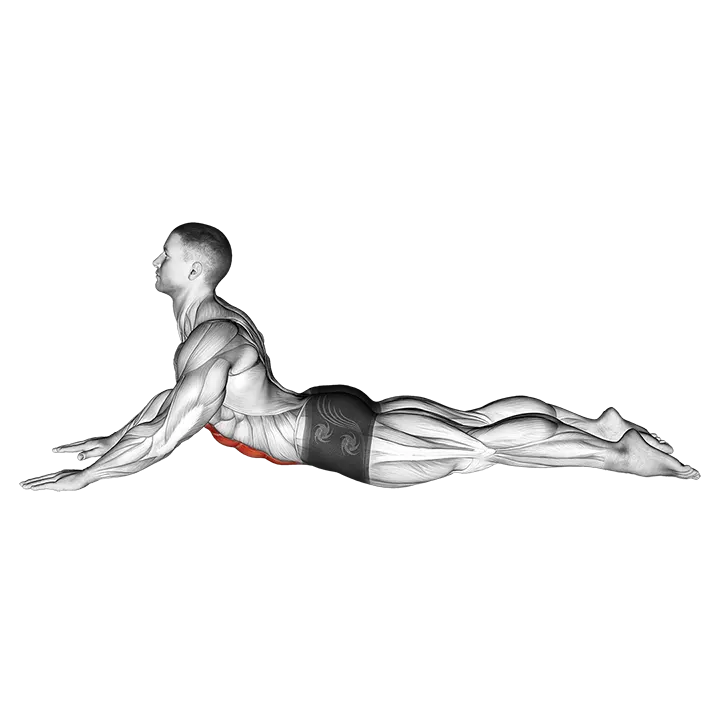
The lying prone abdominal stretch is a bodyweight flexibility exercise that targets the rectus abdominis by extending the spine while the hips remain grounded. Performed face-down on the floor, it counteracts the forward flexion that accumulates during sitting, crunches, and daily posture. It fits naturally into a cool-down or mobility routine.
How to do the Lying (prone) Abdominal Stretch
- 1Lie face-down on a mat with your legs straight and the tops of your feet flat on the floor.
- 2Place your palms flat on the mat beside your chest, roughly aligned with your lower ribs, fingers pointing forward.
- 3Press through your palms and slowly straighten your arms, lifting your chest and upper abdomen off the mat.
- 4Keep your hips and pubic bone pressed firmly into the floor throughout the movement.
- 5Draw your shoulder blades back and down to open your chest and avoid shrugging.
- 6Breathe steadily and hold the extended position for 20–30 seconds, feeling a stretch along the front of your abdomen.
- 7To release, bend your elbows and lower your chest back to the mat with control.
Form tips
- Press your hips into the floor the entire time — allowing them to rise reduces the abdominal stretch and shifts stress to the lower back.
- Keep your elbows soft rather than fully locked if you feel lower-back compression; a slight bend reduces spinal extension range.
- Breathe into your belly on each inhale to deepen the stretch progressively with each exhale.
- Gaze forward or slightly upward, not straight down, to keep the cervical spine in a neutral line with the rest of the spine.
- Ease into the position over 2–3 seconds rather than pressing up sharply to avoid straining the lumbar spine.
Common mistakes
- Letting the hips lift off the floor, which removes tension from the rectus abdominis and turns the movement into a lower-back extension instead of an abdominal stretch.
- Fully locking out the elbows and hyperextending the lower back, which can compress the lumbar vertebrae, especially if the hip flexors are tight; a small elbow bend maintains a safer spinal curve.
- Holding the breath, which increases intra-abdominal pressure and prevents the abdominal wall from relaxing into the stretch.
- Shrugging the shoulders toward the ears, which creates neck tension and closes the chest, reducing the quality of the anterior torso stretch.
- Rushing through the hold — under 15–20 seconds does not give the abdominal muscle and fascia enough time to release, and static stretches need sustained duration to work.
Frequently asked questions
Is the lying prone abdominal stretch the same as a cobra pose?
They are very similar. Cobra pose in yoga is the direct equivalent — both use the same face-down, arms-press position to extend the spine and stretch the rectus abdominis. The main difference is that yoga cues often include additional breath-work and a more gradual progression from low cobra to full cobra.
How long should I hold the lying prone abdominal stretch?
Hold each rep for 20–30 seconds, which is the minimum needed for a meaningful static stretch response. You can repeat 2–3 times, resting briefly between holds. Avoid holding beyond 60 seconds in a single rep as the benefit plateaus.
Can I do this stretch if I have lower back pain?
It depends on the type of back pain. Extension-based stretches can actually relieve disc-related pain in some people, but they may aggravate facet joint issues. Consult a physiotherapist before adding this stretch if you have an existing lumbar condition.
When is the best time to do the lying prone abdominal stretch?
It works best during a cool-down after training or as part of a morning mobility routine. Avoid it as a warm-up before heavy lifting, since passive stretching before intense activity can temporarily reduce muscle force output.
Why do I feel this stretch more in my lower back than my abs?
This usually means your hips are lifting off the floor or you are pressing up too high. Focus on keeping the pubic bone pinned to the mat and reduce your arm extension until you feel the tension shift to the front of your torso.