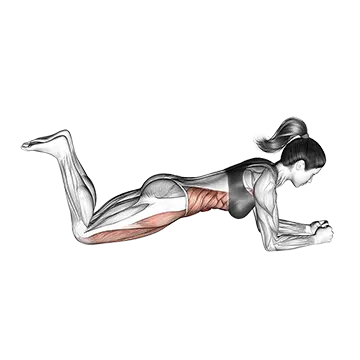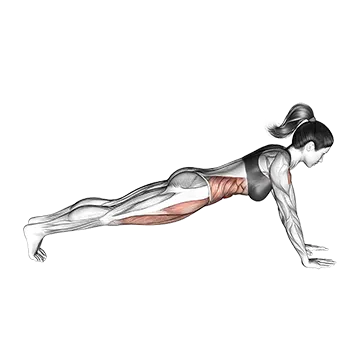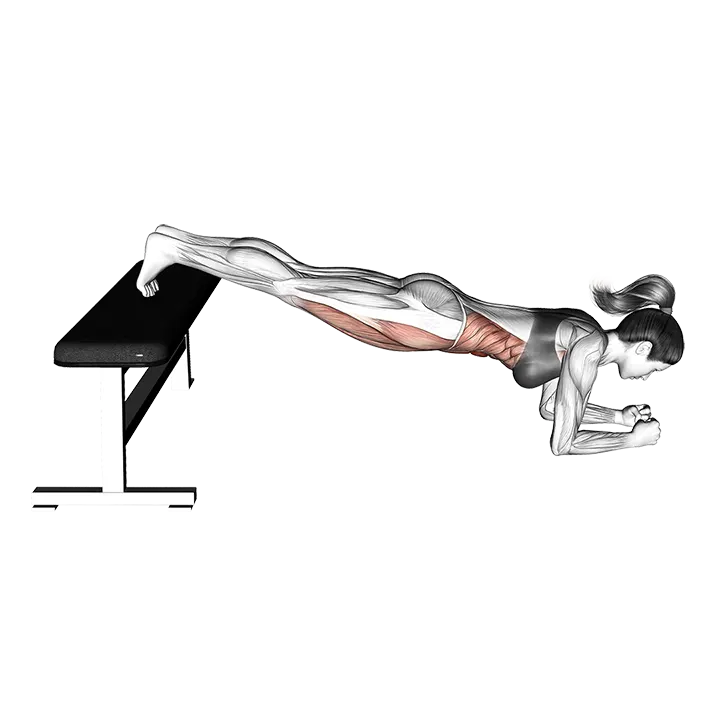
Narrow Leg Bench Bridge
- Target muscle
- Rectus Abdominis
- Synergist muscles
- Deltoid Anterior, Obliques, Quadriceps, Serratus Anterior, Tensor Fasciae Latae
- Equipment
- Body weight
- Body part
- Waist
- Type
- Strength
The Narrow Leg Bench Bridge is a bodyweight core exercise that elevates the feet on a bench and places them close together, intensifying demand on the rectus abdominis and core stabilizers. Synergists including the obliques, quadriceps, tensor fasciae latae, deltoid anterior, and serratus anterior work to maintain alignment throughout the hold. It is well suited for building midline stability and anterior core strength using nothing but your bodyweight and a flat bench.
How to do the Narrow Leg Bench Bridge
- 1Place a flat bench behind you and sit on the floor in front of it, facing away.
- 2Lean back and position both heels on top of the bench with your feet together or no more than a few inches apart — this narrow stance is the key challenge of the movement.
- 3Plant your hands flat on the floor beside your hips for initial stability.
- 4Brace your core, press through your heels, and lift your hips off the floor until your body forms a straight line from shoulders to heels.
- 5Lift your hands off the floor and extend your arms alongside your torso or hold them slightly out to the sides for balance, engaging the deltoid anterior and serratus anterior.
- 6Hold the top position with your glutes lightly squeezed, but focus on drawing your lower ribs toward your hips to keep the rectus abdominis under tension.
- 7Keep your hips level — resist any rotation caused by the narrow foot placement.
- 8Lower your hips back to the floor under control to complete one repetition, or hold the top position for the prescribed time if performing an isometric variation.
Form tips
- Actively pull your lower ribs down toward your pelvis throughout the hold to keep the rectus abdominis engaged rather than letting your lower back arch.
- The narrow foot stance naturally destabilizes you laterally — anticipate this by pre-bracing your obliques before you lift.
- Drive through your heels rather than your toes so the quadriceps stay engaged and your legs hold a locked, stable line.
- Keep your chin tucked slightly so your cervical spine stays neutral; avoid craning your neck upward.
- If you feel excessive lumbar compression, reduce the height of the bench or widen your feet slightly until core strength improves.
Common mistakes
- Letting the hips sag: Dropping the hips removes tension from the core and shifts stress to the lower back, defeating the purpose of the exercise.
- Placing feet too wide: A wide stance reduces the stabilization demand on the rectus abdominis and obliques, making the movement significantly easier and less targeted.
- Hyperextending the lower back at the top: Arching excessively at the top compresses the lumbar spine and shifts load away from the rectus abdominis.
- Holding the breath: Failing to breathe steadily spikes intra-abdominal pressure and limits how long you can maintain the position safely.
- Pushing through the toes instead of the heels: This reduces quadriceps and core involvement and can place unwanted stress on the ankle and knee joints.
Frequently asked questions
Why does the Narrow Leg Bench Bridge target the rectus abdominis rather than the glutes?
The elevated, narrow foot position shortens the hip-extension lever and forces the core — particularly the rectus abdominis — to work hard to prevent the spine from extending or rotating. The glutes contribute minimally compared to a standard floor glute bridge, which uses a much wider base and fuller range of hip extension.
How high should the bench be for the Narrow Leg Bench Bridge?
A standard flat bench at roughly 17–18 inches is appropriate for most people. Higher surfaces increase the hip-extension angle and core demand; if you are a beginner, start with a lower surface such as a step or low box and progress as your strength improves.
Can I do the Narrow Leg Bench Bridge as an isometric hold instead of reps?
Yes — holding the top position for time (20–45 seconds per set) is an effective way to build core endurance. Timed holds are especially useful when you want to accumulate volume without fatiguing the joints through repeated loading.
What muscles does the Narrow Leg Bench Bridge work?
The rectus abdominis is the primary target, working to hold the spine against extension. The obliques resist lateral rotation from the narrow stance, the quadriceps help keep the knees extended, the tensor fasciae latae stabilizes the hip, and the deltoid anterior and serratus anterior engage when the arms are lifted and held off the floor.
How does the Narrow Leg Bench Bridge fit into a core training routine?
It works well as an anti-extension and stability drill placed after compound movements or as part of a dedicated core circuit. Pair it with anti-rotation exercises such as Pallof presses and flexion work such as leg raises for balanced core development.