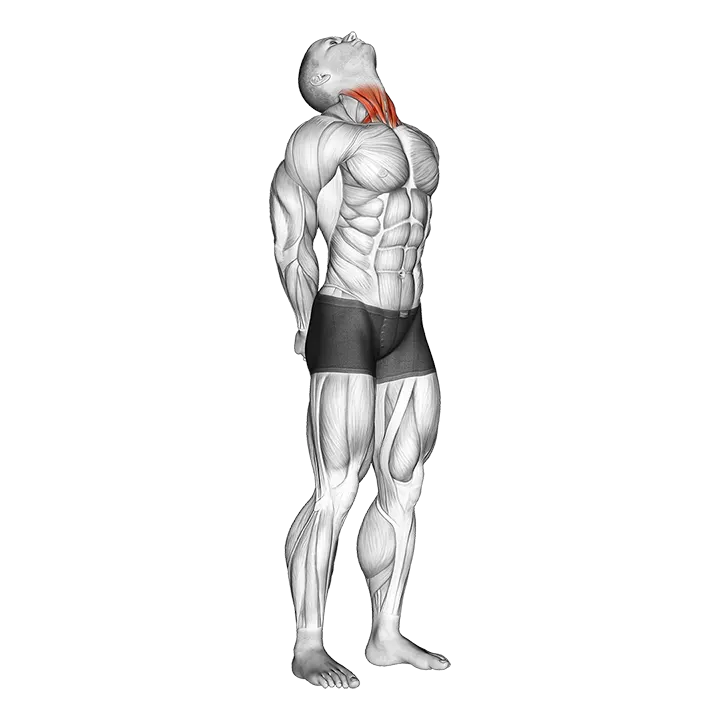
Neck Extension Stretch
- Target muscle
- —
- Equipment
- Body weight
- Body part
- Neck
- Type
- Stretching
The neck extension stretch gently tilts the head backward to lengthen the anterior neck muscles — primarily the sternocleidomastoid and scalenes — which tend to shorten and tighten from prolonged forward head posture. It is commonly used by desk workers and anyone who spends long hours looking at screens to relieve cervical tension and support better postural alignment.
How to do the Neck Extension Stretch
- 1Sit or stand tall with your spine neutral, shoulders relaxed, and feet hip-width apart on the floor.
- 2Relax your jaw and let your mouth close gently so your neck muscles are not braced.
- 3Place your hands loosely in your lap or at your sides — do not use your hands to push or pull your head.
- 4Slowly lift your chin up and away from your chest and begin to tilt your head backward, leading with the top of your skull moving toward the back wall.
- 5Continue the movement until you feel a gentle stretch across the front of your throat and along both sides of your neck — stop well before any point of discomfort or dizziness.
- 6Hold this position for 20–30 seconds, breathing slowly and evenly, allowing the anterior neck muscles to gradually release.
- 7To release, gently bring your head back to neutral by lifting your chin and returning your gaze forward — do not let your head drop forward quickly.
- 8Rest for a breath or two, then repeat for 2–3 rounds as needed.
Form tips
- Move into the stretch slowly and stop the moment you feel any sharp pain, dizziness, or tingling — these are signals to back off immediately.
- Keep your shoulders down and away from your ears throughout the stretch; shrugging reduces the stretch on the sternocleidomastoid and scalenes.
- Breathe continuously through the hold — holding your breath increases muscular tension and limits how much the neck can release.
- Never use your hands to force your head further back; gravity and relaxation alone are sufficient to produce the stretch safely.
- If you have a history of cervical disc issues, cervical stenosis, or chronic neck pain, consult a healthcare provider before performing this stretch.
Common mistakes
- Dropping the head back too fast or too far, which compresses the cervical facet joints and can cause dizziness or nerve irritation instead of a productive stretch.
- Allowing the jaw to jut forward and the mouth to hang open, which creates tension in the suboccipital muscles rather than allowing the anterior neck to fully lengthen.
- Shrugging the shoulders upward during the stretch, which shortens the upper trapezius and scalenes and prevents the anterior neck from achieving a full, even stretch.
- Holding the breath, which keeps the neck musculature braced and prevents the passive lengthening needed for an effective static stretch.
- Releasing the stretch with a sudden forward drop of the head rather than a controlled return to neutral, which can strain the small muscles and connective tissue at the front of the cervical spine.
Frequently asked questions
What muscles does the neck extension stretch target?
The stretch targets the anterior neck muscles that run along the front and sides of the cervical spine. The primary muscles stretched are the sternocleidomastoid, which runs from behind the ear to the collarbone, and the scalenes, which attach the cervical vertebrae to the upper ribs. Both groups shorten with prolonged forward head posture and are lengthened when you tilt the head backward.
How long should I hold a neck extension stretch?
Hold each repetition for 20–30 seconds. This duration is long enough for the muscle spindles to relax and for passive lengthening to occur, but short enough to avoid placing excessive sustained load on the cervical structures. Two to three rounds per session is a typical starting point.
Is it safe to do neck extension stretches every day?
For most healthy adults, gentle neck extension stretching once or twice a day is safe and can help counteract the tightness that builds up from desk work or screen use. If you experience dizziness, pain that radiates into your arm, or numbness at any point, stop immediately and speak with a physical therapist or physician before continuing.
Why do I feel dizzy when I tilt my head back?
Dizziness during neck extension can result from compression of the vertebral arteries or stimulation of the vestibular system as head position changes. If this happens, return your head to neutral slowly, sit down if you are standing, and do not continue the stretch. Persistent dizziness with neck movement warrants evaluation by a healthcare provider.
What is the difference between neck extension and neck flexion stretches?
Neck extension involves tilting the head backward, which stretches the anterior (front) muscles such as the sternocleidomastoid and scalenes. Neck flexion involves bringing the chin toward the chest, which stretches the posterior (back) muscles such as the upper trapezius and cervical extensors. Both movements are complements to each other in a balanced neck mobility routine.







