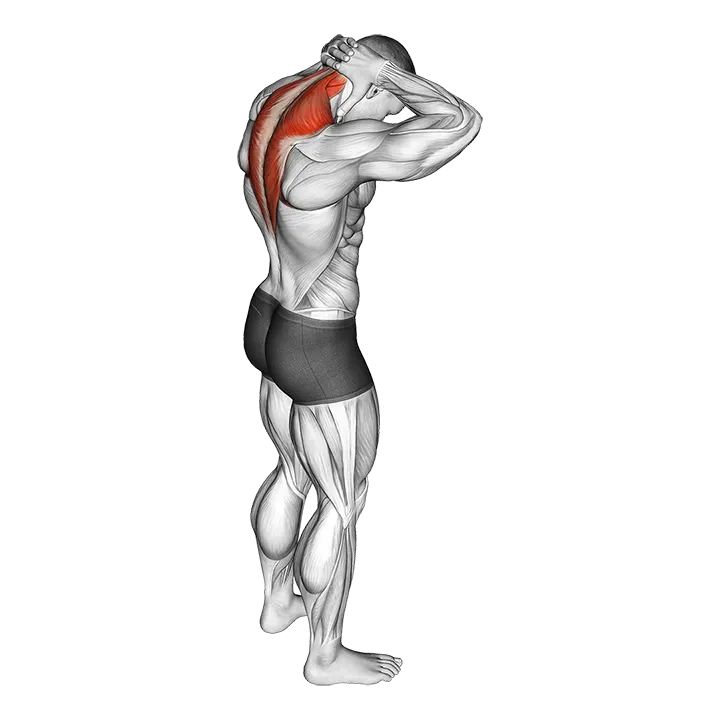
Neck Extensor Stretch
- Target muscle
- —
- Equipment
- Body weight
- Body part
- Back
- Type
- Stretching
The Neck Extensor Stretch is a bodyweight stretching exercise that targets the extensor muscles running along the back of the neck and upper back. Performed by gently flexing the chin toward the chest, it relieves tension built up from prolonged sitting, forward-head posture, or desk work, and is suited to all fitness levels.
How to do the Neck Extensor Stretch
- 1Sit or stand tall with your spine long and your shoulders relaxed away from your ears.
- 2Look straight ahead to establish a neutral starting position.
- 3Slowly lower your chin toward your chest, allowing the weight of your head to guide the movement without forcing it.
- 4Place both hands lightly on the back of your head and allow the gentle weight of your arms — not active pressure — to deepen the stretch.
- 5Hold this position and breathe steadily, exhaling to relax further into the stretch.
- 6Hold for 20–30 seconds, feeling the stretch along the back of your neck and upper back.
- 7To release, remove your hands first, then slowly raise your head back to neutral.
- 8Repeat 2–3 times per session, resting a few seconds between each hold.
Form tips
- Use only the weight of your arms on the back of your head — never push or pull actively with your hands.
- Keep your jaw relaxed and your mouth slightly open to avoid clenching the jaw and adding tension to the neck.
- Breathe slowly throughout the hold; each exhale is an opportunity to let the muscles release a little more.
- Keep your shoulders down and back so the stretch stays focused on the neck rather than shifting into the upper traps.
- Move into and out of the stretch slowly to avoid triggering a protective muscle reflex that would reduce the stretch.
Common mistakes
- Pressing hard on the back of the head with the hands, which can compress the cervical vertebrae and strain the neck instead of gently lengthening the muscles.
- Rounding the shoulders and upper back during the stretch, which shifts the tension away from the neck extensors and adds unwanted load to the thoracic spine.
- Holding the breath, which keeps the muscles guarded and prevents the soft-tissue release that makes the stretch effective.
- Bouncing or pulsing at the end range, which activates the stretch reflex and causes the muscles to contract rather than lengthen.
- Moving too quickly into full flexion, which can cause discomfort in people with cervical stiffness and reduces the muscle's ability to relax into the stretch.
Frequently asked questions
What muscles does the Neck Extensor Stretch target?
It primarily stretches the neck extensor muscles along the back of the neck and upper back, including the semispinalis capitis, splenius capitis, and the upper fibers of the trapezius that contribute to neck extension.
How long should I hold the Neck Extensor Stretch?
A hold of 20–30 seconds is generally recommended for static stretching. Repeating for 2–3 sets gives the muscles enough time to relax and lengthen without overstressing the tissue.
Is this stretch suitable for beginners?
Yes. It requires no equipment, uses only body weight and gravity, and the intensity can be controlled simply by how much you let your chin drop. Anyone with significant neck pain or a diagnosed cervical condition should consult a healthcare provider before starting.
When is the best time to do the Neck Extensor Stretch?
It works well as part of a warm-down after training, during breaks from desk work, or in a morning mobility routine. Avoid performing deep static neck stretches as a warm-up before heavy lifting.
Are there alternative stretches for the same area?
The seated neck flexion stretch and the levator scapulae stretch target overlapping areas. Foam rolling the upper thoracic spine can also relieve tension that contributes to neck extensor tightness.







